
Managing a remote engineering team well comes down to five things: lightweight rituals that keep everyone aligned, enough daily time-zone overlap for live collaboration, autonomy inside clear guardrails, tooling that makes work visible, and measuring output rather than hours logged. Get those right and a distributed team can ship as reliably as any co-located one, often with better written records and fewer interruptions. This guide sets out each practice in concrete terms a UK or EU engineering leader can apply this quarter.
Remote engineering is not a watered-down version of office work. It is a different operating model with its own strengths, and the managers who thrive treat it that way rather than trying to recreate the office over video calls.
What does good remote engineering management actually look like?
The biggest shift is from presence to outcomes. In an office, it is tempting to equate someone being visible at their desk with progress. Remotely that signal disappears, which is healthy, because it forces you to manage what actually matters: clear goals, visible work, and shipped results. The managers who struggle are usually the ones trying to restore the old presence signal through surveillance, status pings and back-to-back calls. The ones who succeed redesign around written clarity and trust.
Good remote management rests on a few principles:
- Default to writing. Decisions, designs and context belong in durable documents, not in someone's memory or a call nobody recorded.
- Make work visible. A well-maintained board, clear tickets and frequent small pull requests tell the team where everything stands without anyone asking.
- Protect focus. Engineering is deep work. Fewer, better meetings and generous blocks of uninterrupted time beat a calendar full of check-ins.
- Trust by default, verify through output. Hire and vet well, give people real ownership, and judge them on what ships rather than when they are online.
If you are moving a team from office-first to remote-first, the change-management effort is mostly cultural. Our guide to building remote engineering culture and retaining remote talent covers the belonging and retention side that underpins everything here.
Which rituals keep a distributed team aligned?
Rituals are the heartbeat of a remote team. The aim is the minimum set that keeps everyone aligned without eating the day. Too few and the team drifts; too many and you have simply moved office interruptions onto Zoom.
A dependable weekly rhythm for most remote engineering teams looks like this:
- Daily async stand-up. A short written update on what each person shipped, what is next, and any blockers, posted in a shared channel. Reserve live stand-ups for the overlap window only when something genuinely needs discussion.
- Weekly planning. One focused session to agree the week's priorities and commitments, held inside the overlap so everyone can contribute live.
- Fortnightly retro. A regular, blameless look at what is working and what to improve. This is where remote teams quietly get better over time.
- One-to-ones. A protected, recurring conversation between each engineer and their lead about growth, blockers and wellbeing, not just status.
The discipline that makes rituals work is keeping them lightweight and predictable. People should know exactly when each happens and what it is for, so the rest of the week is clear for deep work. For the time-zone mechanics behind scheduling these, see managing distributed teams across IST and GMT.
How much time-zone overlap do you need?
Overlap is the single most underrated lever in remote engineering management. With almost no shared hours, every question becomes a 24-hour round trip and momentum dies. With a solid block of overlap, code review, pairing and quick decisions happen live, and the rest of the day is protected for focused work.
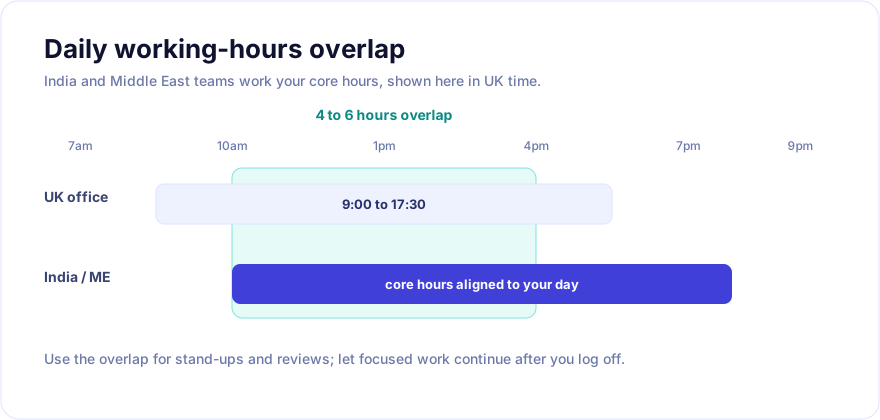
A practical target is around four to six hours of daily overlap with your core team. That is enough for stand-ups, reviews and planning to happen synchronously, while leaving each side meaningful focus time outside the shared window. Teams in India and the Middle East can comfortably align to UK and EU working days, which is exactly why those regions work so well for European companies. The OSCABE managed model is built around this overlap so collaboration is live rather than relayed.
The goal is not maximum overlap, which would erase the deep-work advantage of remote, but enough overlap. Use the shared hours for anything collaborative and let asynchronous work carry the rest. If you want to push more work off the meeting calendar entirely, read our piece on async communication for remote engineering teams.
How do you balance autonomy with alignment?
The remote sweet spot is high autonomy inside clear guardrails. Micromanagement does not survive distance; it just becomes a stream of anxious messages that slow everyone down. But autonomy without alignment produces a team that is busy in different directions. The answer is to be tight on the what and the why, and loose on the how.
That means investing heavily in clarity at the edges of each piece of work:
- Clear outcomes. Every initiative has a stated goal, success measure and owner, so engineers can make good local decisions without checking in constantly.
- Written standards. Coding standards, definition of done, review expectations and architectural principles live in documents, so quality is consistent without a manager policing it.
- Decision records. Significant technical choices are written down with their context and trade-offs, so the team moves forward without relitigating old ground.
- Escalation paths. People know what they can decide alone, what needs a quick sync, and who to involve when something is genuinely blocked.
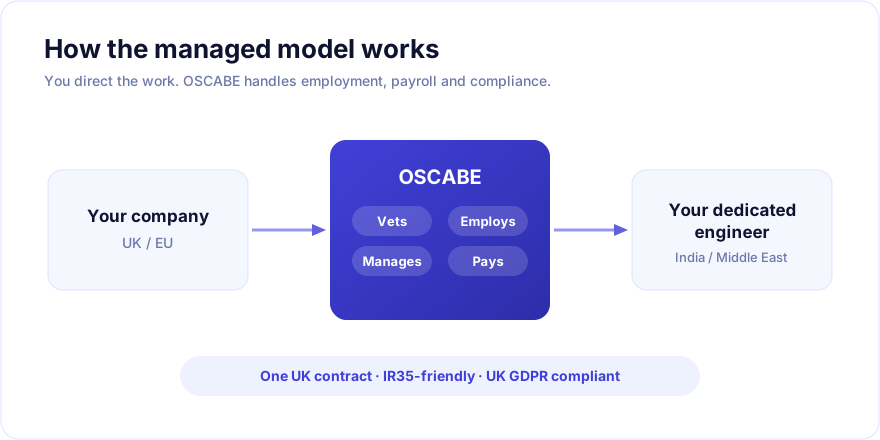
With those guardrails in place, you can give engineers real ownership of an area and trust them to deliver. This is far easier when the team is stable and the people are properly vetted, which is one reason dedicated managed teams outperform a rotating cast of contractors. Continuity lets context compound, and context is what makes autonomy safe; protecting it against single points of failure is covered in knowledge transfer and the bus factor on offshore teams. Autonomy also starts on day one, which is why a structured remote engineer onboarding checklist matters so much.
What tooling and metrics support remote engineering?
Tooling for remote teams should make work visible and reduce the need for synchronous coordination. You do not need an exotic stack; you need a small, well-adopted set of tools that everyone actually uses, with strong written norms layered on top.
The table below maps the core jobs to the kind of tool that handles them.
| Job to be done | Tool category | What good looks like remotely |
|---|---|---|
| Source control and review | Git platform | Small, frequent PRs; reviews inside the overlap window |
| Work tracking | Issue or board tool | Tickets with clear acceptance criteria; status visible to all |
| Knowledge and decisions | Docs and wiki | Durable docs, decision records, runbooks kept current |
| Real-time chat | Messaging | Public channels by default; threads for focus |
| Async updates and calls | Video and recordings | Recorded demos and walkthroughs over live-only meetings |
| CI/CD and quality gates | Pipelines | Automated tests and checks so quality is not manual |
On metrics, the golden rule is to measure output and flow, not activity. Hours online, messages sent and lines of code are vanity signals that reward the wrong behaviour. Better indicators include throughput of completed work, cycle time from start to shipped, change failure rate, and the predictability of delivery against commitments. These tell you whether the team is actually producing value, and they travel perfectly across time zones because they have nothing to do with when someone was at their desk.
A short list of healthy remote metrics:
- Throughput: how much valuable work reaches production over time.
- Cycle time: how long work takes from started to shipped.
- Quality: change failure rate and escaped defects, not raw bug counts.
- Predictability: how reliably the team hits what it committed to.
Pair these with qualitative signals from retros and one-to-ones. Numbers tell you what is happening; conversations tell you why. The combination is what lets you manage a remote engineering team on results rather than presence. The same output-focused discipline is what lets you add capacity cleanly as you grow, which we cover in scaling a startup engineering team with offshore pods.
Frequently asked questions
How do you manage a remote engineering team across time zones?
Anchor the team around a shared overlap window of around four to six hours, run your collaborative rituals inside it, and push everything else to well-documented asynchronous work. Keep decisions and context in durable documents so nobody is blocked waiting for someone in another time zone. For the scheduling detail, see managing distributed teams across IST and GMT.
Should you measure remote engineers by hours or output?
Output, every time. Hours online tell you nothing about value delivered and tend to reward being visible over being effective. Track throughput, cycle time, quality and predictability instead, and use one-to-ones and retros for the context behind the numbers.
How many meetings should a remote engineering team have?
As few as keep everyone aligned, and no more. A typical healthy rhythm is async daily stand-ups, one weekly planning session, a fortnightly retro and regular one-to-ones, with most other coordination handled in writing. Protecting large blocks of focus time is one of the biggest advantages remote work offers, so guard it.
Is it harder to manage offshore engineers than local ones?
Not inherently. The challenges are time-zone overlap, written clarity and onboarding, all of which are solvable with the practices in this guide. With a dedicated, fully-managed team that shares your working hours and has been properly vetted, day-to-day management feels much like managing any other remote team.
Manage a remote team built to deliver
Strong remote engineering management is mostly good management made explicit: clear outcomes, lightweight rituals, real overlap, genuine autonomy and a focus on output. The teams that struggle usually try to recreate the office; the teams that thrive embrace the written, asynchronous, results-first nature of distributed work.
If you want a dedicated, fully-managed remote engineering team that already works your hours and has passed five-stage vetting, contact OSCABE or explore the engineers we provide. You can also see how the managed model handles employment, compliance and retention under one UK contract.