
Async communication lets a remote engineering team make progress without everyone being online at once, by moving status, context and decisions into durable written form instead of live meetings. Done well, it replaces most stand-ups and status calls with clear documents, structured handovers and decision records, so work flows across time zones rather than stalling between them. This guide shows how to build an asynchronous default that still keeps the team aligned and fast.
The point of async is not to abolish conversation. It is to reserve synchronous time for the small slice of work that genuinely needs it, and to handle everything else in writing that anyone can read on their own schedule.
Why async communication matters for distributed teams
When part of your team is in the UK or EU and part is in India or the Middle East, a synchronous-by-default culture quietly punishes everyone. People sit in calls outside their best hours, decisions wait for the next overlapping window, and the written record that future teammates need never gets created. An asynchronous default flips this: the natural output of doing the work is documentation, and live time is spent only where it adds real value.
The benefits compound across a distributed team:
- Time-zone resilience. Work does not block on someone being awake; the next person picks up from a clear written handover.
- Better decisions. Writing forces clarity. A proposal written down is easier to scrutinise than one improvised in a call.
- Fewer interruptions. Engineers get long, protected blocks of focus instead of a day fragmented by meetings.
- A durable record. New joiners and future teammates inherit the reasoning behind every decision, not just the outcome.
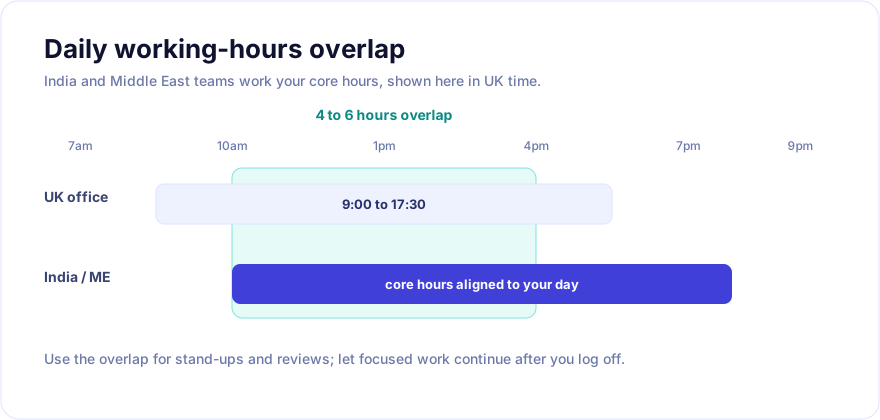
None of this means zero meetings. It means using your overlap window deliberately. Our guidance on managing a remote engineering team covers how the synchronous rituals and the async backbone fit together.
What should be async, and what should stay synchronous?
The skill is sorting work by what it actually needs. Most engineering communication is broadcast or reference: status, context, designs, decisions. That belongs in writing. A smaller slice is genuinely interactive: working through a thorny problem together, a sensitive one-to-one, or building rapport. That benefits from live time.
The table below offers a simple split you can adopt as a team norm.
| Communication type | Best handled | Why |
|---|---|---|
| Daily status and progress | Async (written update) | No discussion needed; everyone reads on their schedule |
| Design proposals | Async first, sync if needed | Written designs get better, wider review |
| Significant decisions | Async record, sync to discuss | Context and trade-offs must be durable |
| Knowledge and runbooks | Async (docs) | Reference material, read on demand |
| Complex problem-solving | Sync (live) | Fast back-and-forth resolves it quicker |
| One-to-ones and feedback | Sync (live) | Tone and trust matter |
| Incident response | Sync (live), async log | Speed matters live; record for the post-mortem |
The default should be async, with synchronous time used as the exception you reach for deliberately, not the reflex you fall into. When you do meet, record it or write up the outcome so the people who were not there still get the value.
How do you run effective written handovers?
Handovers are where async either works or quietly fails. When a UK engineer logs off and a colleague in India picks up, the quality of the written handover decides whether work continues or stalls until the next overlap. A good handover is short, structured and predictable, so reading it is fast and nothing important is left in someone's head.
A reliable handover format covers:
- State: what is done, what is in progress, and where exactly things stand.
- Next: the specific next action and any decisions already made.
- Blockers: anything stuck, who can unblock it, and what was tried.
- Context: links to the ticket, branch, design and any relevant discussion.
Keep handovers in a predictable place, such as the ticket itself or a shared channel, so people always know where to look. The same discipline applies to pull requests: a clear description, the reasoning behind the change and any review notes turn a PR into a handover that a reviewer in another time zone can act on without a call. This is closely tied to avoiding single points of failure, which we cover in knowledge transfer and the bus factor on offshore teams.
How do decision records reduce meetings?
A decision record is a short, durable note capturing a meaningful choice: the context, the options considered, what was decided and why. They are the highest-leverage async habit an engineering team can adopt, because they kill the most wasteful kind of meeting, the one held to re-explain or relitigate a decision someone has forgotten the reasoning for.
A lightweight decision record contains:
- Context: the problem and constraints at the time.
- Options: the alternatives genuinely considered.
- Decision: what was chosen.
- Consequences: the trade-offs accepted and what it enables or rules out.
Once this is a habit, several things improve at once. New decisions can be proposed in writing and approved asynchronously by the right people, with no meeting needed in the common case. Old decisions stop being reopened because the reasoning is there to read. And new joiners onboard faster because the team's history is legible rather than tribal. Decision records pair naturally with a structured remote engineer onboarding checklist, since a new engineer can read the record of why the system is the way it is.
Building an async-first culture without losing connection
The common fear about async is that it makes a team feel cold or disconnected. In practice the opposite is true when it is done deliberately, because async frees up your limited synchronous time for the human moments that actually build a team, rather than burning it on status updates a document could carry.
Practical habits that make an async culture work:
- Write for the reader. Lead with the answer, keep it scannable, and assume the reader has no prior context from a call.
- Set response-time norms. Agree what counts as urgent versus what can wait until someone's next working block, so nobody feels they must be always-on.
- Single source of truth. One agreed home for docs and decisions, kept current, so people trust it instead of pinging for answers.
- Reserve sync for connection. Use overlap time and the occasional call for problem-solving, mentoring and relationship-building, not for reading out updates.
- Make demos async-friendly. Recorded walkthroughs let people see progress without a scheduled meeting and stay available for later reference.
A team that communicates well in writing is also more inclusive: quieter voices and non-native English speakers often contribute more in considered writing than in fast live calls, and everyone has the same record to refer back to. With a dedicated, fully-managed team that overlaps your hours, you get the best of both: enough live time for the work that needs it, and a strong written backbone carrying the rest. This written backbone is also what lets a team scale cleanly, as set out in scaling a startup engineering team with offshore pods, and it works hand in hand with the scheduling discipline in managing distributed teams across IST and GMT.
Frequently asked questions
What is async communication in a remote engineering team?
It is communicating through durable written artefacts, such as documents, tickets, pull request descriptions, handovers and decision records, that people read and respond to on their own schedule rather than in real time. The aim is to let work progress across time zones without everyone needing to be online together, reserving live meetings for the few things that truly need them.
Does async communication mean no meetings at all?
No. It means meetings become the exception rather than the default. You keep synchronous time for complex problem-solving, sensitive feedback and relationship-building, ideally inside your overlap window, and handle status, design review and most decisions in writing. The result is fewer, higher-value meetings and far more protected focus time.
How do you keep a remote team aligned without constant calls?
Through clear written outcomes, visible work on a shared board, structured handovers and decision records, plus a small set of regular rituals. When everyone can see the current state and the reasoning behind decisions in one trusted place, alignment comes from the written record rather than from being in every conversation. See managing a remote engineering team for the full operating rhythm.
What tools do you need for async communication?
Less than you might think: a git platform with good pull request hygiene, an issue tracker with clear acceptance criteria, a docs or wiki tool for durable knowledge and decision records, and a chat tool used with public channels by default. The norms matter more than the specific tools; writing well and keeping a single source of truth is what makes async work.
Build a remote team that communicates by default in writing
Async communication is what lets a distributed engineering team turn time-zone spread from a liability into an advantage. Move status, designs and decisions into clear, durable writing, reserve live time for the work that genuinely needs it, and your team ships steadily around the clock with a record that makes everyone faster.
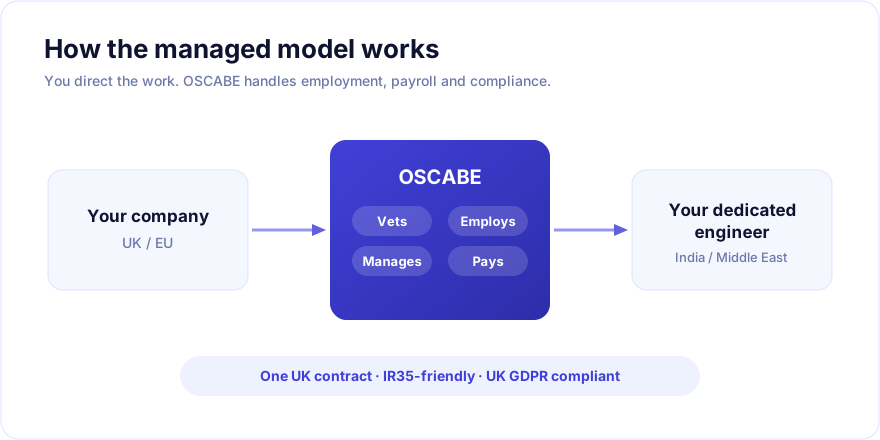
If you want a dedicated, fully-managed remote engineering team that already works asynchronously and overlaps your hours, contact OSCABE or browse the engineers we provide. You can also see how the managed model supports productive distributed teams under one UK contract.