
Reducing bus-factor risk in an offshore team comes down to making knowledge live in systems rather than individuals: structured documentation, deliberate cross-training, recorded handovers and an onboarding process that captures context as it is created. A team has a "bus factor" of one when a single person's departure would stall delivery, and that risk grows quietly as offshore teams scale. A managed model helps directly, because the provider employs the team, plans cover and continuity, and aligns everyone to your core hours, so knowledge transfer is engineered rather than left to chance.
This guide explains what bus-factor and key-person risk really mean for a distributed offshore team, the documentation and cross-training habits that defuse it, how to run knowledge transfer across a time-zone gap, and where a managed model carries the load for you.
What is bus-factor and key-person risk?
The "bus factor" is the number of people who would have to be unavailable before a project loses critical knowledge and stalls. A bus factor of one means a single engineer holds context nobody else has - the only person who understands a payment integration, a gnarly data migration or an undocumented deployment process. Key-person risk is the same idea expressed as a business concern: too much depends on too few people.
For offshore teams the risk has a few specific drivers:
- Knowledge lives in heads, not docs. Fast-moving teams ship first and document later, so context accumulates in individuals.
- Distance hides the gaps. When the team is remote, you often cannot see how concentrated knowledge has become until someone leaves.
- Churn and scaling stretch coverage. Growing a team means more surface area to cover, while any turnover removes context with it.
- Time-zone separation slows recovery. If the one person who knows a system is offline when it breaks, the gap costs hours, not minutes.
The good news is that bus-factor risk is highly manageable. It responds to a handful of disciplined habits, and a managed model builds several of them in by default.
How does a managed model reduce key-person risk?
A managed provider changes the structure of the risk. Because OSCABE employs and manages the team rather than supplying loose freelancers, continuity and cover are planned responsibilities, not your problem to discover after the fact.
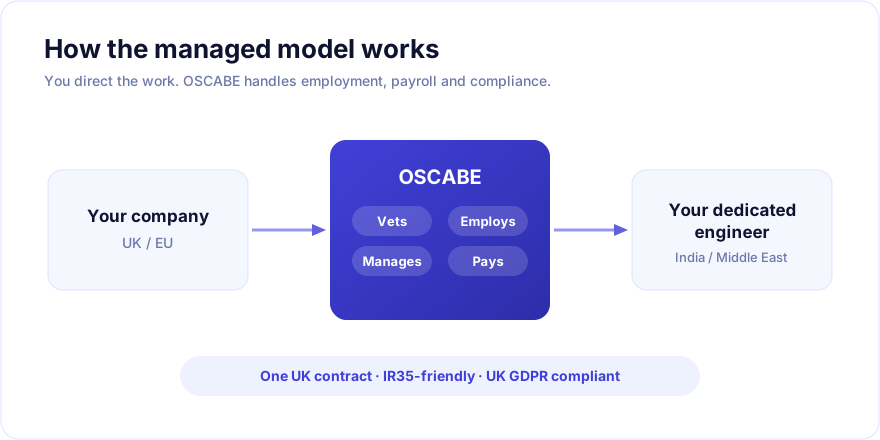
Three structural advantages stand out:
- Employment continuity. A managed team is employed and supported, with the provider responsible for retention, cover during leave and replacement if someone moves on - so a departure does not leave a hole you scramble to fill.
- Pod-based delivery spreads knowledge. Delivering through a small team rather than a lone contractor means context is shared across people from the start, which raises the bus factor structurally.
- Standardised onboarding and documentation expectations. A managed model brings a consistent way of capturing context, so knowledge transfer is a defined process, not an afterthought.
You still own the work and the codebase; the provider owns the people-continuity machinery around it. For how that division works in practice, see our managed teams and how it works pages. For a longer view where the team may eventually become a captive capability, our build-operate-transfer India guide shows how continuity carries through a transfer.
What documentation actually reduces bus-factor?
Not all documentation helps. Reams of stale prose that nobody updates can be worse than none, because it misleads. The documentation that genuinely lowers bus-factor is lean, living and close to the work.
Prioritise these artefacts:
- A current README per service: how to run it, test it, deploy it, and who to ask. The single highest-leverage document.
- Architecture decision records (ADRs): short notes capturing why a choice was made, not just what was built. The "why" is what walks out the door when someone leaves.
- Runbooks for operations: step-by-step recovery for the things that break, written so someone who is not the original author can follow them under pressure.
- An up-to-date system map: what talks to what, where data flows, and where the sensitive parts are.
- Onboarding notes: the path a new joiner follows, kept current by each new joiner improving it as they go.
The discipline is to write the doc where the work happens (in the repo, the issue, the wiki next to the code) and to treat documentation as part of "done". A pull request that changes behaviour should update the relevant README or runbook in the same change. These are exactly the habits a strong onboarding period should instil; our guide to onboarding an offshore development team in 30 days shows where they fit in the first month.
How do you run knowledge transfer across a time-zone gap?
Knowledge transfer is easiest to picture as something that happens in a meeting - but across a time-zone gap, leaning only on live sessions is fragile. The reliable approach blends a protected overlap window for the high-bandwidth conversations with durable, async artefacts for everything else.
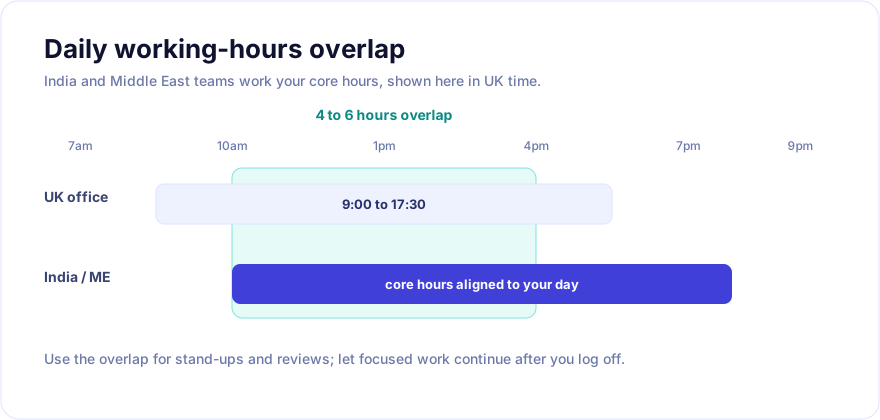
India (GMT+5:30) and the UAE (GMT+4) overlap a UK or EU working day by 4 to 6 hours, which is ample for live knowledge transfer when you use it deliberately:
- Use the overlap for high-bandwidth transfer. Pairing, live walkthroughs of tricky systems, and Q&A on the parts that are hard to grasp from docs alone belong in the shared window.
- Record the walkthroughs. A short recorded explanation outlives the session and serves the next joiner who was not there - turning a one-off into a reusable asset.
- Pass structured handovers at the edge of the window. A short written "done / in progress / blocked / next" note keeps context flowing when one region goes offline.
- Capture decisions in writing, not chat. Chat scrolls away; decisions belong in ADRs and issues where they remain findable.
For the mechanics of overlap windows, handovers and async habits, our guide to managing distributed teams across time zones is a practical companion. OSCABE aligns the team to your core hours, so the overlap you rely on for knowledge transfer is dependable rather than ad hoc.
What cross-training and process habits raise the bus factor?
Documentation captures knowledge; cross-training distributes it. Together they move a team from "one person knows this" to "several people can handle this".
| Practice | What it does | Effect on bus-factor |
|---|---|---|
| Pair programming on critical areas | Two people build context on the same system | Raises it directly - no single owner |
| Code review as a teaching tool | Reviewers learn the code they approve | Spreads context across the team |
| Rotating ownership / on-call | More than one person learns each system | Removes single points of failure |
| ADRs and runbooks kept current | Decisions and recovery steps live in systems | Knowledge survives any departure |
| Recorded walkthroughs | Context outlives the session and the author | New joiners ramp without the original author |
| Standardised onboarding | Each joiner absorbs context the same way | Faster, more even knowledge spread |
The unifying principle is simple: never let a critical system have exactly one person who understands it. Build redundancy in deliberately through pairing, review and rotation, and back it with lean living documentation. A managed model supports this because pod-based delivery and consistent onboarding push knowledge across people by design, rather than relying on individual goodwill.
How do you keep knowledge from leaking out on departures?
Some turnover is inevitable, so plan for it rather than fearing it. Three measures matter most. First, make documentation part of the normal workflow so context is captured continuously, not in a panicked exit interview. Second, deliver through a pod so a departure removes one contributor from a knowledgeable group rather than the only person who understands a system. Third, use a managed provider that handles cover and replacement, so the people-continuity burden does not fall on you mid-project.
It also helps to treat offboarding as a defined process: a leaver's last weeks should include a structured handover, a documentation sweep of anything only they know, and a recorded walkthrough of their hardest-to-grasp work. When that is routine, a departure is a manageable transition rather than a crisis. Confidentiality and IP continuity matter here too; our notes on NDAs and confidentiality for offshore developers cover protecting context as people move on.
Frequently asked questions
What is a healthy bus factor for an offshore team?
Aim for at least two or three people who can handle any critical system, and ideally no system that only one person understands. The exact number matters less than the principle: no single departure should be able to stall delivery. Pod-based delivery and disciplined documentation get you there.
Does a managed model really reduce key-person risk?
Yes, structurally. Because the provider employs and manages the team, continuity, leave cover and replacement are planned responsibilities, and pod-based delivery spreads knowledge across people rather than concentrating it in one contractor. You keep ownership of the work while the provider carries the people-continuity load.
How much documentation is enough?
Enough to run, test, deploy and recover each system without its original author, plus the "why" behind key decisions. Favour a few living documents (READMEs, ADRs, runbooks) kept current as part of "done" over large volumes of prose that quickly go stale and mislead.
How do you transfer knowledge when the team is in another time zone?
Use the 4 to 6 hour daily overlap for high-bandwidth live transfer such as pairing and walkthroughs, record those sessions for future joiners, pass structured written handovers at the edge of the window, and keep decisions in durable docs rather than chat. A managed provider that holds your core hours makes the live part reliable.
Ready to scale an offshore team without the key-person risk?
If you are growing an offshore team and want to avoid the quiet accumulation of bus-factor risk, the recipe is lean living documentation, deliberate cross-training, recorded handovers and a provider that plans continuity for you. OSCABE delivers dedicated, vetted teams aligned to your core hours under one UK contract, with pod-based delivery and standardised onboarding that spread knowledge by design, from £2,000/month. See how it works, get in touch, or browse our engineers to start matching candidates now.