
You can onboard an offshore development team to genuine productivity in about 30 days if you treat onboarding as a structured project rather than a welcome email. The fastest path is a week-by-week plan that front-loads access and security, establishes shared rituals and documentation early, and aims for a small, real deliverable shipped by the end of week four. With a fully-managed model, the provider handles employment, equipment and compliance, so your 30 days focus on integration and delivery rather than paperwork.
This playbook gives you a concrete week-by-week checklist, the access and security steps that protect you, the rituals that make a distributed team feel co-located, and a realistic target for the first deliverable.
What does a successful 30-day onboarding look like?
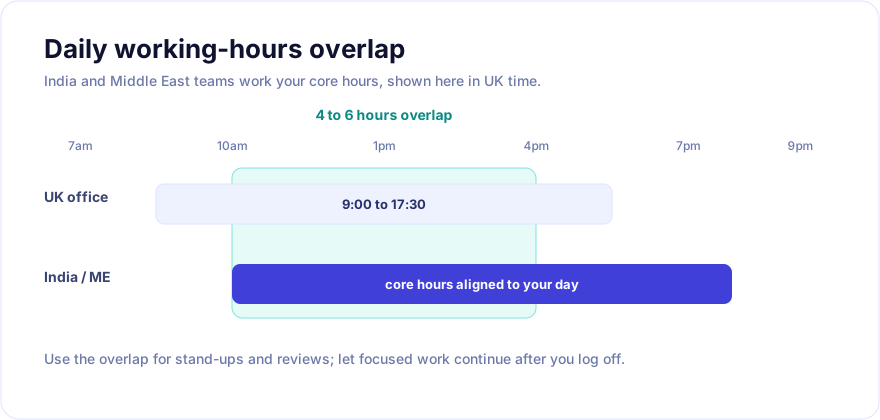
A good onboarding has three outcomes by day 30: the team can build, test and ship in your environment without hand-holding; the team understands your product, standards and people; and you have a working feedback loop (stand-ups, reviews, retros) that surfaces problems early. The structure below assumes a dedicated managed team aligned to your core hours, with 4 to 6 hours of daily overlap.
| Week | Theme | Primary outcome |
|---|---|---|
| Week 1 | Access, security and context | Tooling access granted; codebase running locally; product walkthrough done |
| Week 2 | First contributions | First small pull requests merged; rituals embedded |
| Week 3 | Owning a slice | Team owns a feature or component end to end |
| Week 4 | First deliverable | A real, user-visible change shipped to a real environment |
Week 1: access, security and context
Week one is about removing blockers before they cost you momentum. Aim to have every engineer able to run the codebase locally by Friday.
Access and accounts
- Create accounts in your identity provider (SSO) and enforce multi-factor authentication from day one.
- Grant least-privilege access to the repositories, ticketing, CI/CD, cloud console and communication tools the team needs - and nothing more.
- Issue or confirm managed devices, with disk encryption and endpoint protection in place.
- Provision VPN or zero-trust network access if your environments require it.
Security baseline
- Walk the team through your acceptable use, data-handling and secret-management policies.
- Confirm that production personal data is masked or replaced with synthetic data for development.
- Add the team to your secrets manager rather than sharing credentials in chat.
Context and product
- Run a recorded product walkthrough: what it does, who uses it, how money is made.
- Share the architecture overview, repo map and "how we ship" notes.
- Pair each engineer with a buddy on your side for their first two weeks.
For the data-protection backdrop to all of this, our GDPR guide for hiring offshore developers covers processor terms and transfer mechanisms, and our piece on offshore team security with ISO 27001 and SOC 2 sets out the controls a serious provider should already operate.
The reason to front-load all of this in week one is simple: access friction is the silent killer of onboarding momentum. An engineer who spends three days waiting on a repository invite or a VPN profile loses far more than three days, because the delay breaks the thread of context they were building. Treat access as a launch-blocking task, not a background ticket, and assign one person on your side to own it until everyone is unblocked.
Week 2: first contributions and rituals
By week two the team should be merging real, if small, changes - and your rituals should be running on autopilot.
Ship something small
- Hand out genuinely small tickets (a bug fix, a copy change, a test) so the team exercises the full path: branch, build, test, review, merge, deploy.
- Treat the first merged pull request as a milestone; it proves the toolchain works end to end.
Embed the rituals
- Daily stand-up inside the overlap window, kept short and outcome-focused.
- Pull request reviews with a clear service-level expectation (for example, reviewed within one working day).
- A lightweight weekly demo and a fortnightly retro.
Getting rituals right across time zones is its own discipline; our guide to managing distributed teams across time zones covers async habits and handovers in depth.
Week 3: owning a slice end to end
Week three shifts the team from "completing tickets" to "owning a slice". Give them a feature or component they are responsible for, including its tests, documentation and rollout. Ownership is what turns a group of contractors into a team, and it surfaces any gaps in your documentation while there is still time to fix them before the end of the month.
Use this week to tighten the feedback loop: are reviews timely, are estimates realistic, is the team unblocked during the overlap window? Adjust the rituals now rather than letting friction harden.
Watch for the documentation tax. When an engineer hits something undocumented - an undocumented build step, a tribal-knowledge deploy quirk, a setting "everyone just knows" - the fix is to write it down immediately, not to answer it verbally and move on. Treat each such question as a small bug in your onboarding and patch the docs as you go. By the end of week three your documentation should be measurably better than when the team started, because a fresh team is the best documentation auditor you will ever have.
Week 4: ship the first deliverable
The goal for week four is a real, user-visible change shipped to a real environment (staging or production behind a flag). It does not need to be large; it needs to be genuine. A shipped deliverable proves the team can navigate your build, test, review and release process unaided, and it gives everyone a confidence-building win.
Close the month with a retro that captures what to keep, change and document, and agree the ownership areas for the next 30 days.
It is worth being explicit about what week four is not. It is not a performance review and it is not the moment to judge velocity against a long-term baseline. Thirty days in, you are confirming that the path from idea to production works and that the team can walk it without you holding their hand. Speed comes later, once the team has context and owns enough of the codebase to move confidently.
How does a managed model accelerate onboarding?
A managed model compresses onboarding because the provider has already handled the slow, administrative parts before day one. Recruitment, vetting, employment contracts, local payroll, equipment and baseline security are done; the engineers arrive ready to integrate.
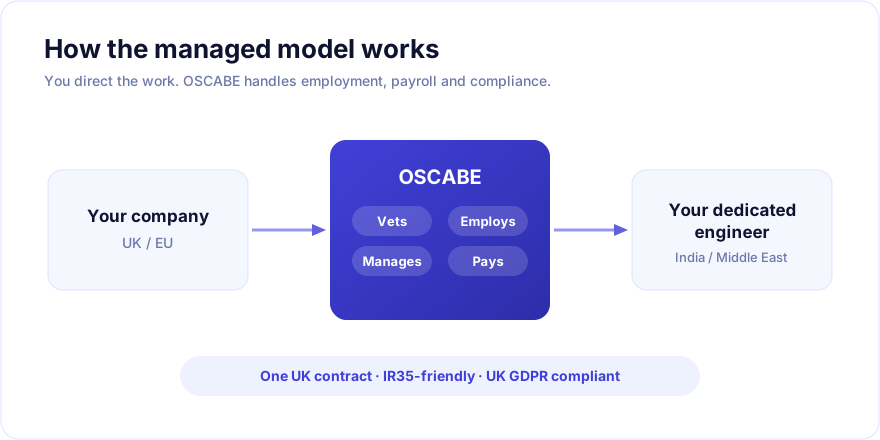
Practically, that means your 30 days are spent on the high-value work - access, context, rituals and a first deliverable - rather than chasing laptops, contracts and compliance paperwork. OSCABE aligns the team to your core hours and stands behind delivery under one UK contract; see exactly how on our how it works page.
A 30-day onboarding checklist
- Day 1-2: SSO and MFA, least-privilege access, devices issued, buddies assigned.
- Day 3-5: Codebase running locally for everyone, product walkthrough recorded, policies acknowledged.
- Week 2: First pull requests merged, stand-ups and reviews running, secrets in a manager not chat.
- Week 3: Team owns a feature or component; documentation gaps fixed.
- Week 4: First user-visible deliverable shipped; month-end retro; next ownership areas agreed.
Frequently asked questions
Is 30 days realistic for offshore onboarding?
For a focused, dedicated team aligned to your hours, yes. The constraint is rarely engineering ability; it is access, context and clear ownership. Front-load those and a small first deliverable by week four is a reasonable target.
What is the single biggest onboarding risk?
Access and environment setup dragging on. If engineers cannot run the codebase and ship a trivial change in week one, every later milestone slips. Treat "everyone can build locally by Friday" as a hard week-one goal.
How do we keep this secure?
Use SSO with MFA, grant least-privilege access, work on managed and encrypted devices, keep secrets in a manager, and develop against masked or synthetic data. Our offshore team security guide details the controls, including ISO 27001 and SOC 2 considerations.
Do we manage the team day to day?
Yes - that is the point of a dedicated managed model. You direct the work, run the rituals and review the code; the provider handles employment, payroll, equipment and compliance behind the scenes.
Ready to onboard a team that ships in 30 days?
If you want an offshore development team that is productive inside a month rather than a quarter, start with the structure above and a provider that removes the administrative drag. OSCABE delivers dedicated, vetted developers aligned to your core hours, under one UK contract, so your 30 days go on integration and delivery. See how it works, get in touch, or browse our engineers to start matching candidates now.