
You can run an offshore development team to the same security standard as your in-house staff, provided you layer the right controls: a recognised information-security framework such as ISO 27001 or SOC 2, strong access controls, managed and encrypted devices, least-privilege permissions and a proper data processing agreement. The deciding factor is usually not geography but enforcement - whether someone is actually accountable for these controls day to day. A fully-managed model puts that accountability on a single provider who employs the team and stands behind the controls under one contract.
This guide explains what ISO 27001 and SOC 2 mean for an offshore team, the access and device controls that matter, the contractual layer (the DPA), and how a managed model enforces all of it in practice.
What do ISO 27001 and SOC 2 actually mean?
Both are ways of demonstrating that an organisation manages information security seriously, but they work differently.
- ISO 27001 is an international standard for an Information Security Management System (ISMS). Certification by an accredited body shows the organisation has a risk-based system of policies, controls and continual improvement, audited periodically. It answers: "Is there a managed, certified security system?"
- SOC 2 is an attestation report (Type I at a point in time, Type II over a period, commonly 3-12 months) prepared by auditors against the Trust Services Criteria - security, availability, processing integrity, confidentiality and privacy. It answers: "Were the stated controls designed and operating effectively over time?"
For an offshore engagement, either can give you assurance; many buyers treat ISO 27001 certification or a SOC 2 Type II report as a baseline signal of maturity, alongside their own due diligence.
| Aspect | ISO 27001 | SOC 2 |
|---|---|---|
| Type | Certification against a standard | Attestation report by auditors |
| Scope | Whole ISMS (risk-based) | Trust Services Criteria you select |
| Output | Certificate | Type I (point in time) or Type II (period) report |
| Common in | UK, EU, global | US-centric, widely accepted globally |
| Best read as | "A managed security system exists" | "Controls operated effectively over time" |
A certificate or report is necessary but not sufficient. What protects you day to day are the concrete controls underneath it.
Which access controls matter most for an offshore team?
Access control is where most real-world risk is won or lost. Aim for a small set of strong, consistently applied controls:
- Single sign-on (SSO) with multi-factor authentication (MFA). One identity, one place to revoke, MFA on everything.
- Least privilege. Grant only the access a role needs, and nothing more. Default to read-only and elevate deliberately.
- Role-based access control (RBAC). Permissions tied to roles, not to individuals, so joiners and leavers are easy to manage.
- Just-in-time and time-boxed access. Elevated or production access granted for a window, then automatically removed.
- Joiner-mover-leaver process. Access provisioned on day one and fully revoked the day someone rolls off.
- Audit logging. Who accessed what, when - reviewed, not just collected.
The principle is that access should be easy to grant narrowly and easy to remove completely. Our guide to onboarding an offshore development team in 30 days shows where to build these controls into the first week so they are in place before the team starts shipping.
A useful test is the leaver scenario. If an engineer rolled off tomorrow, could you revoke every piece of their access in minutes, with confidence that nothing was missed? If the honest answer is "we would have to go hunting through a dozen systems", your access is too diffuse. Centralising identity behind SSO and tying permissions to roles is what makes that revocation a single, reliable action rather than a scavenger hunt.
What about devices, MDM and the working environment?
Endpoints are a common weak point, so treat devices as part of the security perimeter:
- Managed devices with MDM. Mobile Device Management lets you enforce configuration, push updates and remotely wipe a lost or compromised machine.
- Full-disk encryption on every device, enforced and verified.
- Endpoint protection (anti-malware/EDR) and automatic patching.
- Screen lock, strong authentication and no shared logins.
- Secrets in a manager, never pasted into chat or stored in plaintext repos.
- Data minimisation in dev: build and test against masked or synthetic data so production personal data is rarely exposed.
A practical rule: if you would not allow it on an in-house laptop, do not allow it on an offshore one. The standard should be identical regardless of where the engineer sits. The advantage of managed devices is that this parity is enforced automatically rather than left to each person's good intentions - configuration, patching and encryption are pushed centrally, and a lost or compromised machine can be wiped remotely the moment it is reported.
How does the contractual layer (the DPA) fit in?
Technical controls need a contractual backbone. Where your company decides why and how personal data is processed, you are the controller and the provider is your processor, which means UK and EU GDPR require a written data processing agreement (DPA) meeting Article 28: processing only on your instructions, confidentiality, security measures, sub-processor rules, assistance with data-subject rights, deletion or return at the end, and audit support. Alongside the DPA you need an appropriate transfer mechanism for data leaving the EEA.
This is the legal glue that makes the security controls enforceable rather than aspirational. For the full detail on processor terms, transfer tools and transfer risk assessments, see our GDPR guide for hiring offshore developers. If you are documenting cross-border risk formally, our forthcoming guide to transfer impact assessments for UK and EU transfers goes deeper on the assessment itself.
How does a managed model enforce all of this?
The hard part of offshore security is not knowing the controls; it is making sure they are applied consistently and that someone is accountable when they are not. This is where a managed model earns its keep.
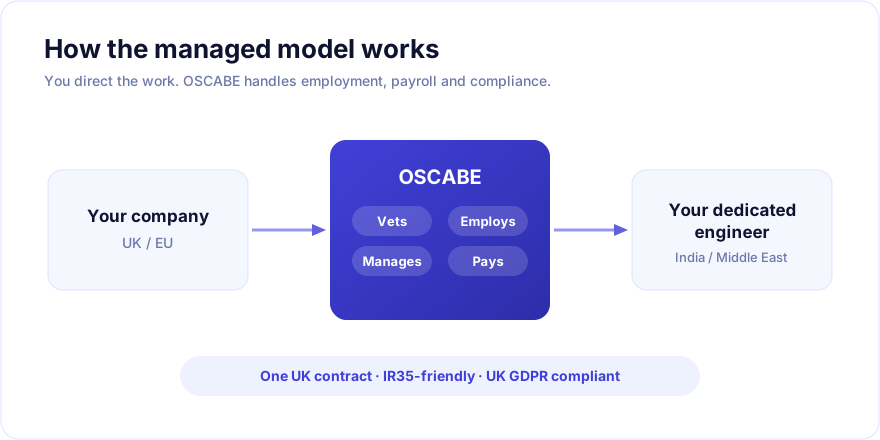
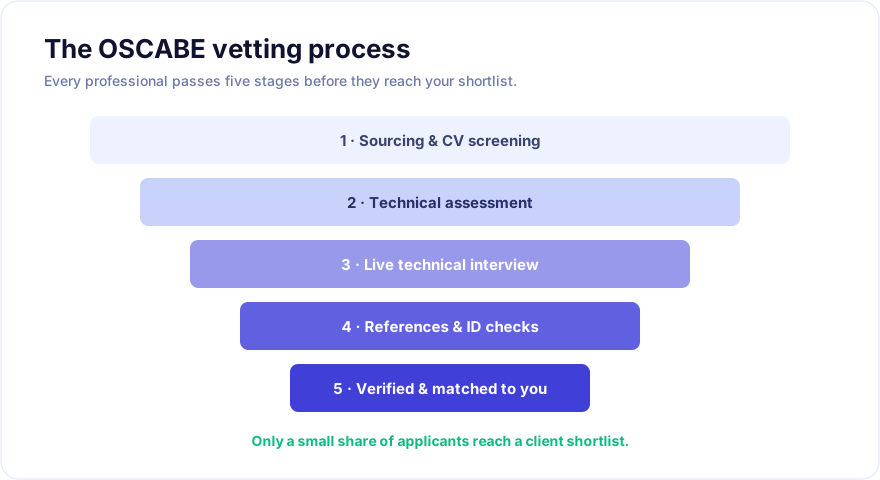
In a managed model the provider employs the engineers directly, so security and confidentiality obligations flow straight down to the individuals doing the work, and the provider operates the device, access and data controls as standard rather than leaving them to each freelancer. Because OSCABE vets every professional through a five-stage process before they reach you, the people inside those controls are already screened.
OSCABE delivers under UK GDPR-compliant processor terms, ISO 9001:2015-certified processes and a security-first operating model, with the whole engagement sitting under one UK contract and a single accountable counterparty. That is far easier to govern than a collection of individual contractors each running their own setup. See the structure on our managed teams page.
An offshore security checklist
- Confirm the framework: ISO 27001 certification or a SOC 2 report, plus your own due diligence.
- Enforce SSO with MFA and least-privilege, role-based access.
- Use just-in-time, time-boxed elevation and a clean joiner-mover-leaver process.
- Require managed, encrypted devices with MDM, EDR and automatic patching.
- Keep secrets in a manager; develop against masked or synthetic data.
- Sign a DPA meeting Article 28 and put an appropriate transfer mechanism in place.
- Ensure a single accountable provider operates and evidences the controls.
Frequently asked questions
Do I need both ISO 27001 and SOC 2?
Usually not. Either can serve as a baseline signal of security maturity; the right choice depends on your sector and customers. What matters more is that the underlying access, device and data controls are real and consistently enforced, backed by a DPA.
Is an offshore team inherently less secure?
No. Security is determined by controls and enforcement, not location. An offshore team on managed, encrypted devices with SSO, MFA, least privilege and a proper DPA can match or exceed a loosely governed in-house setup.
Who is accountable if data is mishandled?
As controller you remain accountable to data subjects and regulators for ensuring appropriate safeguards, while the processor is directly liable for its own obligations and breaches. A strong DPA allocates responsibility and requires breach notification. A managed model gives you one accountable counterparty rather than many.
How do access controls work in practice for offshore developers?
Grant least-privilege access through SSO with MFA, tie permissions to roles, elevate production access only just-in-time and for a limited window, and revoke everything on rolloff. Log access and review it. The aim is narrow grants that are simple to remove completely.
Ready to run an offshore team that meets your security bar?
If you need offshore engineering that holds to the same security standard as your in-house team, the answer is a recognised framework, concrete access and device controls, a proper DPA and a provider accountable for enforcing them. OSCABE delivers dedicated, vetted teams under UK GDPR-compliant processes and one UK contract. Explore our managed teams, get in touch, or browse our engineers to start matching candidates now.