
Transfer Impact Assessment (TIA) for Offshore Teams: UK & EU Guide
A transfer impact assessment (TIA) is the documented check you carry out to confirm that, when you send personal data abroad under Standard Contractual Clauses or the UK equivalent, the protections will actually hold up in practice in the destination country. Since the Court of Justice's Schrems II ruling, having a transfer tool in place is necessary but not sufficient; you also have to assess whether the law and practice where the data lands could undermine those protections, and add supplementary measures if they could. For UK and EU companies engaging offshore teams in India, a TIA (called a transfer risk assessment in UK guidance) is generally needed before any personal data leaves.
This guide explains what Schrems II changed, where SCCs and supplementary measures fit, when a TIA is required for India transfers, and a practical step outline you can follow. It complements our deeper piece on GDPR when hiring offshore developers.
What is a transfer impact assessment?
A TIA is a structured, documented evaluation of whether a specific international data transfer can rely on its chosen safeguard (typically the EU SCCs, or the UK IDTA / SCCs plus the UK Addendum) and still give data subjects protection that is essentially equivalent to UK or EU standards. The terminology varies:
- Under EU GDPR, the assessment is commonly called a transfer impact assessment (TIA).
- Under UK GDPR, the ICO's guidance frames the same exercise as a transfer risk assessment (TRA).
The labels differ; the underlying job is the same. You are asking whether your contractual safeguards, combined with any technical and organisational measures, are enough given the realities of the destination country, particularly the prospect of government access to the data.
Why Schrems II made this necessary
In the Schrems II decision, the Court of Justice of the European Union confirmed that SCCs remain a valid transfer mechanism but held that they cannot operate in a vacuum. Because SCCs bind only the contracting parties and cannot override the destination country's domestic laws, the parties must assess, case by case, whether those laws (especially powers of public authorities to access data) could prevent the SCCs from being effective. Where a gap exists, the exporter must apply "supplementary measures" to close it, or not proceed with the transfer.
The ICO carried this principle into UK practice through the transfer risk assessment requirement. So whether you are operating under UK GDPR, EU GDPR, or both, the consequence of Schrems II is the same: a transfer tool plus a documented assessment, not a transfer tool alone.
SCCs and supplementary measures
Two building blocks sit beneath every compliant restricted transfer.
The transfer tool provides the contractual safeguard:
- For UK transfers, the International Data Transfer Agreement (IDTA), or the EU SCCs with the UK International Data Transfer Addendum.
- For EU transfers, the European Commission's SCCs.
Supplementary measures are the extra protections you add where the assessment shows the contract alone may not be enough. These are typically technical, organisational or contractual:
- Technical: strong encryption in transit and at rest, pseudonymisation, and holding decryption keys outside the destination country.
- Organisational: strict access controls and minimisation, internal policies on handling government access requests, and regular review.
- Contractual: transparency obligations, commitments to challenge unlawful access requests, and notification duties.
For offshore development and data work, common and effective measures include minimising the personal data exposed in the first place, using test or synthetic data where production data is not essential, and tightly controlling who can access what.
| Element | What it does | Typical answer for an India transfer |
|---|---|---|
| Transfer tool | Contractual safeguard for the transfer | UK IDTA, or SCCs + UK Addendum (EU SCCs for EU data) |
| TIA / TRA | Assesses whether the safeguard holds in practice | Documented before the transfer |
| Supplementary measures | Close any gap the assessment finds | Encryption, minimisation, access control |
| Re-assessment trigger | Keeps the assessment current | New data types, new sub-processors, legal change |
When do you need a TIA for India transfers?
You generally need a TIA (or TRA) whenever you make a restricted transfer of personal data, meaning you send personal data to a country that does not benefit from a UK or EU adequacy decision, and you are relying on SCCs or the IDTA as your safeguard. At the time of writing, transfers to India fall into this category, so the assessment is generally required before any personal data is shared with an India-based team.
A few practical pointers:
- It is the data, not the developer, that triggers the rules. If your offshore team will access personal data, the transfer rules engage regardless of who employs them.
- Truly anonymised data is out of scope. If data is anonymised so that no one can re-identify any individual, it is no longer personal data and the transfer rules do not apply. True anonymisation is a high bar; pseudonymised data remains personal data.
- Assess at the level of the arrangement. You can assess a transfer arrangement rather than every record, and reuse the assessment where the facts are materially the same, then review it periodically.
- Adequacy can change. Adequacy decisions and guidance evolve, so check the current ICO or EU position before relying on any assumption.
A practical TIA step outline
A workable TIA does not have to be a research dissertation, but it should be honest and on file. A typical sequence is:
- Map the transfer. Identify the exporter and importer, the categories of personal data, the volume and sensitivity, the purpose, and the onward recipients (sub-processors).
- Confirm the transfer tool. Establish which safeguard you are relying on (IDTA, SCCs plus Addendum, or EU SCCs) and that it is properly executed.
- Assess the destination. Consider the relevant laws and practice in the destination country, focusing on whether public authorities could access the data in a way that undermines the safeguards.
- Evaluate effectiveness. Decide whether the contractual protections, with your existing technical and organisational measures, deliver protection essentially equivalent to UK or EU standards.
- Add supplementary measures. Where a gap remains, apply encryption, minimisation, access controls or contractual commitments, and re-evaluate.
- Decide and document. Record the conclusion (proceed, proceed with measures, or do not proceed) and the reasoning, and keep it on file.
- Review. Re-assess when circumstances change, such as new data types, new sub-processors, or developments in the destination country.
The ICO provides a TRA tool to structure this exercise under UK GDPR, and the same logic applies to an EU TIA.
How a managed provider supports your TIA
A TIA is your assessment to make as controller, but a well-run offshore provider makes it far easier to complete and stand behind.
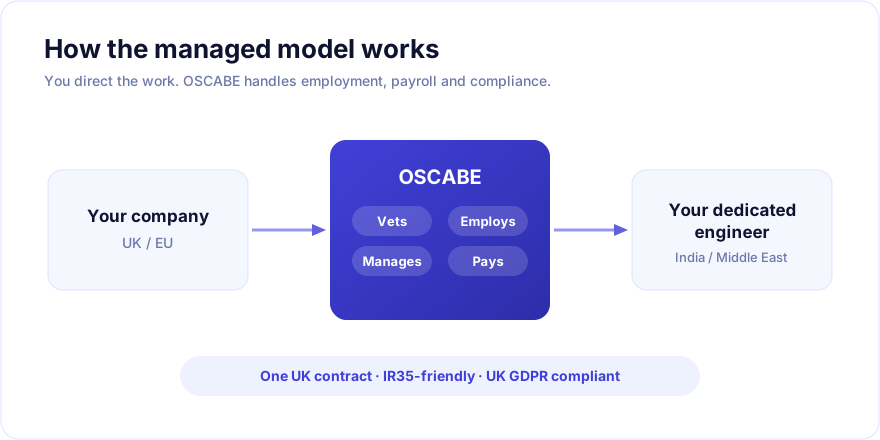
A capable provider should give you:
- A controller-to-processor data processing agreement meeting Article 28, separate from but alongside the transfer tool.
- An appropriate transfer mechanism (IDTA or SCCs plus Addendum) ready to execute.
- Documented technical and organisational measures you can cite as supplementary measures in your assessment: encryption, access controls, device management, and data minimisation practices.
- A current sub-processor list with flow-down obligations, so your assessment reflects the full chain.
OSCABE is UK GDPR compliant and structures offshore work with these controls in mind, supported by ISO 9001:2015 quality management, so the information you need to complete a TIA is available rather than something you have to extract piecemeal. Because OSCABE employs the team directly, confidentiality and security obligations flow down to the individuals doing the work. See how it works and our EU page for the EU client angle.
For related compliance topics, see GDPR and hiring offshore developers for the full transfer framework, EU VAT reverse charge for offshore services for the tax treatment of cross-border services, and offshore team security: ISO 27001 and SOC 2 for the technical and organisational measures that support your supplementary-measures analysis.
Frequently asked questions
Is a TIA the same as a transfer risk assessment?
In substance, yes. "Transfer impact assessment (TIA)" is the term commonly used under EU GDPR, while UK guidance refers to a "transfer risk assessment (TRA)". Both describe the documented evaluation, required after Schrems II, of whether your transfer safeguard will be effective in practice in the destination country. If you operate under both regimes, the same assessment can address both with care.
Do I need a TIA for every transfer to India?
You generally need one for each restricted transfer scenario, but you can assess at the level of a transfer arrangement rather than per record, and reuse it where the facts are materially the same. Review it periodically and whenever circumstances change, such as new categories of data, new sub-processors, or legal developments in the destination country.
What supplementary measures are typical for offshore development?
Encryption in transit and at rest, pseudonymisation, strict access controls and minimisation, holding keys outside the destination country, and using test or synthetic data where production data is not essential. Contractual commitments to challenge unlawful access requests and to notify you can also form part of the package. The right mix depends on the data and the conclusions of your assessment.
Can I skip a TIA if the provider is ISO certified?
No. Certifications and strong security controls support your assessment and can serve as supplementary measures, but they do not replace the TIA itself. As controller you still need to evaluate and document whether the transfer safeguard is effective given the destination country, then decide and record your conclusion.
General information, not legal advice
This article provides general information about transfer impact and transfer risk assessments for international data transfers, current as at the date of publication. It is not legal advice and does not create a professional relationship. Data protection outcomes depend on specific facts and the rules can change; please take advice from a qualified data protection adviser before acting. Where useful, consult the current ICO and EU guidance and the relevant authorities directly.
Ready to send data offshore with your assessment in order?
OSCABE provides dedicated, fully-managed remote teams from India and the Middle East under one UK contract, with UK GDPR processor terms, an appropriate transfer mechanism and documented security controls that support your transfer assessment. We carry the data-protection plumbing so you can focus on delivery. Explore our engineers and managed teams, or contact us to review your transfer setup.