
Build-Operate-Transfer (BOT) in India is a phased model where a partner builds a dedicated offshore team or captive centre for you, operates it day to day for a fixed period, then transfers the legal entity and staff into your ownership. It lets a UK or EU company end up owning an Indian operation without setting it up cold from scratch, while someone else carries the early risk. OSCABE runs BOT and GCC programmes in India from £12,000 per month, structured so you can de-risk the build by running it as a fully-managed operation first and only transferring when the unit is proven.
This guide gives you the honest mechanics: what each phase involves, what it costs, how long it takes, and when BOT beats a simpler managed team.
What is Build-Operate-Transfer (BOT)?
BOT is a three-stage arrangement for standing up an offshore operation, most commonly a Global Capability Centre (GCC) in India. The phases are exactly what the name says.
- Build. Your partner recruits the team, registers or provides a local entity, sets up offices or remote infrastructure, and puts tooling, security and HR processes in place. This is the heaviest lift and where most timelines slip if it is done badly.
- Operate. The partner runs the centre on your behalf, managing payroll, HR, compliance, performance and delivery, while you direct the actual work and roadmap. The team behaves like yours; the employment and operational risk sits with the partner.
- Transfer. After an agreed period, the entity and employees move into your ownership. You become the legal employer in India and take on local compliance, facilities and people management directly.
The appeal is sequencing. You get a working, de-risked operation before you commit to owning it, rather than gambling on a cold entity setup in an unfamiliar jurisdiction. For the broader category map, see staff augmentation vs managed team vs BOT.
What does the Build-Operate-Transfer timeline look like?
A realistic BOT programme runs over 18 to 24 months before transfer, though this varies with headcount and how mature your target operating model is. The figure below shows the typical shape.
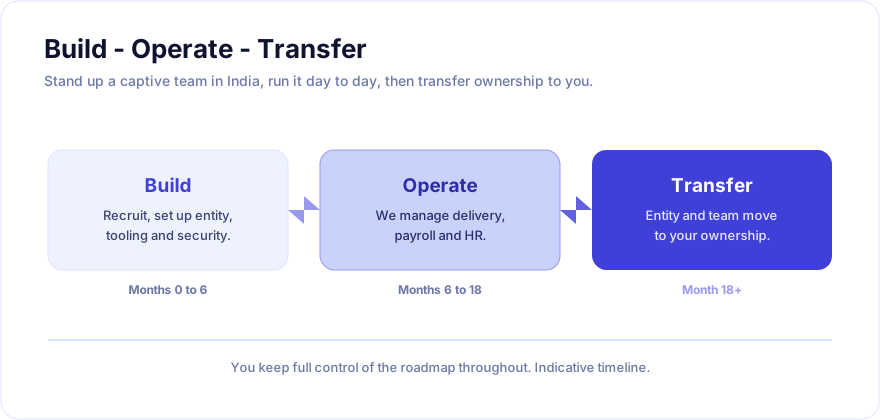
Broadly, the phases break down like this:
- Months 0 to 6 (Build): Recruit the founding team and a local lead, stand up or assign the entity, configure security, devices and access, and get the first cohort productive. Expect the bulk of effort and cost here.
- Months 6 to 18 (Operate): The partner manages delivery, payroll and HR while the team scales toward target size and your processes embed. You keep full control of the roadmap throughout.
- Month 18+ (Transfer): Legal entity and staff transfer to you. Plan a handover runway for knowledge transfer, statutory registrations and a smooth change of employer.
The slow part is deliberate. You are buying a working operation, not renting a few contractors, so the timeline reflects building something durable. If you need people delivering in weeks rather than quarters, BOT is the wrong tool and a managed team is the right one.
How much does Build-Operate-Transfer in India cost?
BOT pricing has two layers: the recurring cost of running the team, and the programme or management fee for building and operating it. Treat any single number with caution, because the variables (headcount, seniority, location, whether you use a partner entity or your own) move the total significantly.
The table below gives indicative 2026 ranges. Cost ranges are drawn from public market data and salary guides and should be validated against a real scope.
| Cost element | What it covers | Indicative range |
|---|---|---|
| Programme / management fee | Build and operate work: recruitment, entity, HR, compliance, delivery management | From £12,000/month (OSCABE BOT/GCC) |
| Per-engineer run cost | Salary, employer costs, devices, workspace, benefits | Roughly £2,000-£4,500/month per mid-to-senior engineer |
| One-off setup | Entity registration, legal, tooling, security baseline | Variable; often folded into the programme fee |
| Transfer costs | Legal transfer, statutory registrations, knowledge handover | One-off near the end of the programme |
| Ongoing post-transfer | Local compliance, payroll, facilities once you own it | Your responsibility after transfer |
The economics only make sense at scale. BOT typically pays off when you are building 20 or more roles and intend to keep the operation for years, because you amortise the setup and management fee across a large, long-lived team. For smaller or shorter needs, the per-head cost of a managed team is far lower in total. Compare the full picture in the true cost of an offshore development team.
BOT vs a managed team: which should you choose?
This is the decision most UK and EU buyers actually face. Both give you a dedicated, vetted offshore team that works only for you. The difference is whether you end up owning the operation.
| Factor | Managed team (OSCABE) | Build-Operate-Transfer |
|---|---|---|
| What you end up with | Ongoing managed team, no entity | A captive Indian entity you own |
| Time to first delivery | Days to a few weeks | 3-6 months to stand up |
| Commitment | Rolling monthly | 18-24 months, then ownership |
| Who employs the team | OSCABE | Partner first, then you |
| Compliance and payroll | OSCABE, under one UK contract | Partner first, then yours |
| Entry cost | From £2,000/month per professional | From £12,000/month programme-level |
| Best scale | 1-30+ roles, flexible | 20+ roles, long-term strategic |
| IR35 position (UK) | Low (managed B2B service) | Low while operated; review on transfer |
| Exit | Stop or scale down monthly | Complex; you own staff and entity |
The honest summary: a managed team is faster, cheaper to start, lighter on commitment and removes employment liability entirely, which suits the majority of companies. BOT is the right answer when owning the operation is a strategic goal in its own right and you have the scale and time horizon to justify it. For a dedicated comparison of the captive-centre routes, read managed GCC vs Build-Operate-Transfer, and for the step-by-step build see how to set up a GCC in India.
What are the risks of Build-Operate-Transfer?
BOT is powerful but front-loads risk, and being clear-eyed about it is the difference between a smooth programme and an expensive lesson.
- Time-to-value risk. Months can pass before the operation hits full productivity. If your roadmap needs output now, that lag hurts.
- Transfer complexity. Moving an entity and its employees carries legal, tax and statutory work, and any change to terms must respect local employment law. Plan the transfer from day one, not as an afterthought.
- Retention through the handover. A change of employer can unsettle staff. Good partners manage communication and retention carefully so the team you receive is the team you built.
- Compliance after transfer. Once you own the entity you own its obligations under India's labour framework, including ongoing filings and statutory benefits. See India's labour codes for UK and EU employers.
- Scope and cost creep. Vague targets inflate the build. Lock down headcount, seniority and a clear definition of "operational" before you sign.
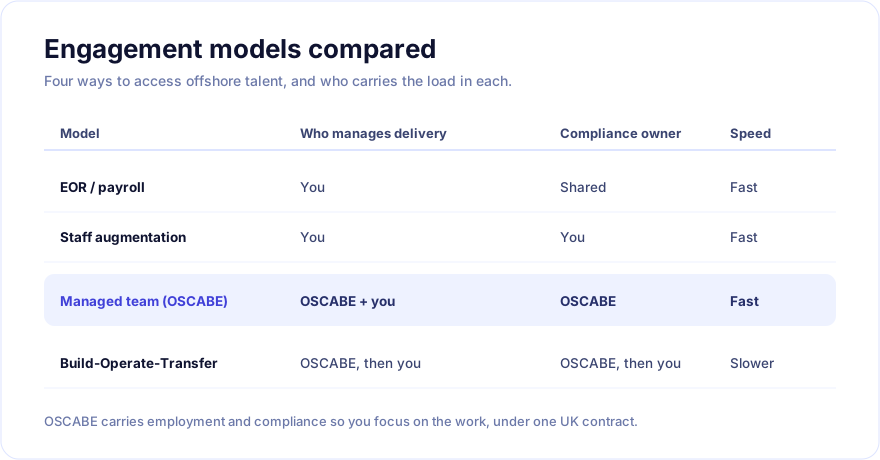
OSCABE structures BOT to blunt these risks: you run the unit as a managed operation first, with transparent invoicing where the professionals keep the majority of what you pay and our fee is shown on every invoice, and you only transfer once the operation is demonstrably working. The four-model view below shows where BOT sits relative to lighter options.
When should you actually choose BOT?
Choose BOT when all of these are true: offshore is a long-term strategic bet, you genuinely want to own the team and intellectual property outright, you have the scale (typically 20+ roles) to amortise the setup, and you can wait quarters rather than weeks for full productivity. In that situation, BOT gives you a wholly owned, de-risked operation that you did not have to build alone. Hiring developers in India through any model is well established and legal for UK firms; see hiring remote developers in India.
If even one of those conditions is shaky, start with a managed team. You get the same dedicated, vetted talent delivering immediately, with none of the entity overhead, and OSCABE can move you to BOT later if the operation grows into something you want to own. Explore the wider model in how it works or for European buyers, options for EU clients.
Frequently asked questions
What does BOT stand for in offshoring?
BOT stands for Build-Operate-Transfer. A partner builds a dedicated offshore team or captive centre, operates and manages it on your behalf for an agreed period, then transfers the legal entity and employees into your ownership. It is used by companies that want to own an offshore operation eventually but prefer not to set it up alone from scratch.
How long does a Build-Operate-Transfer programme take?
A typical BOT programme runs around 18 to 24 months from build to transfer, with the first 3 to 6 months spent standing up the team and infrastructure. The timeline depends on headcount, seniority and how clearly the target operating model is defined. If you need delivery within weeks, a managed team is the faster route.
Is BOT cheaper than running a managed team?
Not to start, and not at small scale. BOT carries a programme fee from £12,000 per month and only becomes cost-effective when amortised across a large, long-lived team of roughly 20 or more roles. A managed team from £2,000 per month per professional is the lower total cost for most ongoing needs. See the true cost of an offshore development team.
What happens to IR35 after the entity transfers?
While the operation is run as a managed B2B service, the engagement is IR35-friendly because the partner employs and directs the workers. After transfer you own the Indian entity and employ the staff directly, so the UK off-payroll question changes shape and should be reviewed with your adviser. Check your facts against the HMRC off-payroll guidance.
Mapping BOT to your goal
Build-Operate-Transfer in India is the right model when owning a large offshore operation is the objective and you have the scale and patience to get there. For everything short of that, a managed team delivers the same talent faster and lighter, and keeps the option to transfer open. The smart move is to match the model to the goal, not to over-build for a need a managed team would serve perfectly.
To scope a BOT programme or compare it against a managed team for your exact roles, contact us or browse the roles and engineers OSCABE can staff in India and the Middle East.