
A managed GCC and Build-Operate-Transfer (BOT) both give you a dedicated offshore operation in India, but they differ on one thing: ownership. A managed GCC is run for you under one UK contract with no foreign entity to own, so it is faster, lighter and easier to exit. BOT adds a transfer phase that ends with you owning the Indian entity and staff outright, which means more control but more cost, time and commitment. OSCABE offers both from £12,000 per month, so you can choose ownership as a goal rather than a default.
This is a fair, decision-focused comparison of the two captive-style routes, including who each one genuinely suits.
Managed GCC vs BOT: what is the real difference?
Both models deliver the same thing in the near term, a dedicated, vetted team in India working only for you, managed day to day by a partner. The divergence is what you are left holding at the end.
- Managed GCC. A partner recruits, employs, manages and pays a dedicated team that functions as your offshore capability centre, under one UK B2B contract. You direct the work; the partner carries employment, payroll and compliance. There is no entity for you to own and no transfer event. You can scale up or down without unwinding a legal structure.
- Build-Operate-Transfer (BOT). The same managed operation, plus a planned transfer. After an agreed period the partner moves the legal entity and employees into your ownership, and you become the direct employer in India with the compliance and facilities that entails.
Put simply, a managed GCC is the operate phase offered on its own; BOT is build, operate and transfer in sequence. For the full mechanics of each, see the Build-Operate-Transfer India guide and how to set up a GCC in India.
How do managed GCC and BOT compare side by side?
This table is even-handed. BOT wins on ultimate ownership and control; a managed GCC wins on speed, simplicity, cost-to-start and ease of exit. Figures are indicative 2026 ranges from public market data and salary guides.
| Factor | Managed GCC (OSCABE) | Build-Operate-Transfer |
|---|---|---|
| End state | Ongoing managed operation, no entity | You own the Indian entity and staff |
| Control over work and IP | High (via contract) | Highest (you own it after transfer) |
| Time to first delivery | Days to a few weeks | 3-6 months to stand up |
| Commitment | Rolling, scale up or down | 18-24 months, then ownership |
| Who employs the team | OSCABE | Partner first, then you |
| Compliance and payroll | OSCABE, under one UK contract | Partner first, then yours |
| Entry cost | From £12,000/month programme-level | From £12,000/month, plus transfer costs |
| Risk profile | Low; partner carries employment | Higher; risk shifts to you on transfer |
| Exit | Stop or scale down with notice | Complex; you own staff and entity |
| Best for | Capability without ownership burden | Long-term, strategic ownership at scale |
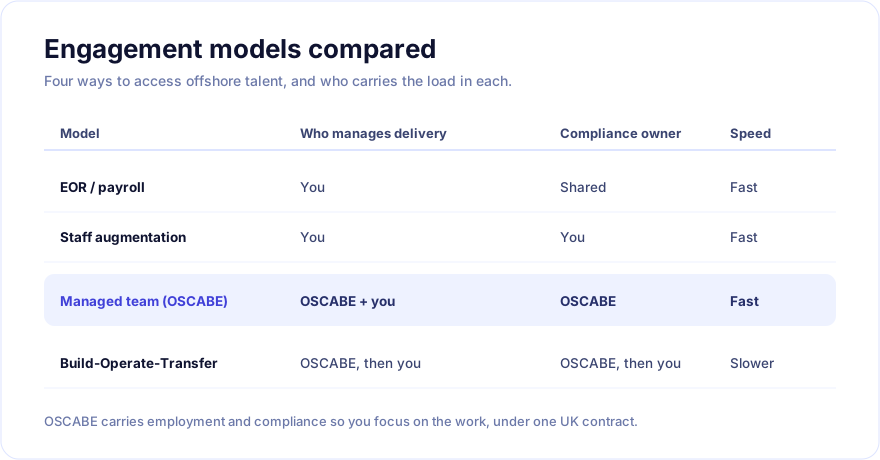
The engagement-model view below places both routes against lighter options, so you can see where each sits on the control-versus-overhead spectrum.
Which gives you more control?
BOT gives more ultimate control because, after transfer, you own the entity, employ the staff directly and hold the IP and operation outright. Nothing sits between you and the team. That matters when the offshore operation is a long-term strategic asset you want fully under your roof.
A managed GCC still gives strong practical control. You set the roadmap, direct the work and own the output through contract, with the work performed exclusively for you. What you do not control is the employment relationship, which is the point: the partner carries it so you do not have to run Indian payroll, HR and statutory compliance. For most teams, contractual control over the work is enough, and shedding the employment burden is a feature, not a compromise.
Which carries more risk?
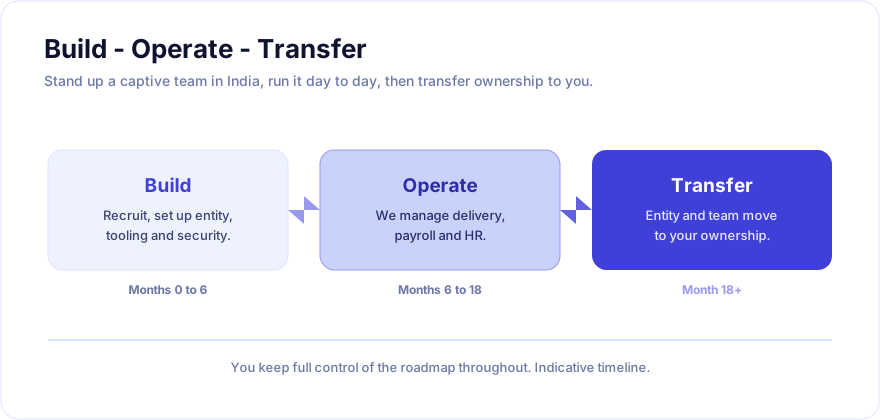
Risk is the cleanest way to separate these models, because BOT deliberately shifts risk to you over time. The timeline below shows where that shift happens: risk stays with the partner through the build and operate phases, then moves to you at transfer.
- Managed GCC. The partner carries employment liability, payroll, statutory compliance and retention throughout. A resignation is the partner's problem to backfill. Your downside is largely limited to the contract.
- BOT. Risk is low while the partner operates, then transfers to you. After the handover you own employment liability, ongoing compliance under India's labour codes, facilities and retention. The transfer itself adds legal, tax and change-of-employer risk that must be planned from the start. See India's labour codes for UK and EU employers.
Neither is "riskier" in the abstract. BOT trades higher long-term risk for ownership; a managed GCC keeps risk with the partner in exchange for not owning the entity. The wider category trade-offs are mapped in EOR vs managed service vs staff augmentation.
Which costs more?
Both OSCABE routes start from £12,000 per month at programme level, but the total cost diverges over time. BOT adds one-off transfer costs (legal transfer, statutory registrations, knowledge handover) and, crucially, hands you the full running cost and compliance overhead once you own the entity. A managed GCC keeps costs predictable and bundled under one contract for as long as you run it, with no transfer event and no post-transfer obligations.
So the cost question is really a time-horizon question. Over a long enough life at large scale, owning the entity through BOT can be efficient because you amortise setup across years and a big team. For shorter horizons or smaller headcount, a managed GCC is the lower total cost and the lower hassle. OSCABE keeps either route transparent: the professionals keep the majority of what you pay, and our fee appears on every invoice. Compare the underlying economics in the true cost of an offshore development team.
Which is easier to exit?
A managed GCC is far easier to exit. Because there is no entity to own, you scale down or stop with contractual notice, and the partner handles winding down employment. There is no legal unwinding on your side.
BOT is harder to exit once transfer completes, precisely because you now own staff and an entity. Exiting then means managing redundancies, statutory obligations and entity closure under Indian law. This asymmetry is why starting with a managed GCC is a sensible default: you keep optionality, and you only take on the harder-to-reverse commitment of ownership when you are confident the operation is worth keeping for the long term.
Who should choose each model?
- Choose a managed GCC if: you want a dedicated offshore capability fast, you value low commitment and easy exit, you would rather not run Indian payroll and compliance, and ownership of the entity is not a near-term goal. This fits the large majority of UK and EU companies. Start at managed teams or, for European buyers, EU clients.
- Choose BOT if: offshore is a long-term strategic bet, you specifically want to own the entity, staff and IP, you have the scale (typically 20+ roles) to amortise setup, and you can wait quarters for full productivity and accept the transfer and ownership burden. See how it works.
The pragmatic path many companies take is to start managed and transfer later: run the operation as a managed GCC, prove it, then move to BOT once owning it is clearly justified. Because OSCABE delivers both, you can evolve without changing partners or re-vetting your team.
Frequently asked questions
Is a managed GCC just BOT without the transfer?
Effectively, yes. A managed GCC is the operate phase of BOT delivered on its own: a partner runs a dedicated offshore operation for you with no transfer event. BOT adds the build and transfer stages so you end up owning the entity. If you may want ownership later, BOT structures the path; if you want the capability without the ownership burden, a managed GCC is enough.
Which is cheaper, a managed GCC or BOT?
Over short to medium horizons or at modest scale, a managed GCC is cheaper in total because it has no transfer costs and no post-transfer compliance burden. BOT can become efficient over a long life at large scale, where you amortise setup across years and a big team. Both OSCABE routes start from £12,000 per month at programme level.
Can I start with a managed GCC and switch to BOT later?
Yes, and it is a common, low-risk path. You run the operation as a managed GCC first, prove it works, then move to BOT to take ownership once that is clearly justified. Because OSCABE delivers both models, you can transition without changing partners or re-vetting the team you have built.
Who owns the intellectual property in each model?
In both models the work is performed exclusively for you and IP ownership is secured by contract, so you control the output. The difference is the entity: under BOT you also own the legal vehicle and employ the staff after transfer, whereas a managed GCC secures your IP contractually while the partner carries the employment.
Choosing between them
Managed GCC versus BOT comes down to whether owning an Indian entity is a goal in itself. If it is, and you have the scale and patience, BOT delivers full ownership and maximum control. If it is not, a managed GCC gives you the same talent and near-term control with less cost, risk and commitment, and keeps the door to BOT open.
To compare both routes against your roadmap and headcount, contact us or explore the engineers and teams OSCABE can stand up in India and the Middle East.