
To set up a GCC (Global Capability Centre) in India you register or secure a legal entity, choose a city, recruit and employ local talent, build compliance and payroll on India's labour framework, and stand up IT and information security to your standards. Done cold, this is a multi-month programme with real legal and operational risk. The lower-risk route for most UK and EU companies is a managed GCC, where a partner runs the centre for you under one UK contract and, if you want, transfers it to your ownership later. OSCABE delivers managed GCC and Build-Operate-Transfer programmes in India from £12,000 per month.
This guide walks the build step by step, then compares GCC against BPO and BOT so you can choose the right structure before you commit.
What is a GCC and why set one up in India?
A Global Capability Centre is a company-owned offshore unit that delivers core work (engineering, data, finance, operations) for the parent business, rather than an outsourced vendor doing it at arm's length. India is the default location because of its deep technical talent pool, English working language, mature compliance ecosystem and a strong cost differential against UK and EU salaries.
The strategic draw is control. A GCC is your operation, your culture, your IP and your roadmap, just located offshore. That is also why it is a bigger commitment than hiring a few remote contractors, and why the build has to be done properly. For where a GCC sits among the alternatives, see staff augmentation vs managed team vs BOT.
How to set up a GCC in India: the five steps
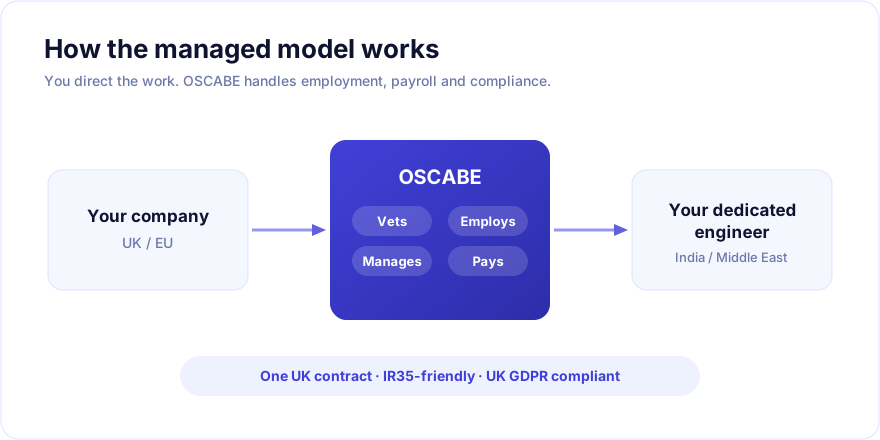
The build splits into five workstreams that overlap in practice. The managed model below shows how a partner can carry the employment, payroll and compliance layers while you keep direction.
1. Establish the legal entity
You need a legal vehicle to employ people in India. Most foreign parents incorporate a private limited company, which can be wholly owned, then complete tax and statutory registrations. This is the step that most often delays a cold build, because incorporation, banking and registrations take time and local expertise. A managed GCC sidesteps the wait by letting you operate under a partner's structure first and only incorporate when you transfer.
2. Choose a location
City choice shapes talent access and cost. Bengaluru, Hyderabad, Pune, Chennai and the NCR region are the established technology hubs, each with different talent depth, salary levels and competition for hiring. Tier-2 cities can cut cost and churn but may narrow the senior talent pool. Decide based on the roles you need, not just the headline rent.
3. Recruit and employ the team
Sourcing, assessing and hiring the right people is the make-or-break workstream. A GCC lives or dies on the quality of its founding cohort and local leadership. Rigorous, role-specific vetting matters more here than anywhere, because early hires set the standard. OSCABE applies a five-stage vetting process so only a small share of applicants reach a client shortlist; the same discipline underpins a managed GCC. For the talent market itself, see hiring remote developers in India.
4. Build compliance and payroll
Once you employ people in India you must run compliant payroll and meet statutory obligations under the country's labour framework, including provident fund, state insurance where applicable and the consolidated labour codes. Getting this wrong creates liability fast. This is precisely the burden a managed model absorbs for you. Read India's labour codes for UK and EU employers for the detail.
5. Stand up IT and information security
Your GCC must meet the same security bar as the rest of your business: managed devices, identity and access control, network security, data-protection controls and, for UK and EU data, appropriate safeguards for international processing as the ICO expects. Bake security into the build from device one rather than retrofitting it after the team is live.
GCC vs BPO vs BOT: what is the difference?
These three are often confused, but they answer different questions. A GCC is something you own; a BPO is a vendor you hire; BOT is the phased route to ending up with a GCC.
| Dimension | GCC (captive) | BPO (outsourced) | BOT (phased to captive) |
|---|---|---|---|
| Ownership | You own the unit | Vendor owns everything | Partner first, then you |
| Control over work and IP | Highest | Lowest | Grows to highest |
| Who employs staff | You | The vendor | Partner, then you |
| Speed to start | Slowest (cold build) | Fast | Medium |
| Best for | Long-term strategic capability | Defined, repeatable processes | Owning a centre without a cold build |
| Commitment | Highest | Contractual, flexible | High, ends in ownership |
| Cost shape | High fixed, low per-unit at scale | Per-seat or per-process | Programme fee, then owned cost |
In short: choose a BPO when you want a process run for you with no ownership; choose a GCC when you want to own strategic capability offshore; choose BOT when you want a GCC but would rather not build it cold. A managed GCC is effectively the operate phase of BOT offered on its own, with transfer optional. The dedicated comparison is in managed GCC vs Build-Operate-Transfer, and the full BOT mechanics are in the Build-Operate-Transfer India guide.
How much does a GCC in India cost, and how long does it take?
Cost has two layers: the recurring run cost of the team and the build or management overhead. Ranges below are indicative for 2026, drawn from public market data and salary guides, and should be validated against a real scope.
| Element | Indicative range | Notes |
|---|---|---|
| Managed GCC / programme fee | From £12,000/month | OSCABE managed GCC and BOT |
| Per-engineer run cost | Roughly £2,000-£4,500/month | Mid-to-senior; varies by city and seniority |
| Entity and setup (cold build) | One-off, variable | Incorporation, legal, banking, tooling |
| Compliance and payroll ops | Ongoing | Heavier if self-run; absorbed in managed model |
On timeline, a cold-built GCC typically takes 3 to 6 months to reach first productive delivery and longer to scale, because incorporation, hiring and infrastructure all sit on the critical path. The phased BOT view below illustrates the shape.
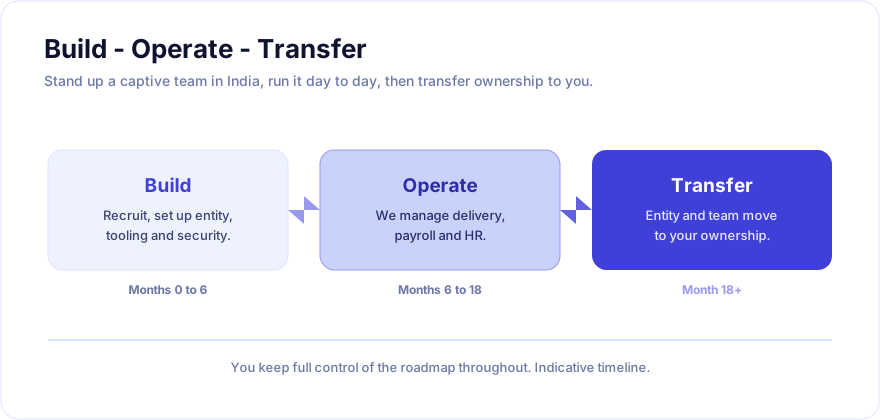
A managed GCC compresses time-to-value because the partner's structure, processes and hiring engine already exist, so the team can start delivering in weeks while ownership questions are deferred.
Should you build a GCC cold or use a managed model?
For most UK and EU companies, a managed GCC is the better starting point. You get an owned-feeling operation with dedicated, vetted staff delivering quickly, without absorbing entity setup, payroll and compliance risk on day one. You keep the option to transfer to a wholly owned GCC later through BOT once the unit is proven.
Build cold from the outset only when you have strong in-country expertise, a large committed headcount and a clear reason to own the entity immediately. Otherwise, starting managed and transferring later captures the upside of a GCC while removing most of the early downside. OSCABE structures this transparently: the professionals keep the majority of what you pay, and our fee is shown on every invoice. See how it works or, for European buyers, options for EU clients.
Frequently asked questions
What does GCC stand for?
GCC stands for Global Capability Centre, a company-owned offshore unit that performs core functions such as engineering, data, finance or operations for the parent business. Unlike a BPO, a GCC is owned and controlled by the company, not an outside vendor, which gives stronger control over work, culture and intellectual property.
How long does it take to set up a GCC in India?
A cold-built GCC typically takes around 3 to 6 months to reach first productive delivery, with longer to scale to full size, because entity incorporation, hiring and IT all sit on the critical path. A managed GCC can have a team delivering within weeks because the partner's entity, compliance and hiring engine already exist.
Is a managed GCC the same as Build-Operate-Transfer?
They are closely related. A managed GCC is essentially the operate phase delivered on its own, with transfer optional, while BOT is the full build-operate-transfer sequence that ends in you owning the entity. If you may want ownership later, BOT structures the path; if you want the capability without owning the entity, a managed GCC is enough. See managed GCC vs Build-Operate-Transfer.
Do I have to incorporate a company in India to run a GCC?
To own a GCC outright, yes, you ultimately need a legal entity in India to employ staff and meet statutory obligations. With a managed GCC you can operate under a partner's structure first and incorporate only when you decide to transfer, which removes the upfront incorporation delay and risk.
Getting the build right
Setting up a GCC in India rewards companies that want to own strategic capability offshore and can carry the build. For most, the pragmatic path is a managed GCC: dedicated, vetted talent delivering fast under one UK contract, with compliance and payroll handled, and a clean route to ownership through BOT if and when it makes sense.
To scope a managed GCC or a full BOT programme for your roles, contact us or explore the engineers and teams OSCABE can stand up in India and the Middle East.