
India's Labour Codes 2026: What UK and EU Employers Should Know
India has consolidated a large number of central labour laws into four codes covering wages, social security, industrial relations, and occupational safety, health and working conditions. For UK and EU companies that engage talent in India, the practical message is that local employment compliance is becoming more codified, not less, and the obligations around wages, social security contributions and worker protections continue to sit with whoever is the employer in-country. If that employer is you, in substance, the responsibility (and the risk of getting it wrong) is yours; if it is a managed provider, the provider carries it.
This guide outlines the four labour codes, what they mean at a practical level, why they matter to UK and EU employers, and how a fully-managed model keeps you compliant without your company having to track and apply Indian labour law directly. It builds on our piece on contractor vs employee in India and misclassification risk.
What are India's four labour codes?
The reforms gather dozens of earlier central labour statutes into four consolidated codes. At a general level, they cover:
- The Code on Wages. Consolidates rules on wages, minimum wages, payment of wages and bonus, and introduces a more uniform definition of "wages" used across the framework.
- The Code on Social Security. Brings together social security provisions, including those relating to schemes such as the Employees' Provident Fund (PF) and Employees' State Insurance (ESIC), and extends the architecture for worker social security.
- The Industrial Relations Code. Consolidates rules on trade unions, standing orders, and conditions around industrial disputes, retrenchment and related matters.
- The Code on Occupational Safety, Health and Working Conditions (OSH). Consolidates workplace safety, health, welfare and working-condition requirements, including aspects of working hours and leave.
The codes aim to simplify and modernise a previously fragmented landscape. Implementation detail, including the precise timing and the rules made under each code, is set centrally and by individual states, so the exact position can vary and evolve. Treat the descriptions here as a general overview rather than a definitive statement of what applies on a given date.
What the codes mean in practice
For an employer in India, the codes touch the everyday mechanics of employment.
The practical themes that matter most are:
- A more uniform definition of "wages." Because several entitlements and contributions are calculated by reference to wages, a consistent definition affects how items such as social security contributions and certain payments are computed. Getting the wage base right matters for correct contributions.
- Social security architecture. PF and ESIC-type contributions remain central, with the social security code providing the framework. Correct registration, contribution and remittance continue to be employer responsibilities.
- Worker protections and industrial relations. Standing orders, dispute mechanisms and protections around termination and retrenchment are consolidated, which shapes how employment is documented and ended.
- Safety, health and working conditions. The OSH code consolidates expectations on welfare, working hours and leave, relevant even where work is largely desk-based.
None of this prevents UK or EU companies from engaging Indian talent. It does mean that the in-country employer must apply the codes correctly, keep pace with the rules made under them, and document employment in line with them.
Why this matters to UK and EU employers
If you engage individuals in India directly, or through a thin arrangement where you are the de facto employer, the labour-code obligations effectively land on you, often without you having the local infrastructure to meet them. That creates several pressure points:
- Misclassification interacts with the codes. If a "contractor" is in substance an employee, the wage, social security and protection rules can apply retrospectively, with contributions and entitlements owed for the period concerned. The consolidated codes reinforce, rather than relax, this exposure.
- Social security gaps are costly. Underpaid or unpaid PF and ESIC-type contributions can be pursued, generally with interest and penalties, and a uniform wage definition can affect how much was due.
- Keeping current is a real burden. Rules made under the codes, and state-level variation, mean compliance is an ongoing exercise, not a one-time setup.
- Permanent establishment risk sits alongside. Engaging and controlling individuals in India can also raise the question of a taxable presence for your company, separate from labour law but often arising from the same facts. See contractor vs employee in India and misclassification risk.
The underlying point is that Indian labour compliance is local, detailed and changing. For a UK or EU company without an Indian entity and local HR, applying it directly is impractical and risky.
How a managed model keeps you compliant
A managed model resolves this by placing the employer responsibility with a provider that already operates in India and applies the labour codes as part of its core business.
| Approach | Who applies India's labour codes? | Compliance burden on you | Risk position |
|---|---|---|---|
| Direct individual / consultant contract | You, in substance, without local infrastructure | High: you must track wages, PF/ESIC, protections and OSH yourself | Misclassification, social security and PE exposure on you |
| Freelancer marketplace | Effectively you; little structural support | High: minimal help applying the codes | You carry the labour and tax risk |
| Employer of Record (EOR) | The EOR's Indian entity for a named hire | Lower: EOR runs compliant employment | Employment-status risk substantially reduced |
| Managed B2B service (e.g. OSCABE) | The provider's Indian entity, as part of the service | Lowest: provider applies the codes continuously | Misclassification, social security, IP and compliance risk sit with the provider |
Under a fully-managed service:
- The provider is the legal employer in India and applies the wage, social security, industrial relations and OSH requirements as part of running compliant employment.
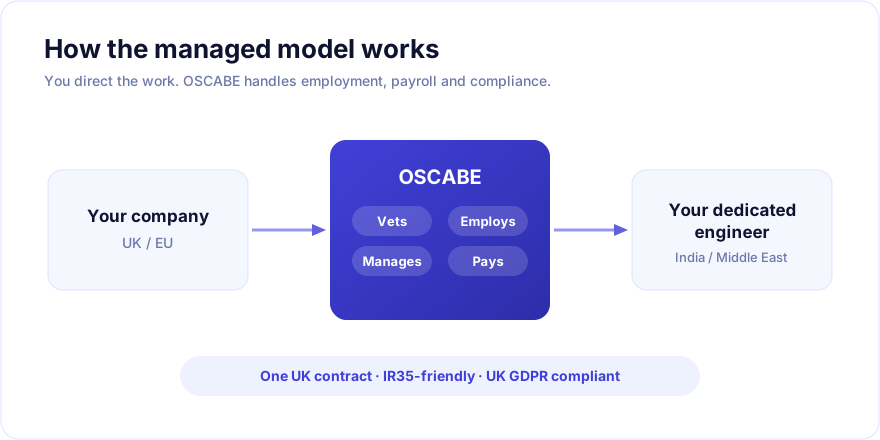
- You buy a service, not a person. Your agreement is a UK B2B services contract; you direct the work and receive deliverables, and you do not take on Indian labour-law obligations directly.
- Compliance stays current. As rules made under the codes change, and as state-level variation applies, the provider keeps employment compliant, so you are not chasing legislative detail in another jurisdiction.
This is how OSCABE is built. UK and EU clients sign one UK agreement; the professionals are employed by OSCABE's Indian entity, with wages, PF, ESIC, statutory protections and local compliance handled at source. Because OSCABE is the employer of record for its people, the misclassification, social security, IP and compliance risk sits with OSCABE, not the client. See how it works and managed teams.
For the closely related topics, see contractor vs employee in India and misclassification risk for status and PF/ESIC exposure, is it legal to hire developers in India from the UK for the compliant engagement models, and our practical guide to hiring remote developers in India.
Frequently asked questions
Do India's labour codes change whether a UK company can hire in India?
No. The codes govern how employment works inside India; they do not stop a UK or EU company from engaging Indian talent. What they do is make local employment compliance more codified, which matters most when you are the de facto employer in-country. Engaging through a managed provider keeps those obligations with the provider rather than your company.
Who is responsible for PF and ESIC contributions under the codes?
The employer in India is responsible for registering, contributing and remitting social security such as PF and ESIC-type contributions, calculated on the relevant wage base. Under a managed model these responsibilities sit with the provider that employs the worker. Under a direct arrangement where you are the de facto employer, the exposure effectively falls on you.
How does the uniform definition of wages affect me?
Because contributions and certain entitlements are calculated by reference to wages, a more uniform definition affects how those amounts are computed. For a UK or EU company this is mainly relevant through the in-country employer, who must apply the correct wage base. With a managed provider, getting this right is part of the service rather than something you calculate.
Is the timing of the codes settled?
Implementation detail, including timing and the specific rules made under each code, is determined centrally and by individual states, and can evolve. Because the position can vary and change, you should not assume a fixed state of play; a managed provider tracks and applies the current requirements, and you should confirm anything material with a qualified adviser.
General information, not legal advice
This article provides a general overview of India's consolidated labour codes for UK and EU employers, current as at the date of publication. It is not legal or tax advice and does not create a professional relationship. The codes, their timing and the rules made under them are detailed and can change, with state-level variation; please take advice from qualified Indian advisers before acting. Where useful, consult current India guidance and the relevant authorities directly.
Ready to engage talent in India without tracking labour law yourself?
OSCABE provides dedicated, fully-managed remote professionals and teams from India and the Middle East under one UK contract, with employment, wages, social security, statutory protections and compliance handled in-country. You direct the work; we apply the labour codes and carry the risk. Browse our engineers and managed teams, or contact us to design the right structure for your business.