
NDA for Offshore Developers: What It Should Cover (UK Guide)
A non-disclosure agreement (NDA) for offshore developers should clearly define what counts as confidential information, set out who may use it and for what, impose security and return-or-destroy obligations, and run for a sensible term. But an NDA on its own does not transfer ownership of anything; it controls disclosure and use, while a separate IP assignment is what actually moves ownership of the code to you. The most common mistake UK firms make is treating an NDA as if it does both jobs. It does not.
This guide explains what a confidentiality agreement should cover, how confidentiality differs from IP assignment, how enforceability works across borders, and a practical section-by-section structure. It describes the building blocks; it does not paste a legal template, because the right wording depends on your facts and should come from a qualified adviser.
What should an NDA for offshore developers cover?
A confidentiality agreement is only as good as its definitions and obligations. At a minimum it should address:
- A clear definition of confidential information. Specific enough to be meaningful (source code, architecture, credentials, customer data, roadmaps, commercial terms) but broad enough to catch the obvious. Define it well and most disputes never arise.
- Permitted purpose and use. The recipient may use the information only to perform the services, and for no other purpose. This single clause does a lot of work.
- Standard exclusions. Information that is already public, already lawfully known, independently developed, or received from a third party without breach is usually carved out.
- Security and handling obligations. How the information must be protected: access on a need-to-know basis, named security measures, and a prohibition on copying beyond what the work requires.
- Onward disclosure and flow-down. Restrictions on sharing with others, and a requirement that anyone who does receive it (employees, sub-processors) is bound by equivalent obligations.
- Term and survival. How long the obligations last, including after the engagement ends. Many obligations should survive termination, sometimes indefinitely for trade secrets.
- Return or destruction. On request or at the end, the recipient returns or securely destroys the information and certifies they have done so.
- Remedies and governing law. Acknowledgement that damages alone may be inadequate (supporting injunctive relief), plus the governing law and forum.
Where personal data is involved, the NDA sits alongside, not instead of, data-protection terms. Confidentiality and UK GDPR processor obligations are different things; you need both. See GDPR and hiring offshore developers.
Confidentiality vs IP assignment: two different jobs
This distinction matters enough to state plainly, because conflating the two leaves a gap that surfaces at the worst time, usually during due diligence or a dispute.
- An NDA / confidentiality clause controls disclosure and use. It stops the developer from leaking, misusing or onward-sharing your information. It does not, by itself, make you the owner of anything the developer creates.
- An IP assignment controls ownership. It transfers the copyright and other IP in the deliverables to your company. Without it, the developer (or their employer) can retain ownership of the code even though they are contractually barred from disclosing it.
You generally need both, working together: confidentiality so your information stays protected, and assignment so the work product belongs to you.
| Mechanism | What it does | What it does not do |
|---|---|---|
| NDA / confidentiality | Restricts disclosure and use of your information | Does not transfer ownership of code or IP |
| IP assignment | Transfers ownership of deliverables to you | Does not, by itself, keep information secret |
| Data processing agreement | Sets UK GDPR processor obligations for personal data | Does not cover non-personal trade secrets or IP |
For the ownership side in depth, including the work-for-hire myth and the India versus UK default rules, see IP ownership and code assignment for offshore developers.
Does an NDA hold up across borders?
A frequent worry with offshore engagements is whether a UK-style NDA is worth anything when the developer is in India. Enforceability is a genuine consideration, and a few principles help.
- Choice of law and forum matter. Parties can usually agree which law governs the NDA and where disputes are resolved. A UK-governed contract with a UK forum is common, but enforcing a UK judgment against an individual or entity abroad can be slower and more complex than enforcing at home.
- Who you contract with changes everything. An NDA signed only by an individual freelancer overseas can be hard to enforce in practice. An NDA backed by a substantial provider that employs the developer, and which contracts with you under one UK agreement, is a more enforceable proposition because there is a creditworthy, contracting counterparty within reach.
- Flow-down is what protects you in reality. Your strongest practical protection is that the obligations flow down to the individual through their employment terms with the provider, so the people actually handling your information are bound, and the provider is responsible for them.
- Contracts work best alongside controls. Even a well-drafted, enforceable NDA is a remedy after the fact. Pair it with access controls, device management and data minimisation so a breach is less likely in the first place.
The practical takeaway: an NDA is far stronger when it is part of a managed structure with a substantial UK-contracting provider, than when it is a standalone document signed by an individual in another jurisdiction. Cross-border enforceability is fact-specific, so take advice where the information at stake is valuable.
A practical NDA structure (described, not a template)
A workable confidentiality agreement for offshore development generally moves through these sections. This is a structural outline to help you brief your adviser, not drafting to copy:
- Parties and recitals. Who is bound, and the context (provision of development services).
- Definitions. Especially "Confidential Information", with examples and the standard exclusions.
- Confidentiality obligations. The core duty not to disclose or misuse, and to protect the information.
- Permitted purpose and permitted recipients. Use limited to the services; disclosure only to those who need to know and are bound by equivalent terms.
- Security measures. Required safeguards, need-to-know access, and copying restrictions.
- Personal data interface. A pointer that any personal data is governed by the data processing agreement and UK GDPR, not just confidentiality.
- Term and survival. Duration of the agreement and which obligations survive termination.
- Return and destruction. Obligations on request and at the end, with certification.
- Remedies. Acknowledgement that damages may be inadequate, supporting injunctive relief.
- Governing law and jurisdiction. The chosen law and forum.
- Boilerplate. No licence granted, no implied IP transfer, assignment, notices, and entire agreement.
Notice what the structure does not do: it does not transfer ownership. That is the job of the IP assignment in your services agreement, which is why the two documents are designed to work together.
How a managed model strengthens confidentiality
A managed provider turns confidentiality from a single document into a layered, enforceable system.
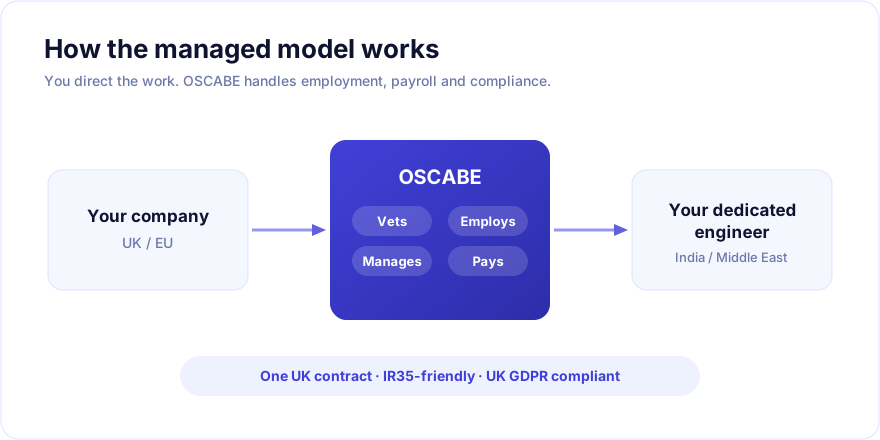
Under a fully-managed service, confidentiality is built in three ways:
- Contractual. A robust confidentiality clause in your UK B2B agreement with the provider, with a creditworthy counterparty you can hold to it.
- Back-to-back. Equivalent obligations flow down to the individual developers through their employment terms, so the people doing the work are bound.
- Operational. Practical controls behind the contract: access governance, device management and security policies, so confidentiality is enforced day to day, not just on paper.
OSCABE operates this way. UK and EU clients contract under one UK agreement; the developers are employed by OSCABE's entity, so confidentiality, IP assignment and security obligations flow straight down to the individuals. OSCABE is UK GDPR compliant and operates to ISO 9001:2015 quality management, which supports both the contractual and operational sides of confidentiality. Because OSCABE is the employer of record for its people, the confidentiality, IP and compliance risk sits with OSCABE, not the client. See how it works and managed teams.
For the closely related topics, see IP ownership and code assignment for offshore developers for ownership, GDPR and hiring offshore developers for personal data, and contractor vs employee in India and misclassification risk for the employment structure that lets obligations flow down.
Frequently asked questions
Does an NDA mean I own the code the developer writes?
No. An NDA controls disclosure and use of your confidential information; it does not transfer ownership of anything. Ownership of the code is moved by a separate written IP assignment in your services agreement. You generally need both an NDA and an assignment, because they do different jobs.
Is a UK NDA enforceable against a developer in India?
It can be, but enforceability is fact-specific. Choice of law and forum, and crucially who you contract with, all matter. An NDA backed by a substantial provider that employs the developer and contracts with you under one UK agreement is far more enforceable in practice than a standalone NDA signed by an individual abroad. Pair the contract with access controls to reduce the chance of a breach in the first place.
How long should confidentiality obligations last?
It depends on the information. General confidential information might be protected for a fixed number of years after the engagement, while genuine trade secrets are often protected for as long as they remain secret. The term and which obligations survive termination should be set deliberately rather than left to a default.
Do I still need a data processing agreement if I have an NDA?
Yes, where personal data is involved. An NDA covers confidential information generally, but UK GDPR requires specific processor terms (an Article 28 data processing agreement) for personal data, plus an appropriate international transfer mechanism. The NDA and the data processing agreement are complementary, not interchangeable.
General information, not legal advice
This article provides general information about confidentiality agreements for offshore software development, current as at the date of publication. It is not legal advice and does not create a professional relationship. Confidentiality and enforceability outcomes depend on the specific drafting and facts, and the rules can change; please take advice from qualified UK and Indian advisers before acting. Where useful, consult current UK and India guidance and the relevant authorities directly.
Ready to protect your confidential information offshore?
OSCABE provides dedicated, fully-managed remote developers and teams from India and the Middle East under one UK contract, with confidentiality, IP assignment and security obligations flowing down to the individuals doing the work. We carry the structure so your information stays protected. Explore our engineers and managed teams, or contact us to review your confidentiality setup.