
IP Ownership for Offshore Developers: Who Owns the Code?
When an offshore developer writes code for you, you do not automatically own it just because you paid for it. In most common-law systems, including the UK and India, intellectual property created by an independent contractor stays with the contractor unless there is a written assignment transferring it to you. Code written by an employee, by contrast, generally vests in the employer by default. The practical consequence is that getting IP ownership right depends entirely on the engagement structure and the contract chain behind it, not on the invoice.
This guide explains who owns code by default, why "work for hire" is a dangerous assumption, how the India and UK default rules compare, and how a properly built assignment chain (the kind a managed provider puts in place) ensures the IP ends up with your company.
Who owns the code by default?
Software is protected primarily by copyright, which arises automatically when the code is written. The first owner of that copyright is, as a starting point, the author, the person who wrote it. Two routes can move ownership to you:
- Employment. Where the author is your employee and creates the work in the course of their employment, the copyright generally vests in the employer by default. This is the position in both the UK and India for employee-created works.
- Written assignment. Where the author is an independent contractor (a freelancer, a consultancy, or their personal company), ownership does not pass automatically. You need a written, signed assignment of the copyright to acquire it.
The trap is the contractor route. Paying a freelancer to build something does not, on its own, transfer the copyright. Without an effective assignment, you may end up with a licence to use the deliverable (sometimes only an implied one) while the developer retains ownership, which can later restrict your ability to modify, resell, license or raise investment against the asset.
The work-for-hire myth
UK and Indian businesses often borrow the American phrase "work made for hire" and assume it means whoever commissions and pays for a work owns it. That is a misreading in two ways.
- It is a US concept with narrow limits. Even in the United States, "work made for hire" applies only to works by employees within scope, or to specifically enumerated categories of commissioned work that are agreed in writing. It is not a general rule that the payer owns commissioned creative output.
- It does not map onto UK or Indian law. Neither the UK nor India has an equivalent doctrine that hands ownership to the commissioner of a contractor's work by default. The reliable mechanism in both systems is a written assignment.
Relying on a "we paid for it, so we own it" assumption is one of the most common and most expensive IP mistakes in offshore engagements. The fix is contractual, and it has to be in place before, not after, the work is done.
India vs UK default rules
The two systems are similar in shape but worth comparing directly, because an offshore engagement with India touches both.
| Question | UK position (general) | India position (general) |
|---|---|---|
| Who owns employee-created code? | Employer, by default, where created in the course of employment | Employer, by default, in the absence of agreement to the contrary |
| Who owns contractor-created code? | The contractor, unless assigned in writing | The contractor, unless assigned in writing |
| How is ownership transferred from a contractor? | Written assignment of copyright (and other IP) | Written assignment of copyright (and other IP) |
| Are moral rights a factor? | Yes; can be waived | Yes; certain moral rights exist and need handling |
| Does paying for the work transfer ownership? | No, not by itself | No, not by itself |
The headline is that both systems default contractor IP to the author and rely on a written assignment to move it. The differences sit in the detail, particularly the treatment of moral rights, which is why offshore IP arrangements should be documented carefully rather than assumed to mirror your home jurisdiction. These are general positions; the precise effect depends on the facts and the drafting, so take advice on anything significant.
Building a clean assignment chain
Because the developer is usually employed by the provider, and the provider contracts with you, the IP has to travel down a chain. A break anywhere in that chain can leave you without good title.
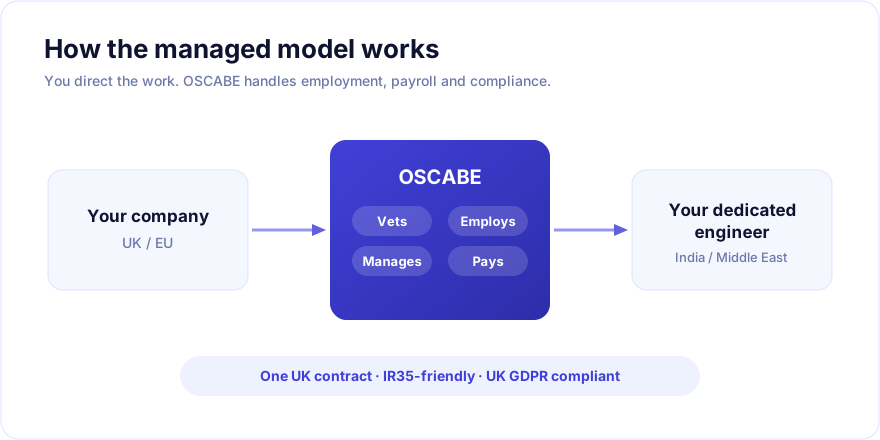
A robust chain has three links:
- Developer to provider. The developer's employment contract should include a present assignment of IP created in the course of their work to the employing entity. This captures ownership at source, the moment the code is written.
- Provider to client. The B2B services agreement between the provider and your company should assign (or grant an exclusive, irrevocable, royalty-free licence to) the deliverables' IP to your UK entity, ideally with a present assignment of future works so each deliverable transfers as it is created.
- Further assurance. A "further assurance" clause obliges the provider to sign any additional documents needed to perfect or register your title later, which matters if you ever need to evidence ownership to an investor, acquirer or court.
Two refinements strengthen the position further. First, address moral rights with appropriate waivers or consents where the local system recognises them, so the developer cannot later object to changes you make. Second, deal with pre-existing and third-party materials (open-source components, the developer's prior libraries) by carving them out and granting you a clear licence to use them, so you know exactly what you own outright and what you use under licence.
With a direct freelancer, you have to construct and verify this chain yourself, including confirming the assignment is valid in the developer's jurisdiction. With a managed service, the chain is built in: the provider already employs the developer (capturing IP at source) and assigns deliverables to you through the UK contract.
How OSCABE assigns IP to the client
OSCABE operates the managed model, and IP assignment is part of the structure rather than an afterthought.
- Capture at source: OSCABE employs the developers directly, so IP created in the course of their work is assigned to OSCABE's entity under their employment terms.
- Assignment to you: the deliverables' IP is assigned to your UK or EU company through one UK B2B agreement, with further-assurance support so title can be evidenced and perfected if ever needed.
- Confidentiality alongside ownership: because OSCABE employs the people doing the work, confidentiality and security obligations flow straight down to the individuals, complementing the IP position.
Because OSCABE is the employer of record for its people, the IP, confidentiality and misclassification risks sit with OSCABE, not the client. See how it works and managed teams for the operating detail.
IP assignment works hand in hand with confidentiality and the wider compliance picture. For confidentiality specifically, see NDAs and confidentiality for offshore developers. For the employment-status angle that underpins who owns employee versus contractor work, see contractor vs employee in India and misclassification risk. And for the broader question of engaging Indian developers compliantly, see is it legal to hire developers in India from the UK.
Frequently asked questions
If I pay an offshore developer, do I automatically own the code?
No. In both the UK and India, paying a contractor for software does not transfer copyright on its own. The author retains ownership unless there is a written assignment to you. You may have a licence to use the deliverable, but not full ownership, which can limit your ability to modify, resell or license it later. A written assignment is the reliable fix.
Does "work made for hire" mean I own commissioned work?
Not under UK or Indian law. "Work made for hire" is a US concept with narrow application, and there is no general equivalent in the UK or India that gives ownership to whoever commissions a contractor's work. Rely on a written assignment instead of the phrase.
How does a managed service make sure I own the IP?
A managed provider employs the developer, so IP is captured at source under the employment contract, and then assigns the deliverables to your company through the B2B agreement, usually with a further-assurance clause. This closes the chain from author to provider to you. With a direct freelancer you would have to build and verify that chain yourself.
What about open-source components in my deliverables?
Open-source and other third-party materials are generally not yours to own outright; you use them under their licences. A well-drafted agreement carves these out, identifies them, and confirms you have the right to use them, so you can distinguish what you own from what you license. This avoids surprises during due diligence.
General information, not legal advice
This article provides general information about IP ownership and assignment for offshore software development, current as at the date of publication. It is not legal advice and does not create a professional relationship. IP outcomes depend on the specific drafting and facts, and the rules can change; please take advice from qualified UK and Indian advisers before acting. Where useful, consult current UK and India guidance and the relevant authorities directly.
Ready to own your code without the IP guesswork?
OSCABE provides dedicated, fully-managed remote developers and teams from India and the Middle East under one UK contract, with IP assignment, confidentiality and compliance built in at source. You get the team and the title; we carry the structure. Explore our engineers and managed teams, or contact us to review your IP setup.