
To evaluate AI models in regulated and technical verticals, you need to source genuine domain experts, qualified lawyers, clinicians, accountants, engineers and scientists, who can tell a subtly wrong answer from a correct one, and then keep their judgments consistent. The most reliable route is a managed pod of credentialed experts, vetted and trained on your rubric before they start, rather than recruiting individuals one by one. A managed expert pod gives you verified credentials, calibrated judgement, a single point of accountability and a UK contract, from around £6,000 per month.
Below we explain why vertical experts are essential, where to source them, how to vet credentials properly, how to manage calibration, and how a managed pod is staffed.
Why vertical domain experts are essential for evaluation
Definition (domain-expert evaluation): Domain-expert evaluation is model evaluation carried out by people formally qualified in the relevant field, so judgments about correctness and risk reflect genuine professional knowledge rather than a layperson's best guess.
In regulated and technical verticals, model risk concentrates exactly where generalist annotators cannot see it. A contract clause that is confidently but subtly wrong, a drug interaction error that sounds plausible, a tax treatment that is correct in one jurisdiction and wrong in another, code that compiles but hides a security flaw: each of these passes a non-expert and fails a qualified one. If your evaluators cannot catch these, your reward model learns to reward them and the errors get baked in.
This is the core argument for hiring domain experts for AI model evaluation, and it sharpens as models are deployed into higher-stakes settings. Expert evaluation is not a luxury layer on top of evaluation; in these verticals it is the control that keeps the model trustworthy.
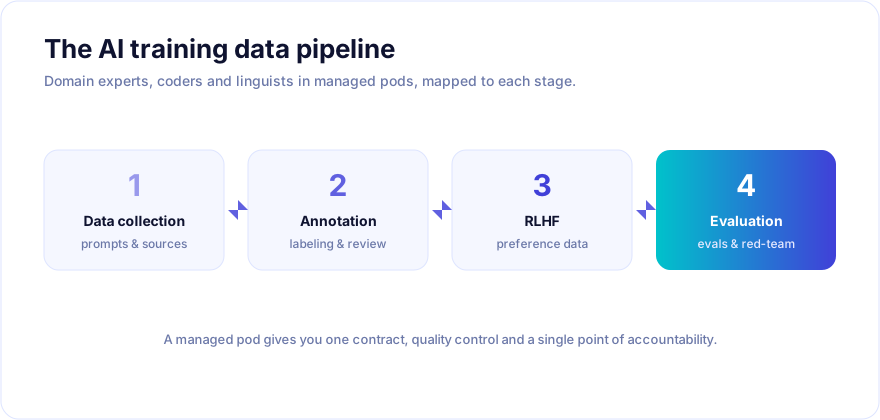
Which verticals need which experts
The need for a credentialed expert rises with the cost of being wrong and the subtlety of the errors. Not every task needs one, but these verticals almost always do.
| Vertical | Why experts are needed | Suitable evaluator |
|---|---|---|
| Law | Subtle, jurisdiction-specific correctness | Qualified lawyers, paralegals |
| Medicine / clinical | Safety-critical, easy to sound plausibly wrong | Clinicians, medical professionals |
| Finance / accounting | Rules-heavy, jurisdiction-specific | Chartered accountants (e.g. ICAI) |
| STEM / engineering | Technical correctness, edge cases | IIT/NIT-trained ML and software experts |
| Software / coding | Correctness, security, idiom | CE-verified engineers |
| Safety / red-teaming | Adversarial, harm-focused judgement | Trained red-teaming specialists |
The common thread is that these are fields where a fluent, confident wrong answer is the most dangerous output a model can produce, and only someone trained in the field can reliably spot it.
Where to source vertical domain experts
There are three practical routes, with different trade-offs on speed, credential quality and management burden.
- Recruit individuals yourself. You hire or contract professionals directly. Maximum control, but slow, and you carry sourcing, credential verification, training, scheduling and QA. Credentialed professionals are expensive and often reluctant to commit to evaluation work part-time.
- Per-task expert marketplaces. Faster access to credentialed people billed per hour or task. Useful for bursts, but credential verification varies by platform, calibration and management stay with you, and ongoing cost adds up.
- Managed expert pods. A dedicated team of qualified experts is sourced, vetted, trained on your rubric and managed for you under one contract at a fixed monthly fee.
For sustained evaluation programmes, the managed pod usually wins on both credential assurance and consistency, because someone else owns the vetting and the calibration loop. The cost picture across all three is set out in the true cost of an AI training data team in 2026.
How to vet domain experts properly
Sourcing the wrong "expert" is worse than no expert, because a confidently incorrect evaluator actively corrupts your training signal. Vetting in regulated verticals therefore has to go beyond a CV. A rigorous process checks:
- Credentials and identity. Verify the qualification is genuine and current, and that the person is who they claim to be. In finance, that might mean a chartered-accountant body such as ICAI; in coding, a verified engineering assessment.
- Domain depth, not just a title. A qualification is necessary but not sufficient. A technical assessment or live interview should confirm working knowledge, including the jurisdiction or sub-specialty you care about.
- Reasoning and communication. Experts must explain why an answer is wrong, not just flag it, because that reasoning becomes part of your evaluation data.
- Calibration potential. Whether they can apply your rubric consistently, which a trial task on your data will reveal.
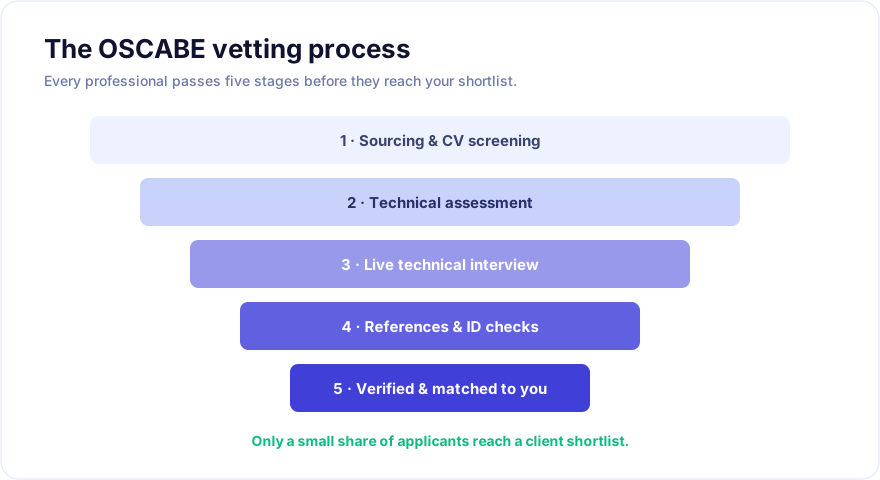
This is exactly the gap a structured, multi-stage vetting process closes. Sourcing and CV screening filter the obvious mismatches; a technical assessment and live interview confirm genuine depth; references and ID checks verify the credential is real; only then is the expert matched to your project. A title alone, taken on trust, is how unqualified evaluators slip into a pipeline.
How to manage calibration once you have the experts
Sourcing qualified experts is only half the problem. Two genuinely qualified people can still disagree, and uncontrolled disagreement poisons your training signal as surely as unqualified judgement does. Managing calibration is what separates a usable evaluation programme from a noisy one.
The controls that matter:
- A clear written rubric. Criteria with worked examples of good and bad outputs, so "correct" is defined for your use case, not assumed.
- Inter-annotator agreement. Measure how often experts agree; low agreement signals an unclear rubric or insufficient training.
- Adjudication. A senior reviewer resolves disagreements and feeds the resolution back into the rubric.
- A stable team. The same experts over time, so calibration compounds rather than resetting with each new contractor.
- Train before they start. Experts calibrate on your rubric and data before producing any live evaluation.
That last point is the decisive one. Training experts on your rubric before they produce live labels sharply reduces early-stage disagreement and is the difference between a benchmark you can trust and one you cannot. The same calibration discipline underpins a credible LLM evaluation and benchmark programme and, where harm is the focus, an AI red-teaming programme.
How OSCABE sources and manages vertical expert pods
OSCABE's AI Training Teams include dedicated Domain Expert AI Teams: managed pods of credentialed professionals who evaluate model outputs in their field. Every expert passes a five-stage vetting process before reaching your shortlist, so credentials are verified rather than assumed. The talent pool spans India and the Middle East and includes:
- CE-verified engineers for software and technical evaluation
- Chartered accountants (e.g. ICAI) for finance and accounting tasks
- IIT/NIT-trained ML and software experts for STEM and technical correctness
- Trained specialists for safety and red-teaming evaluation
Pricing is a transparent monthly fee:
| OSCABE managed pod | From (per month) | Focus |
|---|---|---|
| Coding RLHF Team | £6,000 | Code review and coding RLHF |
| Training Data Pipeline Team | £8,000 | Annotation and data pipelines |
| Domain Expert AI Team | £9,000 | Legal, medical, finance, STEM evaluation |
| RLHF Evaluation Team | £10,000 | Preference data, model eval, red-teaming |
That is roughly 75 to 80% cheaper than the effective cost of sourcing equivalent expert hours on per-hour gig platforms, with management and a UK contract included. Compared with recruiting credentialed professionals in-house, you avoid sourcing, credential verification, payroll, retention and management entirely. Under the "Trained First" model the pod calibrates on your rubric before any live evaluation, with 4 to 6 hours of daily overlap with UK hours. See how the staffing works on how it works.
Frequently asked questions
How do I source domain experts for AI evaluation in regulated verticals?
Identify the verticals that genuinely need credentialed experts (law, medicine, finance, STEM, coding), then engage a provider that can verify credentials and confirm real domain depth, not just a title. The most reliable route is a managed pod, like OSCABE's Domain Expert AI Team, where experts are vetted through a multi-stage process and trained on your rubric before they evaluate, so credentials are assured and you have a single point of accountability under one UK contract.
How do you vet a domain expert's credentials?
Go beyond the CV. Verify the qualification is genuine and current and confirm identity, then use a technical assessment or live interview to confirm working knowledge in the specific jurisdiction or sub-specialty you need, and a trial task to confirm they can apply your rubric. A structured five-stage process (sourcing, assessment, interview, references and ID checks, matching) closes the gap a title alone leaves open.
What happens if two qualified experts disagree?
Disagreement is normal and cannot be eliminated, but it must be controlled. A clear written rubric with worked examples, measured inter-annotator agreement, senior adjudication of conflicts, and a stable team that calibrates over time keep it in check. Training experts on your rubric before they produce live labels sharply reduces early disagreement.
How much does sourcing vertical experts cost?
On per-hour marketplaces, credentialed expert time is expensive and you still carry verification, calibration and management. OSCABE's Domain Expert AI Team starts from £9,000 per month and a Coding RLHF Team from £6,000, roughly 75 to 80% cheaper than gig-platform equivalents, with vetting, management and a UK contract included. See pricing for current figures.
Put verified, calibrated expertise behind your evaluation
In regulated and technical verticals, the people evaluating your model are the difference between a trustworthy system and one that confidently repeats subtle errors. A title taken on trust is not enough; verified credentials, confirmed depth and managed calibration are what make expert evaluation reliable.
To source vetted, calibrated vertical experts without owning the recruitment and management yourself, explore OSCABE's AI Training Teams or contact us. We will scope a Domain Expert AI Team, vetted through five stages and trained on your rubric, with transparent monthly pricing and a UK contract.