
To hire an LLM evaluation and benchmark team, you need people who can design evals that reflect your real use case, grade model outputs consistently against a rubric, and turn those judgments into benchmarks you can track across releases. The most reliable route is a managed evaluation pod, trained on your rubric before they start, rather than recruiting reviewers one by one, because consistency between graders is what makes a benchmark trustworthy. A managed pod gives you calibrated reviewers, a single point of accountability and a UK contract, from around £6,000 per month.
Below we explain what human evaluation and benchmarks are, how to design evals, how rubric grading works, why expert reviewers matter, and how in-house compares with a managed pod.
What is LLM evaluation?
Definition (model evaluation): Model evaluation is the process of measuring the quality of a model's outputs against defined criteria, such as accuracy, helpfulness, safety and instruction-following, using human judges, automated metrics, or both.
Definition (benchmark): A benchmark is a fixed, reusable set of tasks and grading criteria used to score models consistently, so you can compare versions over time and against alternatives on a like-for-like basis.
Automated metrics are cheap and fast, but they miss most of what matters for a real assistant: whether an answer is actually correct, genuinely helpful, safe and well-judged. Human evaluation captures that. The point is not a single pass/fail number; it is a repeatable measurement you trust enough to gate a release on. Building that trust is mostly about consistency between graders, which is why evaluation is as much a process discipline as a content one.
Human evals vs automated benchmarks
Most serious evaluation programmes use both, with humans where judgment is required and automation where it is sufficient.
| Approach | Strengths | Limits | Best for |
|---|---|---|---|
| Automated metrics | Fast, cheap, fully repeatable | Miss correctness, nuance, safety | Regression speed, broad coverage |
| Human evaluation | Captures correctness, helpfulness, safety | Slower, needs calibration | Quality gates, nuanced judgment |
| Human + model graders | Scales human judgment with checks | Needs validation against humans | Large-scale eval with human anchor |
The pragmatic pattern is to anchor on human judgment for the criteria that matter, use automation for speed and breadth, and validate any model-as-grader setup against human labels so you know it agrees with people. The human anchor is what keeps the whole programme honest.
How do you design an LLM evaluation?
A benchmark is only as good as its design. A poorly scoped eval produces a confident number that does not predict real-world quality. Good eval design follows a clear sequence.
- Define what "good" means for your use case. List the criteria (accuracy, helpfulness, safety, format, tone) and how to weigh them when they conflict. This is the foundation everything else rests on.
- Build a representative task set. Collect prompts that mirror real usage, including hard and edge cases, not just easy ones. A benchmark of easy prompts flatters every model.
- Choose a grading method. Decide between absolute rubric scoring, pairwise comparison against a reference, or a mix. Pairwise is more reliable for "is the new model better?"; rubric scoring is better for "does it meet our bar?".
- Write the rubric. Turn each criterion into concrete, gradable guidance with examples of passing and failing answers.
- Calibrate graders. Train reviewers on gold examples until their scores line up, before any live grading.
- Lock and version the benchmark. Freeze the task set and rubric so scores are comparable across releases, and version it when you change either.
For the comparison side specifically (using human-judged pairs to decide whether a new model is preferred), the foundations overlap heavily with preference data and pairwise comparison.
How does rubric grading work?
Rubric grading is where consistency is won or lost. A rubric converts a vague quality criterion into a repeatable judgment, so two reviewers scoring the same output reach the same answer.
What a strong rubric provides:
- Defined criteria. Each dimension (for example factual accuracy, completeness, safety) is described, not assumed.
- A scale with anchors. Each score point has a concrete description and an example, so "3 out of 5" means the same thing to everyone.
- Tie-breaking and edge rules. Guidance for ambiguous cases, partial credit and "both bad" situations, so reviewers do not improvise.
- Worked examples. Real graded answers showing how the rubric applies in practice.
The controls that keep grading consistent in production:
- Inter-annotator agreement. Measure how often reviewers agree; low agreement signals an unclear rubric or undertrained graders.
- Adjudication. A senior reviewer resolves disagreements and refines the rubric, so the standard sharpens.
- A stable team. The same reviewers over time, so calibration compounds instead of resetting with each new contractor.
- Train before live grading. Reviewers calibrate on your rubric first (OSCABE's "Trained First" model), so the benchmark is consistent from the first score.
Why expert reviewers matter
For general-purpose evaluation, strong generalist reviewers handle helpfulness, tone and format well. But for specialist domains, only a qualified reviewer can tell a subtly wrong answer from a correct one, and that is exactly where evaluation has to be trustworthy.
| Domain being evaluated | Risk with generalist graders | Suitable reviewer |
|---|---|---|
| General assistant quality | Low | Trained generalist reviewers |
| Coding / technical | Passes code that looks right but is wrong/insecure | CE-verified engineers |
| Legal | Misses jurisdiction-specific errors | Qualified lawyers / paralegals |
| Finance / accounting | Misses rules-based mistakes | ICAI chartered accountants |
| Medical / clinical | Misses plausibly dangerous answers | Clinicians, medical professionals |
| Safety / adversarial | Underrates harmful outputs | Trained red-teaming specialists |
If your graders cannot catch domain errors, your benchmark rewards confident-but-wrong answers and you ship on a number that does not mean what you think. This is the same logic behind hiring domain experts for AI model evaluation, and it pairs naturally with adversarial testing covered in our guide to hiring an AI red-teaming team.
In-house vs managed evaluation
The choice usually comes down to how often you re-evaluate and how specialised your criteria are. A one-off benchmark can be handled by a short engagement; an ongoing programme rewards a dedicated, calibrated team.
| Factor | In-house team | Managed pod (OSCABE) |
|---|---|---|
| Time to start | Slow (hire, train, calibrate) | Fast (pod trained on your rubric) |
| Grading consistency | Depends on retention | Stable, calibrated team |
| Domain coverage | Limited to who you hire | Domain experts on tap |
| Management overhead | You own it | Included |
| Cost model | Salaries, benefits, tooling | Transparent monthly fee |
| Accountability | Internal | Single point of accountability |
| Compliance / contract | Your responsibility | One UK contract, UK/EU GDPR |
For sustained evaluation, a managed pod usually wins on consistency and cost. For a broader provider comparison, see Mercor vs Surge vs OSCABE for AI training, and for the build economics, the true cost of an AI training data team.
How OSCABE staffs evaluation pods
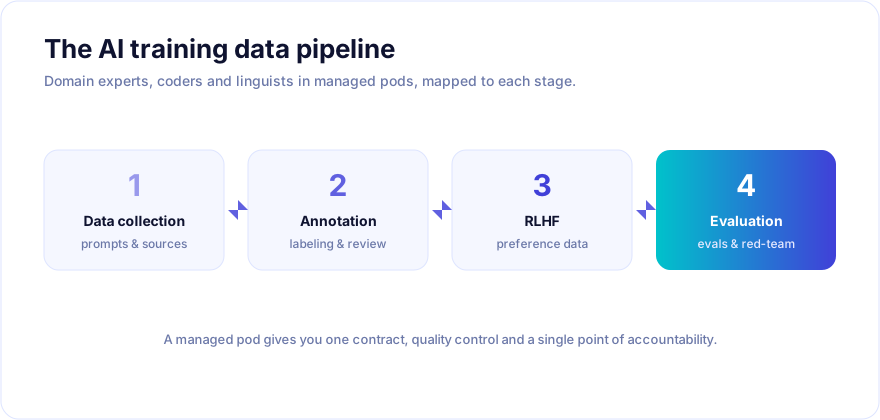
OSCABE's AI Training Teams include the RLHF Evaluation Team: a managed pod that designs evals, grades against your rubric and maintains benchmarks across releases. The talent pool spans India and the Middle East and includes:
- Trained, calibrated reviewers for rubric grading and human evals
- CE-verified engineers for coding and technical evaluation
- ICAI chartered accountants and IIT/NIT-trained experts for domain evaluation
- Trained specialists for safety and red-team evaluation
Pricing is a transparent monthly fee:
| OSCABE managed pod | From (per month) | Focus |
|---|---|---|
| Coding RLHF Team | £6,000 | Coding evaluation and review |
| Training Data Pipeline Team | £8,000 | Annotation and eval pipelines |
| Domain Expert AI Team | £9,000 | Legal, medical, finance, STEM evaluation |
| RLHF Evaluation Team | £10,000 | Human evals, benchmarks, preference data, red-teaming |
That is roughly 75 to 80% below the effective cost of sourcing equivalent expert hours on per-hour gig platforms, with management and a UK contract included. Because the same reviewers work your benchmarks month after month, calibration compounds and your scores stay comparable over time. See how it works and pricing.
Frequently asked questions
How do I hire an LLM evaluation team?
Start by defining what "good" means for your use case and building a representative task set, then decide whether you need a one-off benchmark or an ongoing programme. For an ongoing programme, the most reliable route is a managed evaluation pod, like OSCABE's RLHF Evaluation Team, trained on your rubric before it grades anything, so scores stay consistent across releases and you have a single point of accountability under one UK contract.
What is the difference between an eval and a benchmark?
An eval is any structured measurement of model quality; a benchmark is a fixed, reusable eval (a frozen task set plus rubric) you run repeatedly to compare versions over time on a like-for-like basis. You design evals first, then lock the ones that matter into versioned benchmarks so a score this month is comparable to one from last month.
Can I automate evaluation instead of using human reviewers?
Partly. Automated metrics and model-as-grader setups give you speed and breadth, but they miss correctness, nuance and safety, and any model grader needs validating against human labels to confirm it agrees with people. The pragmatic pattern is to anchor quality gates on calibrated human judgment and use automation for regression speed, keeping a human anchor so the programme stays honest.
How much does an LLM evaluation team cost?
On per-hour platforms, skilled grading is expensive once you add management and the cost of inconsistent scores. OSCABE's RLHF Evaluation Team starts from £10,000 per month and a Coding RLHF Team from £6,000 per month, roughly 75 to 80% cheaper than gig-platform equivalents, with management and a UK contract included. See pricing for current figures.
Put consistent judgment behind your benchmarks
A benchmark you cannot trust is worse than no benchmark, because it gives you false confidence to ship. Trust comes from consistency: a clear rubric, calibrated reviewers, and the right experts where judgment is hard. Get those right and your evaluation becomes a reliable release gate rather than a number nobody quite believes.
To put trained, calibrated reviewers behind your evals and benchmarks without the cost and overhead of building the capability yourself, explore OSCABE's AI Training Teams or contact us. We will scope an evaluation pod trained on your rubric, with transparent monthly pricing and a UK contract, so the scores that gate your releases stay consistent over time.