
To hire an AI red-teaming team for your LLM, you need adversarial specialists who deliberately try to break your model, find inputs that produce unsafe, biased or policy-violating outputs, and document them so you can fix the gaps before release. The fastest reliable route is a managed red-teaming pod, trained on your safety policy before they start, rather than recruiting individual testers one by one. A managed pod gives you consistent coverage, a single point of accountability and a UK contract, with pricing that starts from around £6,000 per month.
Below we explain what LLM red-teaming actually involves, the difference between adversarial and jailbreak testing, who provides red-teaming, how in-house compares with a managed pod, and what to look for when you hire.
What is LLM red-teaming?
Definition (red-teaming): Red-teaming is the deliberate, adversarial probing of a model to find inputs that produce unsafe, biased, incorrect or policy-violating outputs, so those weaknesses can be measured and fixed before deployment.
Where standard evaluation asks "is the model good?", red-teaming asks "how can I make it behave badly?". The two are complementary. Evaluation measures average quality on representative tasks; red-teaming hunts for the tail-risk inputs that average metrics never surface. A model can score well on a benchmark and still hand a user instructions it should refuse, leak training data, or produce confidently wrong advice in a regulated domain.
Red-teaming has become a standard step in responsible model development. The principle that aligning models to be helpful, honest and harmless requires careful adversarial human input is central to alignment research; see Anthropic's work on Constitutional AI and harmlessness for context on why structured human probing matters.
Adversarial testing vs jailbreak testing
People use "red-teaming", "adversarial testing" and "jailbreak testing" loosely, but they describe different (overlapping) activities. Understanding the distinction helps you scope what you actually need.
- Adversarial testing is the broad category: any deliberate attempt to elicit failure, including factual errors, bias, harmful content, privacy leaks and unsafe tool use.
- Jailbreak testing is a subset focused on bypassing the model's safety guardrails, getting it to do something it was trained to refuse, often through role-play framing, obfuscation, encoding tricks or multi-turn manipulation.
- Domain red-teaming probes for harm specific to a use case: a medical assistant that gives dangerous dosing, a coding assistant that emits insecure code, a finance bot that gives non-compliant advice.
A good programme covers all three. Pure jailbreak testing finds the dramatic failures; domain red-teaming finds the quieter, often costlier ones.
What does a red-teaming team actually produce?
Red-teaming is not just "try to break it". A professional team delivers structured, reusable outputs that feed back into training and release decisions.
| Output | What it contains | How you use it |
|---|---|---|
| Attack taxonomy | Categories of failure relevant to your model | Plan coverage, track over releases |
| Adversarial prompts | Concrete inputs that triggered failures | Reproduce and regression-test |
| Severity ratings | How harmful each failure is, on your scale | Prioritise fixes |
| Reproduction notes | Steps and conditions to reproduce | Hand to engineering |
| Coverage report | What was tested and what was not | Evidence for release sign-off |
| Preference / fix data | Better responses for the same prompts | Feed into RLHF and fine-tuning |
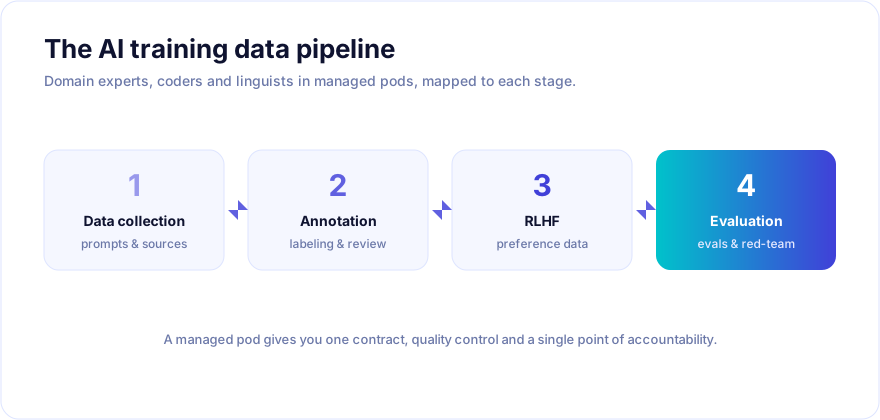
That last row matters: red-teaming and training are connected. The adversarial prompts a team finds become regression tests, and the corrected responses become preference data you can train against. This is why red-teaming sits naturally alongside the wider AI training data pipeline rather than as an isolated audit.
Who provides AI red-teaming?
There are three broad routes to red-teaming capacity, and they differ sharply on coverage, cost and control.
- Per-hour gig platforms (for example Mercor, Surge, Scale). You tap a marketplace of individual testers billed per hour or per task. Fast to start and large pools, but coverage depends on who you happen to draw, and the management and consistency burden sits with you.
- Build it in-house. Maximum control and IP retention, but you carry recruitment, training, tooling and process design, and red-teaming talent that combines security instinct with domain knowledge is genuinely hard to hire and retain.
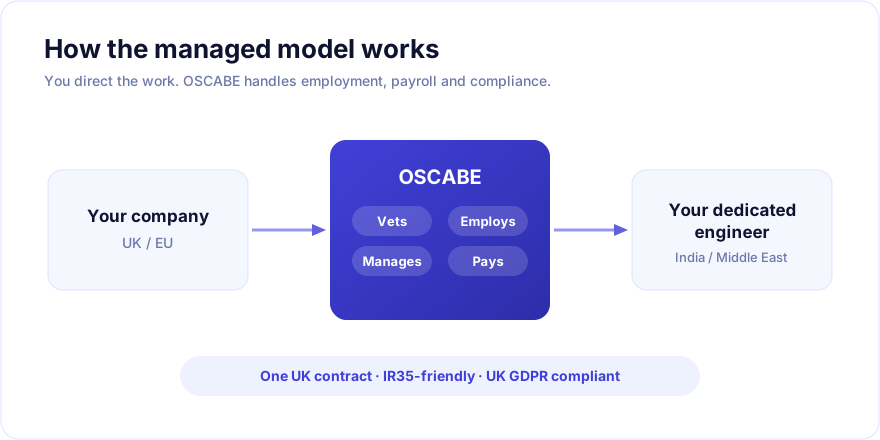
- Managed red-teaming pods (for example OSCABE). A dedicated, managed team is recruited, trained on your safety policy and run for you under one contract, so coverage is planned and consistent rather than ad hoc.
For sustained safety programmes (where you re-test every release), a managed pod usually wins on both coverage and cost. For a broader view of these routes, see our comparison of Mercor vs Surge vs OSCABE for AI training.
In-house vs managed red-teaming
The decision usually comes down to how often you ship and how specialised your risks are. A one-off pre-launch audit can be handled by a short engagement; an ongoing programme rewards a dedicated team that learns your model.
| Factor | In-house team | Managed pod (OSCABE) |
|---|---|---|
| Time to start | Slow (hire, train, tool up) | Fast (pod trained on your policy) |
| Coverage consistency | Depends on retention | Planned, stable team |
| Domain breadth | Limited to who you hire | Domain experts, coders, linguists |
| Management overhead | You own it | Included |
| Cost model | Salaries, benefits, tooling | Transparent monthly fee |
| Accountability | Internal | Single point of accountability |
| Compliance / contract | Your responsibility | One UK contract, UK/EU GDPR |
What to look for when you hire a red-teaming team
Not all red-teaming is equal. Volume of attempts is a weak signal; structured coverage and genuine expertise are the real ones. When you hire, look for:
- A coverage method, not just enthusiasm. Ask how they decide what to test and how they avoid blind spots. A taxonomy beats freestyling.
- Domain expertise where your risk lives. Adversarial testing of a clinical or legal model needs people who can recognise a subtly dangerous answer, not only an obviously rude one. This is the same logic behind hiring domain experts for AI model evaluation.
- Multilingual reach. Many jailbreaks exploit lower-resource languages where guardrails are weaker. A team that can probe in multiple languages finds failures an English-only team never will.
- Reproducibility. Findings you cannot reproduce cannot be fixed. Insist on clear reproduction notes and severity ratings on your scale.
- A feedback loop into training. The best programmes turn findings into regression tests and preference data, so each release is measured against the last.
- Confidentiality and compliance. You are sharing an unreleased model and sensitive prompts. A single contract with clear data handling matters.
How OSCABE staffs red-teaming pods
OSCABE's AI Training Teams include red-teaming as part of the RLHF Evaluation Team: a managed pod of trained specialists who adversarially probe your model, document failures and feed corrections back into your training data. The talent pool spans India and the Middle East and includes:
- Trained red-teaming and safety specialists
- CE-verified engineers for adversarial testing of coding models
- Domain experts (ICAI chartered accountants, IIT/NIT-trained experts) for high-stakes domains
- Linguists for multilingual jailbreak coverage
Pricing is a transparent monthly fee:
| OSCABE managed pod | From (per month) | Focus |
|---|---|---|
| Coding RLHF Team | £6,000 | Code review and coding RLHF |
| Training Data Pipeline Team | £8,000 | Annotation and data pipelines |
| Domain Expert AI Team | £9,000 | Legal, medical, finance, STEM evaluation |
| RLHF Evaluation Team | £10,000 | Preference data, model eval, red-teaming |
That is roughly 75 to 80% below the effective cost of sourcing equivalent expert hours on per-hour gig platforms, with management and a UK contract included. The pod is trained on your safety policy before it produces a single finding, so coverage is calibrated from day one. See how the staffing works on how it works and explore wider managed teams options.
Frequently asked questions
How do I hire an AI red-teaming team for my LLM?
Define your safety policy and the harms that matter most for your use case, decide whether you need a one-off audit or an ongoing programme, then engage a provider that can staff trained adversarial specialists with the right domain and language coverage. The most reliable route for an ongoing programme is a managed pod, like OSCABE's RLHF Evaluation Team, trained on your policy before it starts, so coverage is planned and consistent and you have a single point of accountability under one UK contract.
What is the difference between red-teaming and evaluation?
Evaluation measures average quality on representative tasks ("is the model good?"), while red-teaming adversarially hunts for the tail-risk inputs that make the model behave badly ("how can I break it?"). They are complementary: you need both. For the evaluation side specifically, see our guide to hiring an LLM evaluation and benchmark team.
Do I still need red-teaming if I use a safety-tuned base model?
Yes. Safety tuning on a base model reduces obvious failures, but your prompts, fine-tuning, tools and domain introduce new risks the base provider never tested. Jailbreaks also evolve continuously, and many exploit lower-resource languages where guardrails are weaker. Re-testing each release against your own policy is what keeps a deployed model trustworthy over time.
How much does an AI red-teaming team cost?
On per-hour marketplaces, skilled adversarial testing is expensive once you add management and the cost of inconsistent coverage. OSCABE's RLHF Evaluation Team, which includes red-teaming, starts from £10,000 per month, and a Coding RLHF Team from £6,000 per month, roughly 75 to 80% cheaper than gig-platform equivalents, with management and a UK contract included. See pricing for current figures.
Put a structured red-teaming pod behind your model
A model is only as safe as the worst input you have not tested. Volume of random attempts will not get you there; structured coverage by people who understand your risks will. Red-teaming also pays back twice, because every failure found becomes a regression test and a piece of preference data for the next release.
To put trained, calibrated adversarial specialists behind your model without the cost and overhead of building the capability yourself, explore OSCABE's AI Training Teams or contact us. We will scope a red-teaming pod trained on your safety policy, with transparent monthly pricing and a UK contract.