
The cost of an AI training data team in 2026 typically runs from a few thousand pounds a month for a small annotation effort to tens of thousands for a multi-stream RLHF, evaluation and red-teaming programme. The biggest cost drivers are data volume, the level of domain expertise required, and how much quality assurance you build in. A managed AI training pod through OSCABE starts from £6,000 per month, covering RLHF, data annotation, coding review and domain-expert evaluation under one UK contract.
This guide breaks down what an AI training team actually costs across RLHF, annotation and evaluations, compares in-house, vendor and managed-pod models, and explains the levers that move the price.
What does an AI training data team cost in 2026?
An AI training data team is not one role but a set of capabilities: people who collect and clean data, label and annotate it, generate preference data for RLHF, and evaluate model outputs. Cost depends on which of those you need, at what volume, and to what quality standard. There is no single price because the work scales with your model and your domain.
At the lower end, a small annotation or evaluation effort with generalist annotators can be staffed for a few thousand pounds a month. At the upper end, a programme that combines RLHF preference data, expert evaluation in a regulated domain, and continuous red-teaming can run to tens of thousands monthly. These are realistic ranges based on public market data and salary guides, not figures from a single named study.
The honest answer is that the cost of an AI training team is driven less by headline day rates and more by three structural factors: volume, domain expertise and QA. We cover each below.
What drives the cost of an AI training team?
Three levers move the price far more than the choice of provider does:
- Volume and throughput. More items to label, more prompts to score and more evaluation runs all scale cost roughly linearly until you hit quality bottlenecks. High throughput needs more people and tighter coordination.
- Domain expertise. Generalist annotators are relatively inexpensive. Coders reviewing model-generated code, clinicians evaluating medical answers, or lawyers checking legal reasoning cost far more, because the talent is scarce and the work cannot be done by non-experts.
- Quality assurance. Multi-pass review, inter-annotator agreement checks, gold-standard sets and adjudication all add cost but are what separate usable training data from noise. Cutting QA looks cheaper and usually is not.
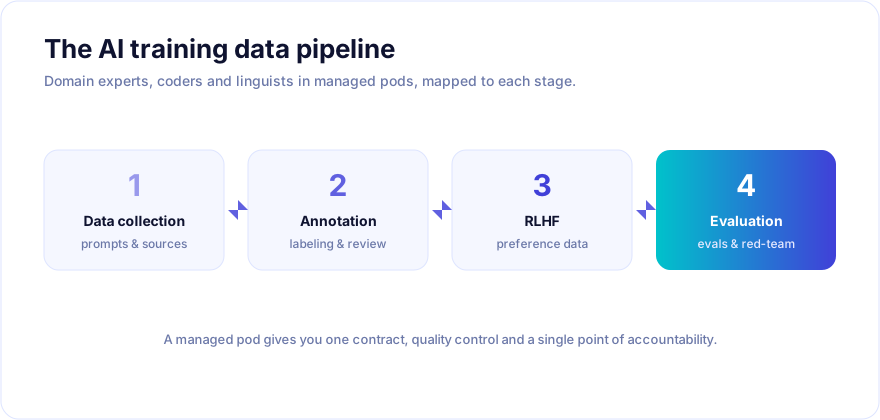
A useful mental model is that you are buying calibrated human judgement at a controlled error rate, not raw hours. The cheapest team that produces inconsistent labels is more expensive once you factor in re-work and the cost of training a model on bad data.
How much do RLHF, annotation and evals cost separately?
The table below shows indicative monthly cost bands for each workstream, staffed by a small dedicated team. Figures are illustrative 2026 ranges and depend heavily on volume, domain and QA depth. Specialist domains sit at the top of each band.
| Workstream | What it involves | Skill level | Indicative monthly cost (small team) |
|---|---|---|---|
| Data annotation / labelling | Classification, bounding boxes, transcription, tagging | Generalist to trained | £4,000 - £12,000 |
| RLHF preference data | Ranking and rating model outputs, writing comparisons | Trained to expert | £6,000 - £18,000 |
| Coding review / code RLHF | Reviewing and rating model-generated code | Software engineers | £8,000 - £22,000 |
| Domain-expert evaluation | Expert scoring in medicine, law, finance and similar | Domain specialists | £10,000 - £30,000+ |
| Model evaluation / benchmarking | Building evals, scoring runs, regression testing | ML-literate evaluators | £6,000 - £18,000 |
| Red-teaming / safety | Adversarial probing, harm and jailbreak testing | Specialists | £8,000 - £24,000 |
Most AI teams need a blend rather than a single stream, and the streams interact: good evaluation tells you where your RLHF and annotation effort should go next. For a deeper explanation of the techniques, see our guides to what RLHF is and who provides RLHF teams and the practical data annotation and labelling guide for AI.
In-house vs vendor vs managed pod: which is cheaper?
There are three ways to staff AI training data work, and each carries a different cost and risk profile.
| Model | What you get | Cost shape | Best for |
|---|---|---|---|
| In-house team | You recruit, employ and manage annotators and experts | High fixed cost, slow to scale, full control | Large, ongoing, highly sensitive programmes |
| Crowd / marketplace vendor | Access to a large pool of taskers, pay per task or per hour | Low headline rate, variable quality, QA on you | Spiky, high-volume, lower-sensitivity work |
| Managed pod | A dedicated, vetted team managed for you under contract | Predictable monthly fee, quality and management included | Ongoing, quality-critical or specialist work |
In-house gives the most control but the highest fixed cost and the slowest path to scale, because you carry recruitment, employment and management for a workload that often fluctuates. Crowd marketplaces show the lowest headline rate, but quality assurance, coordination and rework land on you, which frequently erodes the saving on anything requiring real expertise.
A managed pod sits between the two: you get a dedicated, vetted team with quality control and a single point of accountability, billed as one predictable monthly fee. For most AI companies that need consistent, specialist or quality-critical training data on an ongoing basis, the managed pod is the most cost-effective once rework and management overhead are counted. We compare named providers in Mercor vs Surge vs OSCABE for AI training, and the wider build-or-buy decision in build vs buy an AI data labelling team.
What does OSCABE AI Training cost?
OSCABE provides managed AI training pods from £6,000 per month, covering RLHF, data annotation, coding review and domain-expert evaluation under one UK contract. The pod is dedicated to you, vetted through a five-stage process, managed for quality and retention, and delivered with 4 to 6 hours of daily overlap with UK working hours.
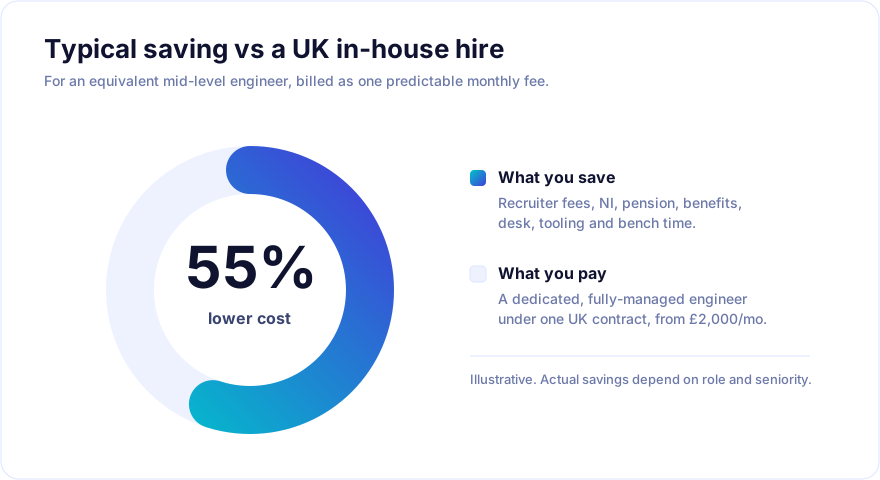
The advantage of the managed model for AI training specifically is that it bundles the three cost drivers into a controlled service. You direct what needs labelling, ranking or evaluating; OSCABE supplies the calibrated people, runs the QA, and keeps the team stable so a resignation is our problem rather than a gap in your data pipeline. Because the talent sits in cost-effective markets in India and the Middle East, you get expert judgement at a fraction of the UK or US fixed-cost equivalent. Explore the full service on the AI Training Teams page, or hire specific roles such as AI tutors, coding reviewers and LLM specialists.
For teams that also need to scale evaluation and benchmarking, see how we staff domain experts for AI model evaluation.
Frequently asked questions
How much does an AI training data team cost in 2026?
It ranges from a few thousand pounds a month for a small annotation effort to tens of thousands for a multi-stream RLHF, evaluation and red-teaming programme. The drivers are data volume, domain expertise and QA depth. OSCABE managed AI training pods start from £6,000 per month under one UK contract.
What is the most expensive part of AI training data work?
Domain-expert evaluation and expert RLHF, where you need clinicians, lawyers, financial specialists or experienced engineers rather than generalist annotators. The talent is scarce, so it sits at the top of every cost band. Quality assurance also adds cost but protects the value of everything else.
Is a managed pod cheaper than building an in-house AI training team?
For most ongoing, quality-critical workloads, yes. In-house carries high fixed cost and slow scaling, while a managed pod gives you a dedicated, vetted, managed team as one predictable monthly fee with QA included. Crowd marketplaces can be cheaper for spiky, lower-sensitivity volume but push quality control onto you.
What does OSCABE AI Training include?
A dedicated, managed pod covering RLHF, data annotation, coding review and domain-expert evaluation, vetted through five stages and managed for quality and retention, from £6,000 per month. Delivery is under one UK contract with UK GDPR-aligned handling and 4 to 6 hours of daily overlap with UK hours.
Scope your AI training programme at a sustainable cost
The true cost of an AI training data team is set by volume, expertise and QA, not by a single day rate, and the cheapest option on paper is rarely the cheapest once rework is counted. A managed pod gives you calibrated, specialist human judgement at a controlled error rate without the fixed cost of building an in-house team.
To scope an RLHF, annotation or evaluation programme for your model, contact OSCABE or explore our AI Training Teams from £6,000 per month. You can also browse the specialists we provide. We will give you a transparent monthly figure under one UK contract.