
Securing a remote engineering team rests on five controls: managed, encrypted devices, least-privilege access to systems, zero-trust networking instead of a flat VPN, clear rules for handling sensitive data, and disciplined offboarding that revokes everything the day someone leaves. Get these right and a distributed team in India or the Middle East can work on your most sensitive systems as safely as staff in your own office. This guide sets out each control in concrete, implementable terms for a UK or EU engineering leader.
Security worries are the most common reason companies hesitate to hire remote engineers. The good news is that remote security is a solved problem when approached deliberately, and a well-run remote setup is often more secure than the leaky office network it replaces.
What does securing a remote engineering team involve?
The old security model assumed a trusted office network behind a firewall, with everything inside treated as safe. Remote work makes that model obsolete, which is healthy, because it forces a better one: trust nothing by default, verify every access, and secure the device and the identity rather than the network perimeter. This is the foundation of modern security whether your engineers are down the corridor or in another country.
The core building blocks are:
- Managed devices. Company-controlled, encrypted machines with enforced security settings, so the endpoint is known and trusted.
- Strong identity. Single sign-on with multi-factor authentication everywhere, so access depends on verified identity rather than location.
- Least privilege. Each person can reach only what their role needs, granted just in time and reviewed regularly.
- Zero-trust access. Every request to a system is authenticated and authorised, rather than trusted because it came from inside a network.
- Data discipline. Clear rules on where data can live, who can see it, and how it is protected.
These controls map onto recognised frameworks such as ISO 27001 and SOC 2, which give you a structured way to demonstrate that they are in place. For how those certifications apply to offshore engagements specifically, see our guide to offshore team security with ISO 27001 and SOC 2.
Device security and MDM for remote engineers
The device is where work actually happens, so a known, controlled, encrypted endpoint is the foundation of remote security. The aim is simple: every machine touching your code or data is one you can configure, monitor and, if necessary, wipe remotely. Mobile device management makes this practical at scale.
A solid device baseline includes:
- Full-disk encryption enforced on every machine, so a lost or stolen laptop is not a breach.
- MDM enrolment to push security policies, manage updates and enforce configuration centrally.
- Endpoint protection with up-to-date anti-malware and the ability to detect and respond to threats.
- Automatic updates and patching so known vulnerabilities are closed quickly without relying on individuals.
- Screen lock, strong authentication and remote wipe so a device out of your hands can be secured fast.
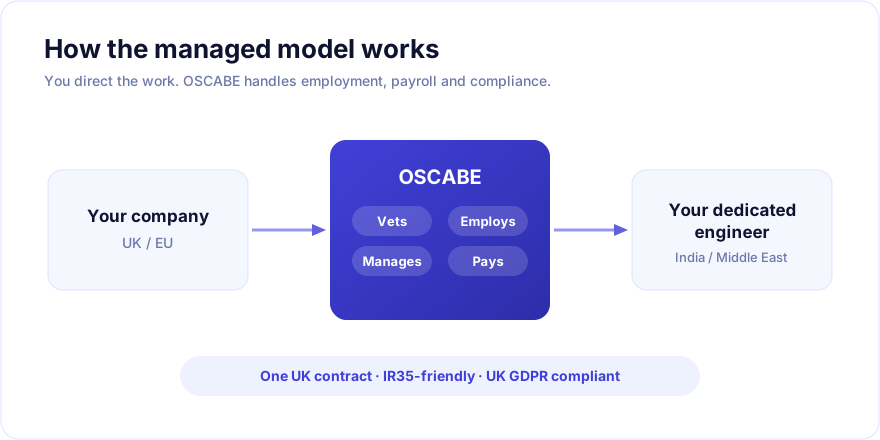
The principle that ties these together is that the company controls the device, not the individual, and ideally engineers do not use personal machines for sensitive work at all. With a dedicated, fully-managed team, this device baseline is provided and maintained as part of the engagement, so you are not relying on someone's home setup. That is a meaningful security advantage over hiring loose contractors who bring their own, unmanaged equipment.
Least privilege, VPN and zero-trust access
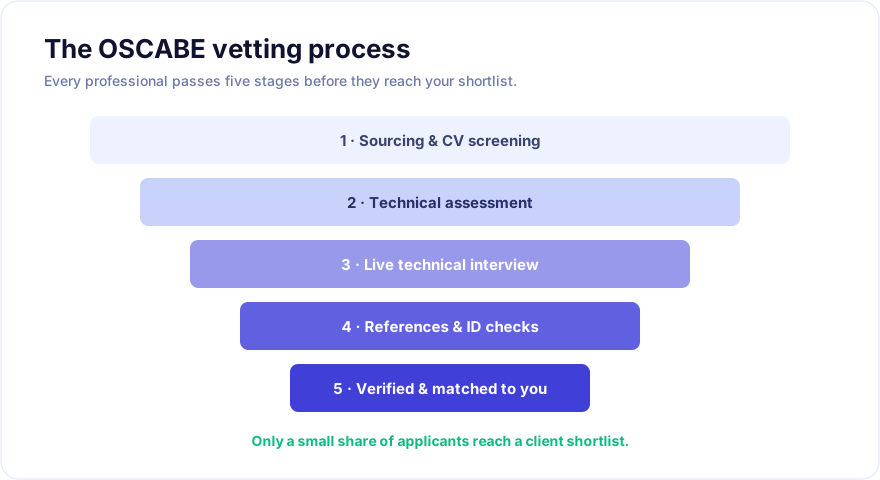
Access control is where most real-world breaches are won or lost. The guiding principle is least privilege: every person and system gets the minimum access needed to do the job, and nothing more. Combined with strong identity, this dramatically limits the damage any single compromised account can do. Least privilege is also more comfortable to grant when you know the people behind the accounts have been properly vetted, which on a managed team means a five-stage process including identity and reference checks before anyone touches your systems.
The table below contrasts the older perimeter approach with a modern zero-trust posture.
| Aspect | Traditional VPN perimeter | Zero-trust access |
|---|---|---|
| Trust model | Trusted once inside the network | Never trusted; every request verified |
| Access scope | Often broad network access | Per-application, least privilege |
| Identity | Network credentials | Strong identity plus MFA per access |
| Device check | Often none after connection | Device posture checked continuously |
| Blast radius if breached | Large; attacker is "inside" | Contained to what that identity can reach |
A flat VPN that drops a remote engineer onto your whole internal network is a liability: one compromised laptop and an attacker has broad reach. A zero-trust approach instead grants access application by application, checks identity and device posture on every request, and assumes no network is inherently safe. You do not have to rebuild everything overnight; start by putting strong identity and MFA in front of your most sensitive systems and tightening access scopes.
Practical access habits to adopt:
- Single sign-on with MFA for every system that supports it, with no shared accounts.
- Just-in-time and time-bound access for sensitive resources, rather than standing privileges.
- Regular access reviews to remove permissions people no longer need.
- Secrets in a vault, never hard-coded or shared over chat, with rotation when people change.
These access disciplines are exactly what auditors look for, and getting them right is the heart of demonstrating security to your own customers. They also need to operate smoothly across time zones, since access reviews and incident response have to fit your shared working hours; the scheduling side of that is covered in managing distributed teams across IST and GMT.
Data handling for distributed teams
Securing devices and access protects the systems; data handling rules protect the information itself. For UK and EU companies this is also a compliance question, because personal data carries GDPR obligations regardless of where the engineer sits. The aim is clear, written rules about what data engineers can access, where it can live, and how it must be protected.
Sensible data-handling practices include:
- Classify your data. Know what is sensitive or personal, and apply stricter controls to it.
- Minimise exposure. Engineers should work with the least sensitive data that does the job; use anonymised or synthetic data in development and testing wherever possible.
- Control where data lives. Keep production data in controlled environments, not on local machines, and be deliberate about where it is stored and processed.
- Encrypt in transit and at rest as a baseline everywhere.
- Log and monitor access to sensitive data so unusual activity is visible.
For UK and EU companies, working through a managed model under one UK contract simplifies the compliance picture considerably, because the contractual and data-protection responsibilities sit with a single, accountable UK entity rather than being scattered across foreign contractors. That makes it far easier to give your own customers and regulators clear answers about how their data is handled. The combination of minimised data exposure and a clean contractual structure is what lets distributed teams handle sensitive work confidently. Getting access provisioned correctly from the very first day is part of this; our remote engineer onboarding checklist covers how least-privilege access is set up on day one.
Offboarding and access revocation
Offboarding is the most overlooked part of remote security and one of the most important. Standing access from people who have left is a classic source of breaches. The rule is simple: the moment someone leaves the engagement, every credential, token and device access is revoked, ideally the same day and through a repeatable checklist so nothing is missed.
A clean offboarding checklist covers:
- Disable identity first. Switching off the central identity account immediately cuts most access in one step.
- Revoke tokens and keys. API tokens, SSH keys, personal access tokens and any credentials the person held.
- Rotate shared secrets. Anything the departing person could have known should be rotated promptly.
- Recover or wipe the device. Retrieve company hardware, or remotely wipe it if it cannot be returned.
- Confirm and record. Verify each access is gone and keep a record that offboarding was completed.
Doing this reliably depends on knowing exactly what each person had access to, which is why good access management and offboarding are two sides of the same coin. With a dedicated, fully-managed team, joiner and leaver processes are handled as a managed service, so revocation is prompt and consistent rather than dependent on someone remembering. That removes one of the most common gaps in remote security and gives you confidence that access ends cleanly when an engagement does. Security is not the only reason clean leaver processes matter: retaining the knowledge a departing engineer held is just as important, which is why we cover knowledge transfer and the bus factor on offshore teams separately.
Frequently asked questions
Is it safe to hire remote engineers offshore?
Yes, when you apply the right controls: managed encrypted devices, strong identity with MFA, least-privilege and zero-trust access, careful data handling and disciplined offboarding. These make a distributed team as secure as in-office staff, and often more so, since the alternative office network is frequently flat and over-trusted. A managed model under one UK contract also simplifies the compliance side.
What security controls should a remote engineering team have?
At minimum: company-managed, encrypted devices under MDM; single sign-on with multi-factor authentication; least-privilege, regularly reviewed access; zero-trust networking rather than a flat VPN; secrets stored in a vault; clear data-handling rules with data minimisation; and a same-day offboarding process. Mapping these to ISO 27001 or SOC 2 gives you a structured way to evidence them.
What is zero-trust access and why does it matter for remote teams?
Zero trust means no request is trusted simply because of where it comes from; every access to a system is authenticated and authorised, and device posture is checked each time. It matters for remote teams because there is no trusted office perimeter to rely on. It limits the blast radius if any single account or device is compromised, granting access application by application rather than opening the whole network.
How should you handle offboarding for a remote engineer?
Through a repeatable checklist run the day they leave: disable their central identity first, revoke all tokens and keys, rotate any shared secrets they knew, recover or remotely wipe their device, then verify and record that everything is done. Prompt, consistent revocation closes one of the most common security gaps. With a managed team, this is handled as part of the service.
Build a remote team that is secure by design
Securing a remote engineering team is not about trusting people less; it is about building a system where trust is verified rather than assumed. Managed devices, least privilege, zero-trust access, disciplined data handling and clean offboarding together let a distributed team work on your most sensitive systems with confidence.
If you want a dedicated, fully-managed remote engineering team that arrives with managed devices, least-privilege access and clean joiner-leaver processes under one UK contract, contact OSCABE or browse the engineers we provide. You can also see how the managed model builds security and compliance into the engagement from day one.