
In 2026, the synthetic-data-versus-human-labeled-data question is no longer either/or: synthetic data scales volume cheaply and is excellent for coverage and bootstrapping, while human experts still win decisively on reasoning quality, edge cases and safety judgement. The strongest pipelines are hybrid, using synthetic data for breadth and human-labelled data for the high-stakes signal that anchors quality. The fastest way to add reliable human judgement is a managed pod of vetted annotators and domain experts, trained on your rubric, from around £6,000 per month.
Below we define both data types, set out where each wins, explain why human experts remain essential for reasoning, edge cases and safety, and show how to combine them in a practical hybrid pipeline.
What is synthetic data and what is human-labeled data?
Definition (synthetic data): Synthetic data is training or evaluation data generated by a model rather than produced or labelled directly by people, for example prompts, responses, or preference comparisons created by an LLM.
Definition (human-labeled data): Human-labeled data is data that people create, classify, rank, correct or judge directly, such as expert preference rankings, written demonstrations, or correctness judgments in a specialised domain.
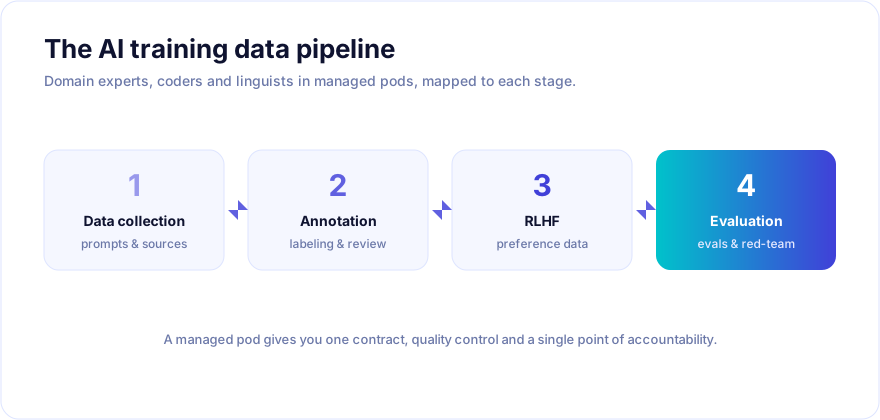
The two are not opposites so much as different tools. Synthetic data is fast and almost unlimited; you can generate millions of examples at the cost of compute. Human-labelled data is slower and costlier per item, but it carries something synthetic data cannot manufacture on its own: ground truth about what is actually correct, safe and useful in the real world. Most of the data annotation work that matters for modern models, from RLHF preference data to domain evaluation, sits on the human side for exactly this reason.
Where synthetic data wins
Synthetic data has earned its place, and dismissing it is as much a mistake as relying on it alone. It is strong where coverage and volume matter more than nuanced judgement:
- Volume and coverage. Generating large, varied datasets to cover formats, languages and surface patterns is fast and cheap.
- Bootstrapping. Seeding a new task or cold-start a model before you have human data to fine-tune on.
- Augmentation. Filling gaps and balancing classes where real examples are scarce.
- Privacy. Producing realistic-but-non-identifiable data where using real records would raise compliance issues.
- Cost per item. Once a generation pipeline is set up, the marginal cost of another example is low.
The catch is that synthetic data inherits the limitations of the model that produced it. It can reinforce existing biases, propagate confident errors, and drift away from reality if used to train successive generations without a human anchor. Quality control on synthetic data is therefore not optional, and that control is itself usually a human job.
Where human experts still win
For the parts of a model that determine whether it can be trusted, human experts remain ahead of synthetic data, and the gap is widest exactly where the stakes are highest.
Reasoning quality
A model generating its own training data can only express the reasoning it already has. It cannot reliably teach itself a standard of judgement it does not yet possess. Human experts supply genuinely better reasoning: a senior engineer's view of a clean solution, a clinician's sense of what is safe, an analyst's grasp of a subtle financial rule. This is the signal that lifts a model above its starting point rather than echoing it.
Edge cases
Synthetic generation gravitates to the typical and well-formed, because that is what the generating model finds most probable. The rare, adversarial and ambiguous cases, the long tail where models fail in costly ways, are precisely what synthetic pipelines under-sample. Human experts can deliberately seek out and label these edge cases, which is where real-world failures concentrate.
Safety judgement
Deciding whether an output is harmful, biased, or quietly dangerous is a judgement about real-world consequences, not a pattern a model can label about itself without circularity. Safety and red-teaming work depends on humans who understand context and intent. A model marking its own homework on safety is the weakest possible control.
This is the same reason high-stakes fields need domain experts for AI model evaluation: in law, medicine, finance and STEM, a plausible-sounding wrong answer is invisible to a generalist and to a generating model alike, but obvious to a qualified professional.
Synthetic vs human-labeled: a side-by-side comparison
| Dimension | Synthetic data | Human-labeled data |
|---|---|---|
| Cost per item | Low once set up | Higher per item |
| Scale / volume | Effectively unlimited | Bounded by people |
| Speed | Fast | Slower |
| Reasoning quality | Capped at the generating model | Can exceed the model |
| Edge-case coverage | Skews to typical cases | Can target the long tail |
| Safety judgement | Weak (self-referential) | Strong (real-world context) |
| Bias risk | Can amplify model bias | Mitigated by qualified judges |
| Best role | Coverage, bootstrapping, augmentation | Ground truth, evaluation, safety |
The pattern is clear: synthetic data is a volume and coverage tool; human-labelled data is a quality and trust tool. Treating either as a full substitute for the other is where pipelines go wrong.
How to run a hybrid pipeline
The practical answer in 2026 is to combine both deliberately, using each for what it does best. A workable hybrid pattern:
- Generate broadly with synthetic data. Use it for coverage, augmentation and cold-start, where volume matters most.
- Anchor with human-labelled gold. Have experts produce a high-quality gold set and rubric that defines what "correct" means for your task.
- Use humans to filter and verify synthetic data. Have qualified people review, correct or reject synthetic examples, so model-generated errors do not propagate.
- Reserve experts for the hard signal. Concentrate human effort on reasoning-heavy, edge-case and safety-critical data, where synthetic data is weakest.
- Evaluate with humans. Keep your benchmarks and final quality judgments human-anchored, because a model cannot be the sole judge of whether it has improved.
Done well, this gives you the cost and scale of synthetic data with the reliability of human judgement where it counts. The deciding factor is having qualified people available to anchor and verify, which is exactly the capability a managed expert pod provides. For the wider cost picture, see the true cost of an AI training data team in 2026.
How OSCABE supplies the human side of a hybrid pipeline
OSCABE's AI Training Teams provide the human-labelling and expert-judgement layer of a hybrid pipeline as managed pods, rather than per-task labour. A Training Data Pipeline Team or Domain Expert AI Team is recruited, trained on your rubric, and managed for you under one UK contract. The talent spans India and the Middle East and includes:
- CE-verified engineers for coding correctness and code data
- ICAI chartered accountants for finance and accounting judgements
- IIT/NIT-trained ML and software experts for STEM and reasoning-heavy tasks
- Trained specialists for safety, red-teaming and synthetic-data verification
Pricing is a transparent monthly fee:
| OSCABE managed pod | From (per month) | Focus |
|---|---|---|
| Coding RLHF Team | £6,000 | Code review and coding RLHF |
| Training Data Pipeline Team | £8,000 | Annotation, gold sets, synthetic verification |
| Domain Expert AI Team | £9,000 | Legal, medical, finance, STEM evaluation |
| RLHF Evaluation Team | £10,000 | Preference data, model eval, red-teaming |
That works out roughly 75 to 80% cheaper than the effective cost of equivalent expert hours on per-hour gig platforms, with management and a UK contract included. Under the "Trained First" model the pod calibrates on your rubric before producing live judgments, so the human anchor in your pipeline is reliable from day one. See how the staffing works on how it works.
Frequently asked questions
Is synthetic data good enough to replace human-labeled data?
For coverage, augmentation and cold-start, synthetic data is genuinely useful and often sufficient. But it cannot replace human-labelled data for reasoning quality, edge cases and safety, because a model generating its own data is capped by the judgement it already has and tends to under-sample the rare, hard cases where real failures occur. The reliable approach is hybrid: synthetic for breadth, human experts for the high-stakes signal.
Where do human experts still beat synthetic data?
Three areas above all: reasoning quality (experts can supply judgement a model does not yet have), edge cases (humans can deliberately target the long tail synthetic pipelines miss), and safety (judging real-world harm is not something a model can reliably label about itself). In specialised domains, only a qualified professional can tell a subtly wrong answer from a correct one.
What is a hybrid data pipeline?
A pipeline that uses synthetic data for volume and coverage while anchoring quality with human-labelled gold sets, having experts verify and filter synthetic examples, reserving human effort for reasoning-heavy and safety-critical data, and keeping evaluation human-anchored. It captures the scale of synthetic data and the reliability of human judgement at the same time.
How much does the human-labelling layer cost?
It depends on how specialised the judgement is. OSCABE's managed pods range from £6,000 per month (coding RLHF) to £10,000 (RLHF evaluation), roughly 75 to 80% cheaper than gig-platform expert hours, with management and a UK contract included. Most teams concentrate this spend on the high-value, reasoning and safety data where humans clearly win. See pricing.
Build a pipeline that scales and stays trustworthy
The synthetic-versus-human debate has a settled answer for 2026: use both, deliberately. Synthetic data gives you reach and low marginal cost; human experts give you the reasoning, edge-case and safety judgement that keeps a model honest as it scales. The risk is leaning so far into synthetic data that quality quietly drifts, with no human anchor to catch it.
To add the qualified human layer your hybrid pipeline needs, without recruiting and managing it yourself, explore OSCABE's AI Training Teams or contact us. We will scope a Training Data Pipeline or Domain Expert AI Team trained on your rubric, with transparent monthly pricing and a UK contract.