
To train a coding agent that actually fixes real bugs, you need software-engineer experts who can author SWE-bench-style tasks: real repositories, real issues, executable tests and verified gold patches that prove a fix works. The most reliable way to source that capability is a managed pod of vetted engineers who build fresh, held-out tasks on your stack, rather than scraping public benchmarks that models may already have seen. A managed coding pod gives you calibrated authors, a single point of accountability and a UK contract, from around £6,000 per month.
Below we explain what SWE-bench-style data is, why authoring beats labelling for agents, how to source and vet engineer-authors, why fresh tasks beat benchmark gaming, and how a managed pod is staffed.
What is SWE-bench-style coding-agent data?
Definition (SWE-bench-style task): A SWE-bench-style task is a self-contained software problem built from a real codebase, comprising the repository state, an issue describing the desired change, a test suite that fails before the fix and passes after it, and a verified reference patch. The model (or agent) is judged on whether its patch makes the tests pass.
This format matters because coding agents do not work in the abstract. They navigate a repository, read existing code, edit multiple files, run tests and iterate. A multiple-choice question about Python syntax tells you almost nothing about whether an agent can resolve a genuine GitHub issue across a 200-file project. SWE-bench-style tasks are valuable precisely because they are executable and end-to-end: success is verified by running code, not by a human guessing whether the answer looks right.
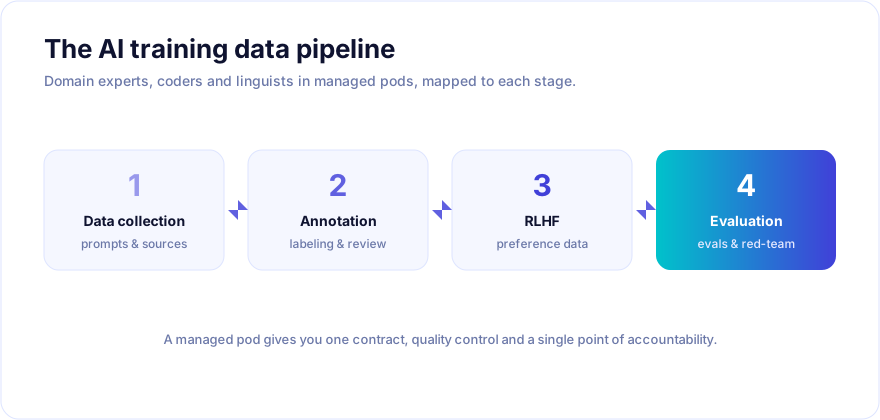
The same logic that drives RLHF and preference data applies here, but with a sharper edge. For agents, the strongest training and evaluation signal is grounded in execution, and constructing that signal requires people who can actually write, run and break real software.
Why authoring beats labelling for coding agents
Most data-annotation work is judgement on existing content: rank these two answers, tag this span, flag this image. Coding-agent data is different because the highest-value work is creation. An engineer has to:
- Find or construct a realistic issue in a real repository.
- Write or curate a test suite that genuinely captures the intended behaviour.
- Produce a reference patch that passes those tests and survives review.
- Document edge cases, failure modes and the reasoning behind the fix.
That is authoring, not labelling, and it cannot be done by someone who does not write production code. A non-engineer cannot be trained in an afternoon to tell whether a patch introduces a subtle race condition or a security regression. This is why generalist crowd labour breaks down for agent data, and why the talent profile looks more like a senior developer than a tasker. The same gap appears across coding review and code RLHF: the work is only as good as the engineer behind it.
What an engineer-author actually delivers
| Output | What it contains | How the model uses it |
|---|---|---|
| Task scaffold | Repo state, issue text, environment setup | Defines the problem the agent must solve |
| Fail-to-pass tests | Tests that fail pre-fix, pass post-fix | Executable success signal |
| Reference patch | Verified gold solution | Gold for supervised data and grading |
| Trajectory notes | How a human would navigate and fix | Demonstration and reasoning data |
| Edge-case log | Tricky inputs, near-miss solutions | Regression tests, harder eval splits |
| Difficulty rating | Calibrated complexity on your scale | Curriculum and benchmark design |
That trajectory and edge-case data is where real value sits. It teaches the agent not just the answer but the path, and gives you held-out splits a model cannot have memorised.
Why fresh expert tasks beat benchmark gaming
Public benchmarks have a contamination problem. Once a benchmark is widely known, its problems and solutions leak into training corpora, and a model can score well by recall rather than capability. A headline number on a public leaderboard can therefore overstate how good an agent really is on work it has never seen.
Fresh, expert-authored tasks fix this in three ways:
- No contamination. Tasks written privately on your repositories, or on recent code the model has not ingested, measure genuine problem-solving rather than memorisation.
- Relevance to your stack. Public benchmarks skew toward popular open-source Python projects. Your agent may need to handle your language, framework, internal conventions and tooling, which only bespoke tasks capture.
- Targeted difficulty. Experts can deliberately probe the failure modes you care about: multi-file refactors, flaky-test debugging, dependency upgrades, security-sensitive changes.
The practical implication is that benchmark scores and training data should both be refreshed continuously. A held-out set authored each cycle, kept private, is the only way to know whether your agent is improving or simply overfitting to a fixed target. This mirrors the discipline behind a good LLM evaluation and benchmark programme: the benchmark is only trustworthy if the model has not seen it.
How to source and vet engineer-authors
Authoring SWE-bench-style data is genuinely senior work, so sourcing is the hard part. There are three broad routes.
- Recruit individuals yourself. Maximum control, but you carry sourcing, technical vetting, environment setup, training and QA, and strong engineers are expensive and reluctant to do data work part-time.
- Per-task or per-hour marketplaces. Faster access to a pool, but task quality varies sharply with who you draw, and verifying that every patch and test suite is correct lands on you.
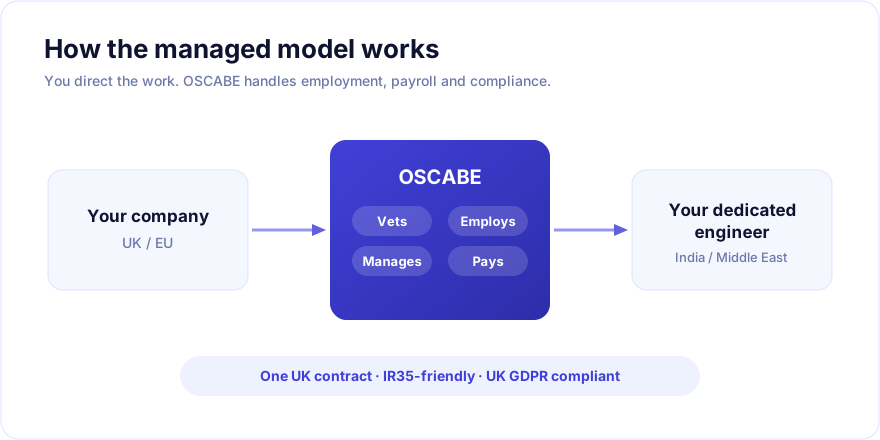
- Managed coding pods. A dedicated, vetted team of engineers is recruited, trained on your task spec and run for you under one contract, so output quality is consistent and the QA loop is built in.
Whatever route you choose, the vetting bar should be high. Look for engineers who:
- Can demonstrate real production experience, not just competitive-programming scores.
- Write clean, runnable tests and explain why a test captures the intended behaviour.
- Understand version control deeply (rebasing, isolating changes, minimal patches).
- Recognise security and correctness pitfalls a compiler will not catch.
- Document their reasoning clearly, because trajectory notes are part of the product.
In-house authoring vs a managed pod
The decision usually turns on whether agent data is a one-off push or an ongoing programme. A single benchmark refresh might be handled internally; a continuous pipeline of fresh tasks rewards a dedicated, calibrated team.
| Factor | In-house authoring | Managed pod (OSCABE) |
|---|---|---|
| Time to start | Slow (hire, set up, train) | Fast (pod trained on your spec) |
| Engineer quality | Limited to who you hire | Vetted, CE-verified engineers |
| Output consistency | Depends on retention | Planned, calibrated team |
| Environment & QA setup | You own it | Included |
| Cost model | Senior salaries, overhead | Transparent monthly fee |
| Accountability | Internal | Single point of accountability |
| Contract & compliance | Your responsibility | One UK contract, UK/EU GDPR |
For most teams shipping an agent on a release cadence, the managed pod wins on both quality and cost, because the same engineers learn your codebase and conventions and stay calibrated release after release. For the broader build-or-buy view, see build vs buy for an AI data-labelling team, and for full cost ranges, the true cost of an AI training data team in 2026.
How OSCABE staffs coding-agent data pods
OSCABE's AI Training Teams include managed Coding RLHF pods built specifically for code review and agent-data authoring. Engineers are sourced from India and the Middle East and pass a five-stage vetting process before they reach your project, so you get genuine production engineers rather than taskers. The pool includes:
- CE-verified software engineers for task authoring and patch review
- IIT/NIT-trained ML and software experts for harder, multi-file problems
- Engineers experienced in test design, CI and reproducible environments
- Reviewers for adjudicating gold patches and difficulty ratings
Pricing is a transparent monthly fee:
| OSCABE managed pod | From (per month) | Focus |
|---|---|---|
| Coding RLHF Team | £6,000 | Code review and coding-agent data |
| Training Data Pipeline Team | £8,000 | Annotation and data pipelines |
| Domain Expert AI Team | £9,000 | Legal, medical, finance, STEM evaluation |
| RLHF Evaluation Team | £10,000 | Preference data, model eval, red-teaming |
That is roughly 75 to 80% below the effective cost of sourcing equivalent senior-engineer hours on per-hour gig platforms, with management and a UK contract included. Under the "Trained First" model the pod calibrates on your task spec, repositories and rubric before authoring live data, with 4 to 6 hours of daily overlap with UK hours. See how the staffing works on how it works.
Frequently asked questions
How do I source engineers to write SWE-bench-style training data?
Decide whether you need a one-off benchmark refresh or an ongoing pipeline, then engage a provider that can staff vetted production engineers who can author real tasks, write fail-to-pass tests and verify gold patches. The most reliable route for an ongoing programme is a managed pod, like OSCABE's Coding RLHF Team, trained on your repositories and task spec before it authors a single task, so quality is consistent and you have a single point of accountability under one UK contract.
Why not just train on the public SWE-bench dataset?
Public datasets are useful for orientation, but once a benchmark is widely known its problems and solutions tend to leak into training corpora, so a model can score well by recall rather than capability. Fresh, privately authored tasks on your own stack measure genuine problem-solving, avoid contamination, and let you target the failure modes you actually care about.
What makes a good coding-agent task?
A real repository state, a clear issue, a test suite that genuinely fails before the fix and passes after it, a minimal verified reference patch, and notes on the trajectory and edge cases. The tests are the heart of it: they turn "did the model answer well?" into an executable, objective check, which is what makes agent data trustworthy.
How much does a coding-agent data pod cost?
On per-hour marketplaces, senior-engineer authoring time is expensive once you add management and the cost of verifying every task. OSCABE's Coding RLHF Team starts from £6,000 per month, roughly 75 to 80% cheaper than gig-platform equivalents, with management and a UK contract included. See pricing for current figures.
Put real engineers behind your agent data
A coding agent is only as good as the tasks it learns from and is measured against, and the strongest tasks are fresh, executable and authored by people who write production code. Scraped benchmarks invite gaming; bespoke expert tasks measure capability and keep measuring it as your agent improves.
To put vetted engineer-authors behind your coding-agent pipeline without recruiting and managing them yourself, explore OSCABE's AI Training Teams or contact us. We will scope a Coding RLHF pod trained on your repositories and task spec, with transparent monthly pricing and a UK contract.