
Offshore healthtech development can be fully HIPAA-aligned in 2026, provided you put the right Business Associate Agreements, access controls and a secure, vetted team in place before any protected health information is touched. The most reliable way to do this is a managed offshore pod governed by one contract with clear data-handling obligations, rather than a loose network of contractors where accountability is diffuse. A managed pod gives you vetted engineers, controlled access, a single point of accountability and a UK contract, from around £6,000 per month.
Below we explain how HIPAA applies to offshore teams, what a BAA must cover, how to design access controls around PHI, and how a secure managed team is structured.
Does HIPAA apply to offshore development teams?
Definition (HIPAA): The Health Insurance Portability and Accountability Act sets US standards for protecting health information. Its Privacy and Security Rules govern how protected health information (PHI) is used, disclosed and safeguarded.
Definition (PHI): Protected health information is individually identifiable health data, anything that links a person to their health, treatment or payment information.
HIPAA does not stop at a border. If your healthtech product handles PHI for US patients or providers, anyone who creates, receives, maintains or transmits that PHI on your behalf is a "business associate", regardless of where they sit. An offshore development team in India or the Middle East that can access PHI is therefore in scope, and you remain responsible for ensuring they meet HIPAA's requirements. Location does not exempt a team; it simply makes the contractual and technical controls more important.
The reassuring part is that HIPAA is a compliance-by-design problem, not a geographic prohibition. With the right agreements and access architecture, an offshore managed team can work on a healthtech product safely. The same logic that governs GDPR when hiring offshore developers applies here: the question is not "can we?" but "how do we structure it?".
What a Business Associate Agreement must cover
Definition (BAA): A Business Associate Agreement is the contract HIPAA requires between a covered entity (or business associate) and a downstream party that handles PHI, setting out how that party will safeguard it.
If your offshore team can touch PHI, a BAA is not optional. A sound BAA should address, at minimum:
- Permitted uses and disclosures. Exactly what the team may do with PHI, and nothing beyond it.
- Safeguards. The administrative, physical and technical controls the team will maintain.
- Subcontractor flow-down. A requirement that any further subcontractors are bound by equivalent terms.
- Breach notification. Clear obligations and timelines to report any suspected breach.
- Return or destruction of PHI. What happens to data when the engagement ends.
- Audit and cooperation. The right to verify compliance and cooperate with investigations.
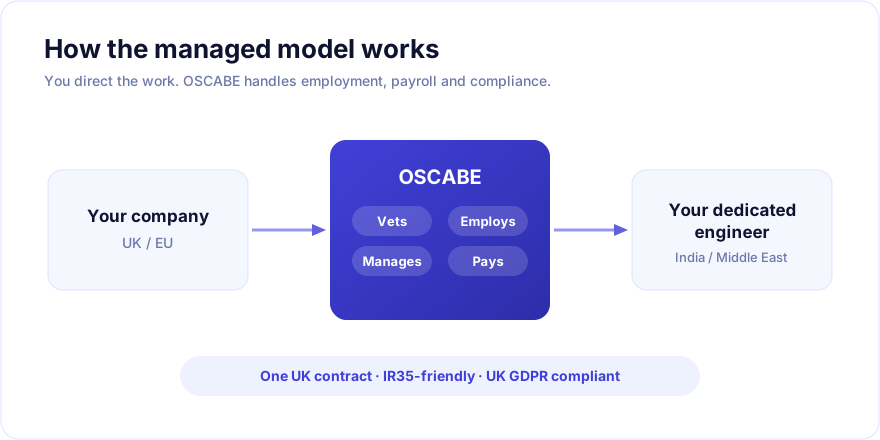
A single, clear contractual chain matters enormously here. When work is spread across loosely engaged contractors, the BAA chain becomes hard to enforce and breach accountability blurs. A managed model, where one entity employs the team and signs the agreements, keeps the chain tight and the accountability single. This is the same single-point-of-accountability principle that makes NDAs and confidentiality enforceable with offshore developers.
Designing access controls around PHI
The most effective HIPAA control is often the simplest: limit who can see PHI in the first place. A great deal of healthtech development does not require access to real patient data at all, and structuring work so that PHI exposure is the exception rather than the default sharply reduces risk.
Practical access-control measures:
- Minimum necessary access. Grant PHI access only to the specific people and systems that genuinely need it, for the narrowest scope and shortest time.
- De-identified and synthetic data for development. Let engineers build and test against de-identified or synthetic datasets wherever possible, reserving real PHI for tightly controlled cases.
- Role-based access control. Define roles and permissions so access maps to job function, not to whoever asks.
- Encryption in transit and at rest. Protect PHI everywhere it moves and lives, using strong, current standards.
- Audit logging. Record who accessed what and when, so access is reviewable and breaches are detectable.
- Secure environments. Where real PHI is involved, work inside controlled environments (such as managed virtual desktops) rather than on uncontrolled local machines.
These controls are not unique to offshore work, but they matter more when the team is distributed, and they are far easier to enforce with a managed team operating under defined security obligations than with an ad hoc contractor network. The broader security posture, including standards such as ISO 27001 and SOC 2, is covered in offshore team security with ISO 27001 and SOC 2.
Loose contractors vs a secure managed team
For healthtech specifically, the engagement model has direct compliance consequences. The table below compares the two common approaches.
| Factor | Loose contractor network | Secure managed pod (OSCABE) |
|---|---|---|
| BAA chain | Fragmented, hard to enforce | Single, clear contractual chain |
| Vetting | Variable, often self-reported | Five-stage vetting and ID checks |
| Access control | Inconsistent per contractor | Defined, role-based, auditable |
| Breach accountability | Diffuse | Single point of accountability |
| Data environment | Often local machines | Controlled, secure environments |
| Offboarding | Easy to overlook | Managed, with access revocation |
| Contract & jurisdiction | Many small agreements | One UK contract |
For a regulated domain like healthtech, the managed model is not just operationally simpler; it is materially easier to make compliant, because the controls HIPAA expects are built into a single, enforceable relationship rather than reconstructed across many. For an adjacent regulated example, see how this works in building an offshore fintech engineering team in 2026.
How OSCABE structures secure healthtech teams
OSCABE provides managed offshore managed teams for healthtech and other regulated domains, structured so that security and accountability sit with one entity under one UK contract. Engineers are sourced from India and the Middle East and pass a five-stage vetting process, including identity checks, before they reach your shortlist, so you know exactly who is on your team.
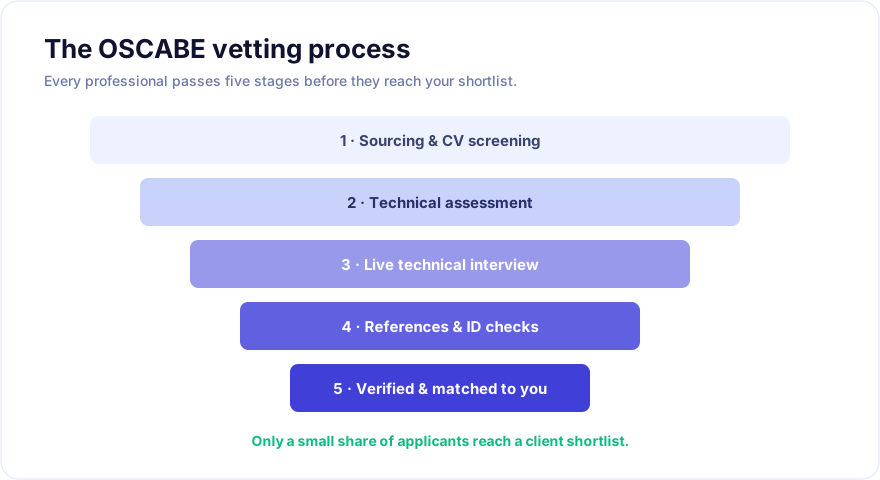
The managed model means OSCABE employs and manages the team while you direct the work, so the BAA chain, access controls and offboarding all flow through a single relationship. Pricing is a transparent monthly fee, with managed pods from £6,000 per month, and delivery includes 4 to 6 hours of daily overlap with UK hours. The talent available includes:
- Vetted full-stack, backend and mobile engineers for healthtech products
- DevOps and cloud engineers for secure, compliant infrastructure
- QA and test-automation specialists for safety-critical workflows
- Data and ML professionals for de-identified analytics and modelling
You can see the staffing approach on how it works and browse the specialists we provide. Because the team is managed for retention, a resignation is OSCABE's problem to solve rather than a gap and an access-control headache for you.
Frequently asked questions
Can offshore developers work on HIPAA-regulated healthtech?
Yes, provided the right controls are in place before any PHI is touched. Anyone handling PHI on your behalf is a business associate regardless of location, so you need a Business Associate Agreement, minimum-necessary access controls, encryption and audit logging, and ideally de-identified or synthetic data for development. HIPAA is a compliance-by-design problem, not a ban on offshore work, and a secure managed team makes it far easier to get right.
Do offshore developers need a BAA?
If they can create, receive, maintain or transmit PHI on your behalf, yes. The BAA must cover permitted uses, safeguards, subcontractor flow-down, breach notification, return or destruction of PHI, and audit cooperation. A managed model keeps the BAA chain single and enforceable, rather than fragmenting it across many small contractor agreements where accountability blurs.
How do you protect PHI with a distributed team?
Limit exposure first: grant minimum-necessary access, use de-identified or synthetic data for most development, and apply role-based access control. Then protect what remains with encryption in transit and at rest, audit logging, and secure controlled environments rather than uncontrolled local machines. These controls are far easier to enforce with a vetted, managed team operating under defined security obligations.
How much does a secure offshore healthtech team cost?
OSCABE's managed pods start from £6,000 per month as a transparent monthly fee, with vetting, management, security obligations and a UK contract included, typically well below the fixed cost of an equivalent in-house hire. The exact figure depends on the roles and seniority you need. Contact us for a scoped quote.
Build healthtech offshore without compromising compliance
Offshore healthtech development is entirely viable under HIPAA, but only when the agreements, access architecture and team security are designed in from the start. The risk is not the location of your team; it is a fragmented engagement where the BAA chain is weak and access is uncontrolled.
To build a vetted, secure offshore healthtech team under one UK contract, with the BAA chain and access controls handled through a single relationship, explore OSCABE's managed teams and the specialists we provide, or contact us. We will scope a secure managed pod for your product, with transparent monthly pricing and a single point of accountability.