
Building an offshore fintech engineering team in 2026 is entirely workable, but it has to be compliance-first: PCI-DSS for card data, FCA-aligned controls where you are regulated, and UK GDPR safeguards for personal data must be designed in from day one. The safest route for most UK and EU fintechs is a fully-managed model, where the provider handles employment, security and compliance under one UK contract. OSCABE managed fintech pods start from £7,500 per month with five-stage vetting.
This guide covers where to hire, the compliance frameworks that apply, how to vet engineers for fintech specifically, and how a managed model de-risks the whole engagement.
Can fintechs build offshore engineering teams compliantly?
Yes, and many already do. The misconception is that handling card data, financial transactions or regulated activity rules out offshore engineering. It does not. What it rules out is an unstructured engagement with weak controls. Regulators and standards bodies care about where data flows, who can access it, and how that access is governed, not about the postcode of the developer in isolation.
A compliant offshore fintech team rests on three pillars: a lawful basis and safeguards for any personal or financial data that leaves the UK, technical and organisational controls that satisfy PCI-DSS and your own security posture, and a contractual structure that keeps accountability clear. Get those right and an offshore team is no riskier than a UK one; get them wrong and a UK team would not save you either.
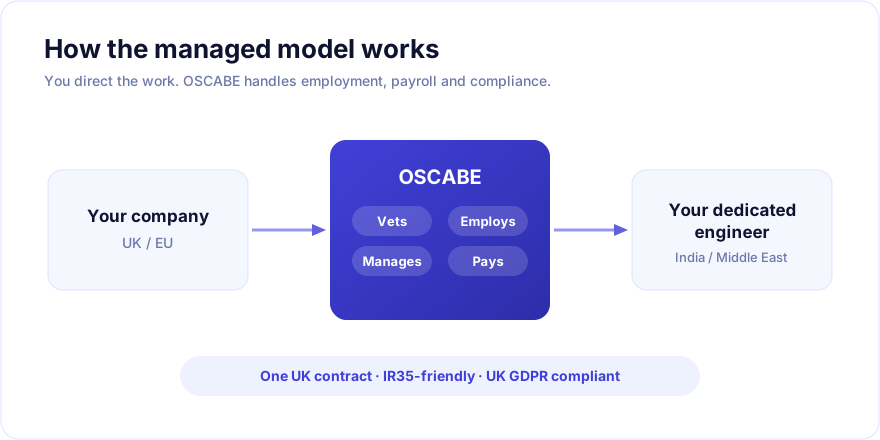
The fastest way to put all three in place is a managed service, because the provider already operates the employment, security and compliance layer you would otherwise have to build country by country.
What compliance frameworks apply to offshore fintech teams?
Fintech sits at the intersection of several regimes. The exact mix depends on what you do, but most teams need to consider the following.
| Framework | What it governs | Why it matters offshore |
|---|---|---|
| PCI-DSS | Handling, storing and transmitting cardholder data | Access controls, network segmentation and logging must extend to offshore engineers |
| UK GDPR | Personal data, including international transfers | Needs a transfer mechanism and a transfer risk assessment for non-UK processing |
| FCA rules (context) | Authorised activities, operational resilience, outsourcing | Outsourcing and third-party risk expectations apply to where development happens |
| ISO 27001 / SOC 2 | Information security management | Provides assurance to partners, banks and auditors over your supply chain |
| DORA (EU context) | Operational resilience for EU financial entities | Relevant for EU fintechs managing ICT third-party risk |
Two points deserve emphasis. First, for any personal data leaving the UK you need an appropriate transfer mechanism and a documented assessment of the destination, in line with the ICO's international transfers guidance. Second, if you are FCA-authorised, outsourcing and operational-resilience expectations mean you must be able to evidence control over where and how development is done; the FCA's own operational resilience materials are the reference point. None of this blocks offshore work, but it must be documented rather than assumed. For the data-protection mechanics specifically, see GDPR when hiring offshore developers.
Where should fintechs hire offshore engineers?
The strongest locations for a UK or EU fintech balance talent depth, time-zone overlap, English fluency and a credible compliance environment. India and the UAE/Middle East lead for most buyers.
India offers a deep pool of engineers with real fintech, payments and high-throughput systems experience, 4.5 to 5.5 hours of daily overlap with the UK, and widely spoken professional English. It is usually the best value for volume engineering, backend and data work. The UAE and wider Middle East offer maximum overlap with UK and EU hours, near-native business English, and a financial-services ecosystem that suits regulated and enterprise fintech; rates sit above India but well below Western Europe. We compare the region in detail in hiring remote developers in the Middle East and GCC.
The deciding factor for fintech is rarely the country in isolation. It is whether the engagement around the engineers carries the right security and compliance controls. That is where the delivery model matters more than the map.
How should you vet engineers for fintech?
Fintech vetting goes beyond a coding test. You are placing people close to sensitive financial and personal data, so identity, integrity and security awareness matter as much as technical skill. A robust process should cover:
- Identity and background verification, including right-to-work and reference checks appropriate to the jurisdiction.
- Technical assessment focused on secure coding, data handling, and the specific stack (payments, ledgers, APIs, cloud).
- A live technical interview that probes how the engineer reasons about security trade-offs, not just whether they can pass a puzzle.
- Security and compliance awareness, so the engineer understands why PCI-DSS segmentation or least-privilege access exists.
- Ongoing controls, including access governance, device security and audit logging once the engineer is working.
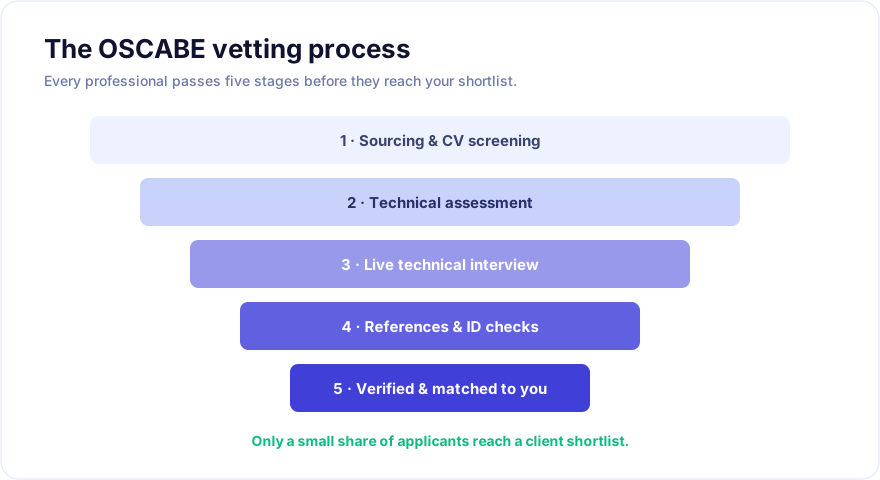
OSCABE runs a five-stage vetting process before any engineer reaches your shortlist, combining CV screening, technical assessment, a live technical interview, and references and ID checks. For fintech specifically, that screening is paired with security-aware delivery under one UK contract. For the broader assurance picture that banks and auditors look for, our approach aligns with recognised information-security practice; read our guide to hiring remote developers in India for UK companies for how the engagement is structured end to end.
How does a managed model de-risk offshore fintech?
A managed model de-risks an offshore fintech team by collapsing the employment, security and compliance burden into one accountable provider and one UK contract. Instead of standing up an entity, running payroll, and assembling controls in another country, you direct the work while the provider carries the rest.
The concrete benefits for a regulated or security-sensitive fintech are:
- One UK contract that keeps accountability and governance clear for auditors, banks and the FCA outsourcing lens.
- IR35-friendly structure, because a genuine managed B2B service is structured differently from inside-IR35 contracting; see the official IR35 guidance.
- UK GDPR-aligned handling with documented data-processing terms and appropriate transfer safeguards.
- Managed retention, so the people who hold context on your payment systems stay, and a resignation is the provider's problem to solve.
- Transparent, predictable cost as one monthly fee rather than a sprawl of local on-costs.
OSCABE delivers dedicated fintech pods from £7,500 per month, vetted, employed, managed and paid under one UK contract, with ISO 9001:2015 quality processes and UK GDPR-aligned handling. OSCABE LTD is verifiable on Companies House. Explore managed teams and pods to see how the model maps to your roadmap.
Frequently asked questions
Is it compliant for a fintech to use offshore engineers?
Yes, when structured correctly. You need appropriate UK GDPR transfer safeguards for personal data, PCI-DSS controls extended to offshore access where card data is involved, and a contractual structure that keeps accountability clear. A managed model puts all three in place under one UK contract, which is why it is the lowest-risk route for most fintechs.
Does PCI-DSS allow offshore developers to access cardholder data?
PCI-DSS does not prohibit offshore access, but it requires the same controls everywhere: strong access governance, network segmentation, least privilege, logging and monitoring. The practical approach is to minimise direct access to cardholder data and apply consistent controls regardless of where the engineer sits. A managed provider operating to recognised security standards makes that easier to evidence.
How does FCA outsourcing guidance affect offshore engineering?
If you are FCA-authorised, outsourcing and operational-resilience expectations mean you must understand and control your material third-party arrangements, including where development happens. That does not rule out offshore engineering; it means you must document the arrangement, assess the risk, and retain oversight. A single UK contract with a managed provider supports that far better than fragmented direct contracts.
What does an offshore fintech pod cost?
OSCABE managed fintech pods start from £7,500 per month, billed as one transparent fee covering employment, vetting, management, retention and UK GDPR-aligned compliance under one UK contract. Individual dedicated engineers start from £2,000 per month. There are no separate per-country compliance costs to add.
Build a fintech team that passes the audit
An offshore fintech engineering team is a sound strategy in 2026, but only if compliance is designed in rather than bolted on. PCI-DSS, FCA context and UK GDPR all point the same way: control where data flows, vet the people close to it, and keep accountability clear under one contract. A managed model delivers exactly that.
To scope a compliance-first fintech pod for your roadmap, contact OSCABE or browse the engineers we provide. We will give you a transparent monthly figure under one UK contract, with five-stage vetting and UK GDPR-aligned delivery included.