
To train computer-vision models and vision-language systems, you need a multimodal image and video annotation team that can draw accurate boxes, masks and keypoints, label across frames consistently, and caption or describe content with real understanding. The most reliable way to source that capability is a managed annotation pod, trained on your labelling guidelines before they start, rather than spreading work across an unmanaged crowd where quality and consistency vary. A managed pod gives you calibrated annotators, a single point of accountability and a UK contract, from around £6,000 per month.
Below we explain what multimodal annotation covers, how image and video differ, how to judge quality, what tooling matters, and how a managed pod is staffed.
What is multimodal image and video annotation?
Definition (multimodal annotation): Multimodal annotation is the human labelling of visual data, images and video, sometimes paired with text or audio, so that computer-vision and vision-language models can learn to detect, segment, track, classify or describe what they see.
Modern vision work spans a wide range of label types, and each demands different skill and tooling. Object detection needs tight bounding boxes; segmentation needs pixel-accurate masks; pose estimation needs precise keypoints; video understanding needs identities tracked consistently across frames. Vision-language models add another layer: captions, visual question-answer pairs, and grounded descriptions that link words to regions of an image.
This is annotation, but it sits at the more demanding end of the data annotation spectrum. The judgements are spatial and temporal rather than purely textual, and small inaccuracies compound: a slightly loose box or a mistracked object teaches the model the wrong thing thousands of times over.
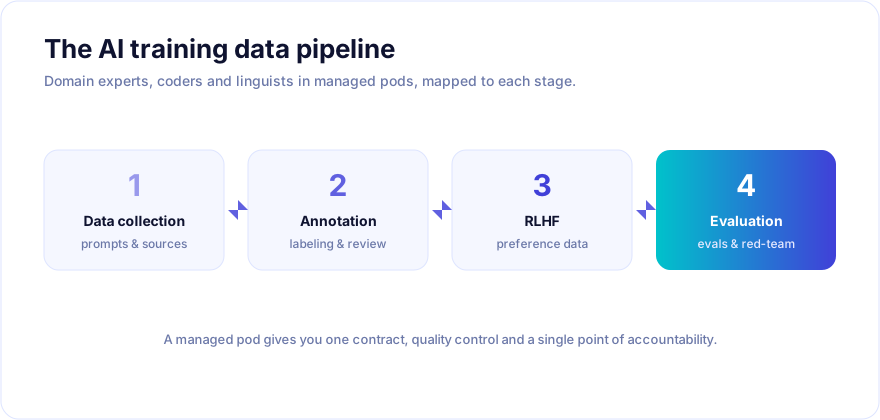
The main types of visual annotation
Different model goals need different labels, and the cost and skill rise with precision.
| Annotation type | What it produces | Typical use |
|---|---|---|
| Image classification | Whole-image category labels | Tagging, content moderation |
| Bounding boxes | Rectangular object regions | Object detection |
| Polygon / semantic segmentation | Pixel-level masks | Precise scene understanding |
| Instance segmentation | Per-object masks | Counting, occlusion handling |
| Keypoint / pose | Landmark points on objects or bodies | Pose, gesture, sports analytics |
| Video object tracking | Consistent IDs across frames | Surveillance, autonomy, AR |
| Action / event labelling | Temporal segments | Activity recognition |
| Captioning / VQA | Text descriptions, question-answer pairs | Vision-language models |
The higher up this ladder you go, the more annotator skill and calibration matter, and the less suited the work is to undifferentiated crowd labour. Pixel-accurate segmentation and reliable video tracking are skilled, attention-intensive tasks, not box-ticking.
How image and video annotation differ
Image annotation is challenging but bounded: each image is a single decision surface. Video annotation adds time, and time changes everything.
- Volume explodes. A single minute of 30fps video is 1,800 frames. Annotating every frame by hand is rarely viable, so teams interpolate between keyframes and correct the result, which is itself a skilled task.
- Temporal consistency is the hard part. An object must keep the same identity across frames even through occlusion, motion blur and lighting changes. Inconsistent IDs quietly poison tracking models.
- Edge cases multiply. Objects enter and leave frame, overlap, and change appearance. Deciding how to label a partly occluded or motion-blurred object needs a clear, well-understood guideline.
- Throughput planning matters. Because video is so much heavier, realistic throughput and a sampling strategy (which frames to label densely) are part of the job, not an afterthought.
The practical implication is that video annotation rewards a stable, trained team far more than image annotation does, because temporal consistency depends on the same people applying the same conventions over long sequences.
How to judge multimodal annotation quality
Headline price per label is misleading for visual data, because a cheap, loose label degrades the model and forces rework. Quality is measurable, and these are the controls that matter:
- Spatial accuracy. For boxes and masks, agreement against gold using overlap metrics (such as intersection-over-union), not just "looks about right".
- Inter-annotator agreement. How consistently independent annotators label the same image or clip. Low agreement signals an unclear guideline.
- Temporal consistency checks. For video, whether object identities hold across frames without drift or ID swaps.
- A clear, illustrated guideline. Edge cases (occlusion, truncation, ambiguous classes) defined explicitly with visual examples.
- Gold-standard items. Known-answer frames seeded to catch drift and bad actors.
- A stable team that calibrates. Agreement that improves over time rather than resetting with every new contributor.
A vendor that cannot describe these controls is selling you volume, not quality, and on visual data the cost of low quality is especially high because errors are spatial and repeat across an entire dataset. The discipline is the same one that underpins good LLM evaluation: measure agreement, define the rubric, and keep the team calibrated.
Tooling and workflow
Good visual annotation depends on the right tooling as much as the right people. The essentials:
- Capable annotation tools. Support for boxes, polygons, masks, keypoints and frame-by-frame video, with interpolation to make video tractable.
- Model-assisted labelling. Pre-labels from an existing model that humans correct, which can sharply increase throughput, with humans still owning final quality.
- Review and adjudication layers. A senior reviewer resolves disagreements and feeds resolutions back into the guideline.
- Secure data handling. Visual data is often sensitive (faces, locations, proprietary footage), so access control and a clear data-handling contract matter.
- Throughput tracking. Visibility of pace and quality together, so you can plan realistic timelines.
A managed pod typically brings the workflow and review structure with it, so you direct the labels you need rather than building the operation yourself.
In-house crowd vs managed annotation pod
The choice usually turns on volume stability and how specialised your data is.
| Factor | Unmanaged crowd | Managed pod (OSCABE) |
|---|---|---|
| Time to start | Fast but variable | Fast, trained on your guideline |
| Quality consistency | Varies with who you draw | Planned, stable team |
| Temporal consistency (video) | Hard to control | Same team across sequences |
| Management overhead | You own it | Included |
| Data sensitivity | Harder to control | One contract, controlled access |
| Cost model | Per task, plus your QA time | Transparent monthly fee |
| Accountability | Diffuse | Single point of accountability |
For ongoing or sensitive computer-vision work, especially video, a managed pod usually wins on quality-to-cost because calibration compounds and temporal consistency depends on a stable team. For the in-house decision, see build vs buy for an AI data-labelling team, and for full cost ranges, the true cost of an AI training data team in 2026.
How OSCABE staffs multimodal annotation pods
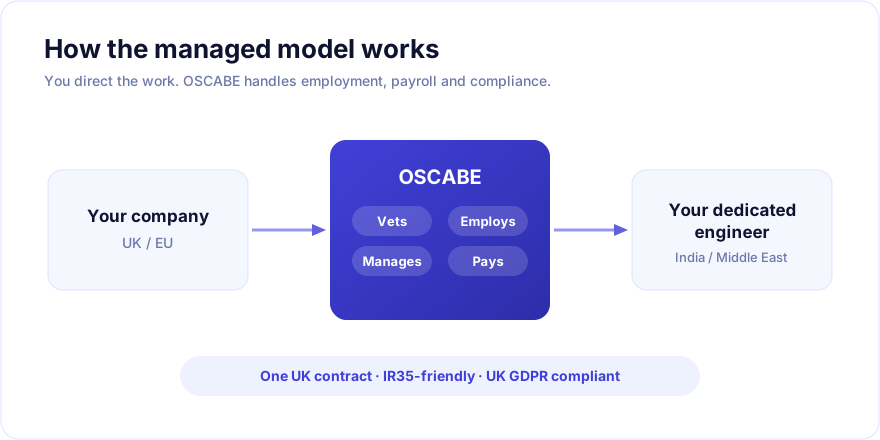
OSCABE's AI Training Teams deliver image and video annotation through managed Training Data Pipeline pods rather than per-task labour. The team is recruited, trained on your labelling guideline, and managed for you under one UK contract. Annotators are sourced from India and the Middle East and pass a five-stage vetting process. The pool includes:
- Trained visual annotators for boxes, masks, keypoints and tracking
- CE-verified engineers for technical and tooling-heavy datasets
- Linguists for multilingual captioning and vision-language data
- Reviewers for adjudication and quality control
Pricing is a transparent monthly fee:
| OSCABE managed pod | From (per month) | Focus |
|---|---|---|
| Coding RLHF Team | £6,000 | Code review and coding RLHF |
| Training Data Pipeline Team | £8,000 | Image and video annotation, pipelines |
| Domain Expert AI Team | £9,000 | Legal, medical, finance, STEM evaluation |
| RLHF Evaluation Team | £10,000 | Preference data, model eval, red-teaming |
That works out roughly 75 to 80% cheaper than the effective cost of equivalent annotation hours on per-hour gig platforms, with management and a UK contract included. Under the "Trained First" model the pod calibrates on your guideline before producing live labels, so quality and temporal consistency are protected from day one, with 4 to 6 hours of daily overlap with UK hours. See how the staffing works on how it works.
Frequently asked questions
How do I source a multimodal image and video annotation team?
Define your label types and a clear, illustrated guideline, decide whether your volume is steady or bursty, and engage a provider that can staff trained annotators with the right tooling and a review layer. For ongoing or video-heavy work, the most reliable route is a managed pod, like OSCABE's Training Data Pipeline Team, trained on your guideline before it produces live labels, so quality and temporal consistency are consistent and you have a single point of accountability under one UK contract.
Why is video annotation harder than image annotation?
Video adds time. A single minute can contain over a thousand frames, objects must keep the same identity across frames through occlusion and motion blur, and edge cases multiply as objects enter, leave and overlap. Temporal consistency is the hard part, and it depends on a stable, trained team applying the same conventions across long sequences, which is why video rewards a managed pod more than image work does.
How do I judge the quality of visual annotation?
Measure spatial accuracy against gold using overlap metrics, track inter-annotator agreement, check temporal consistency for video, insist on a clear illustrated guideline and gold-standard items, and look for a stable team whose agreement improves over time. A vendor that cannot describe these controls is selling volume, not quality.
How much does multimodal annotation cost?
It depends on label precision and volume. OSCABE's Training Data Pipeline Team, which covers image and video annotation, starts from £8,000 per month, and a Coding RLHF Team from £6,000, roughly 75 to 80% cheaper than gig-platform equivalents, with management and a UK contract included. See pricing for current figures.
Put a calibrated annotation pod behind your vision model
Computer-vision and vision-language models are only as good as the labels they learn from, and on visual data a loose box or a mistracked object repeats its error across the whole dataset. Volume from an unmanaged crowd will not get you there; calibrated, consistent annotation from a stable team will, especially for video.
To put a trained, managed annotation pod behind your model without building the operation yourself, explore OSCABE's AI Training Teams or contact us. We will scope a Training Data Pipeline pod trained on your labelling guideline, with transparent monthly pricing and a UK contract.