
Upwork and Fiverr are excellent for small, well-defined tasks with a clear brief and a short timeline, but they tend to break down once you need ongoing product work, consistent quality and clean intellectual-property ownership. At that point, graduating to a fully-managed dedicated remote team usually lowers your risk and your total cost, because a provider vets, employs, manages and retains the people for you. OSCABE places dedicated professionals from £2,000 per month and managed pods from £7,500 per month, all under one UK contract.
This guide is fair to Upwork and Fiverr, explains exactly where the marketplace model genuinely works, and shows the signals that mean it is time to move to a managed team rather than another freelancer.
Where do Upwork and Fiverr genuinely work?
Freelance marketplaces are a brilliant fit for a specific shape of work, and it is worth being honest about that before describing the limits.
- Small, defined deliverables. A logo, a landing page, a one-off script, a data clean-up: anything with a crisp brief, a clear "done", and little dependence on your wider codebase.
- Short timelines and low coupling. Work that does not need deep context on your systems, and where a handover at the end is simple.
- Trying something cheaply. Validating an idea or filling a one-week gap without committing to a hire.
For that kind of work, the marketplace model is fast, flexible and cost-effective, and there is no reason to over-engineer it. The friction starts when the work stops being a discrete task and becomes ongoing product development that depends on accumulated context.
When do freelance marketplaces break down?
The marketplace model breaks down in a handful of predictable situations, and recognising them early saves a lot of pain.
- Ongoing product work. The moment you need someone to hold context on your codebase across months, the per-task marketplace model fights you, because freelancers churn and context resets.
- Consistency and quality. Quality on marketplaces varies widely between providers, and you carry the cost of vetting, rework and managing inconsistent output.
- Coordination at scale. Stitching several freelancers into one coherent team is a management job you end up doing yourself, with no single point of accountability.
- Availability and retention. A freelancer juggling several clients can deprioritise you, go quiet, or disappear mid-project, leaving a gap you have to fill from scratch.
- IP and compliance. Default marketplace terms and a chain of individual contractors can complicate intellectual-property ownership and UK or EU compliance.
When two or three of these are true at once, you are usually paying a hidden tax in management time, rework and risk that dwarfs the low headline rate. That is the signal to graduate to a managed team. For the broader category context, see offshore vs nearshore vs managed team.
Marketplace vs managed team: risk, quality and IP
The table below compares the two models on the dimensions that matter most once work becomes ongoing. Figures are typical 2026 ranges from public market data and vary by role and region.
| Factor | Upwork / Fiverr (freelance marketplace) | Managed remote team (OSCABE) |
|---|---|---|
| Best for | Small, defined tasks | Ongoing product work |
| Who manages the work | You | OSCABE, to your goals |
| Quality consistency | Varies by provider | Standardised, five-stage vetting |
| Vetting | You do most of it | Included, role-specific |
| IP ownership | You must secure it per contract | Assigned to you under one UK contract |
| Availability | Shared across clients | Dedicated to you |
| Retention / replacement | You manage | OSCABE manages |
| Typical cost | Low per task, variable | From £2,000/month all-in per professional |
| Compliance / GDPR | Largely your responsibility | Handled under one UK contract |
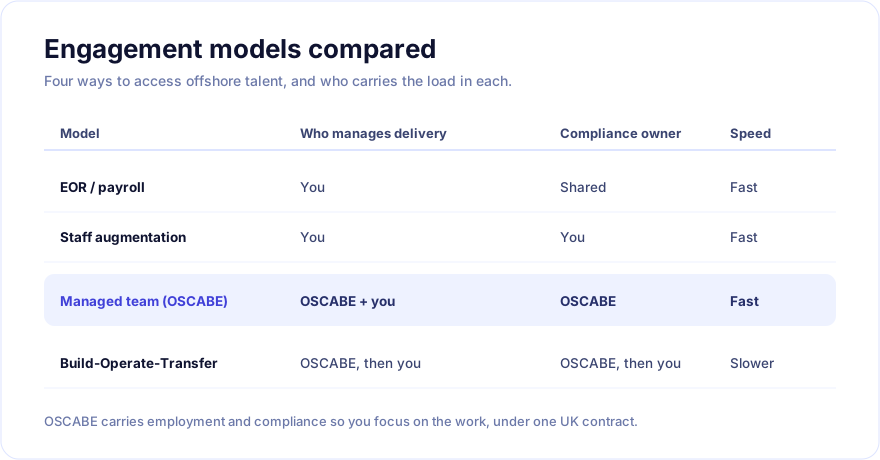
The point is not that a managed team is always better; it is that the two models suit different work. For a one-off task, a marketplace is the right tool. For a team you depend on, a managed model removes the risk, quality and IP problems that the marketplace pushes back onto you. See managed teams and pods.
Why a managed team lowers risk on quality and IP
Once work is ongoing, three risks dominate, and a managed model is designed to absorb each of them.
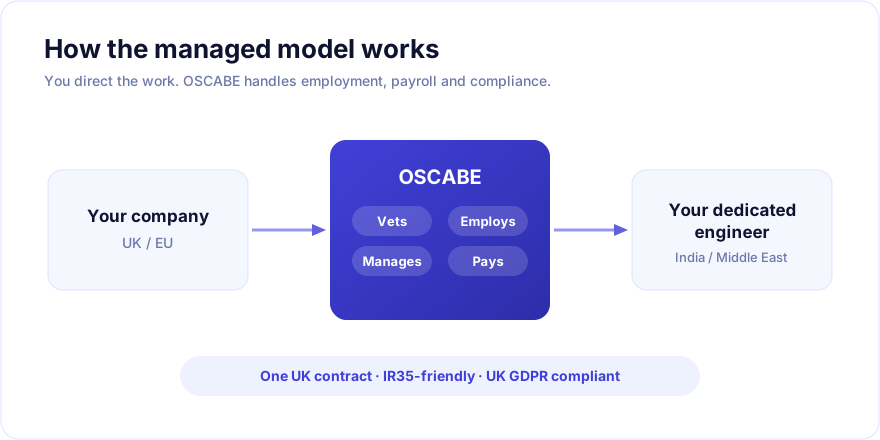
Quality risk. On a marketplace you vet each freelancer yourself and absorb the cost of inconsistent output. A managed provider applies one standard to everyone. OSCABE uses a five-stage process: CV screening, a technical assessment, a live technical interview, and references and identity checks, with matching typically inside 72 hours, and it stands behind the result with replacement.
IP risk. With a chain of individual freelancers, you must make sure each contract assigns intellectual property to you, and gaps are easy to miss. A managed team consolidates this: work is delivered under one UK B2B contract with clear IP assignment and confidentiality terms, so ownership is not left to a patchwork of marketplace agreements.
Retention and continuity risk. A freelancer who leaves takes their context with them and leaves you re-hiring. With a managed team, retention is the provider's responsibility, and if someone moves on, replacement and knowledge transfer are handled for you. That continuity is what turns a year of work into compounding context rather than repeated onboarding. For how to bring a managed team up to speed quickly, see how to onboard an offshore development team in 30 days.
On compliance, UK buyers should note that the marketplace model can leave you assessing employment status yourself; a genuine managed B2B service is structured to be IR35-friendly, per the official IR35 guidance. OSCABE delivers under one UK contract with UK and EU GDPR-aligned handling, and OSCABE LTD is verifiable on Companies House.
How to graduate from marketplace to managed team
Moving from freelancers to a managed team does not have to be a big-bang switch. A sensible path looks like this:
- Keep using marketplaces for genuine one-off tasks. There is no need to retire them; they remain the right tool for small, defined work.
- Identify the work that has become ongoing. Wherever you have re-hired the same skill three times, or where context loss keeps costing you, that is a candidate for a dedicated team member.
- Start with one or two dedicated professionals. Move the ongoing, context-heavy work to a managed dedicated hire from £2,000 per month, and keep the marketplace for the rest.
- Grow into a pod when the surface justifies it. When a product area needs a small cross-functional team, a managed pod from £7,500 per month gives you that as a unit. For the growth path, see scaling a startup engineering team with offshore pods.
The aim is to match each kind of work to the right model: marketplaces for tasks, a managed team for the product you depend on.
Frequently asked questions
Is Upwork or Fiverr good enough for ongoing development work?
For genuinely small, defined tasks, yes. For ongoing product development that depends on context, consistency and clean IP, marketplaces tend to break down, because freelancers churn, quality varies and management falls to you. At that point a managed dedicated team usually lowers both risk and total cost.
How is IP handled differently in a managed team versus a marketplace?
On a marketplace you must secure intellectual-property assignment in each individual contract, and gaps are easy to miss across a chain of freelancers. A managed team consolidates delivery under one UK B2B contract with explicit IP assignment and confidentiality terms, so ownership is clear rather than stitched together per engagement.
Will a managed team cost more than freelancers?
Per task, freelancers look cheaper. For ongoing work, a managed team is often cheaper on total cost once you account for vetting, rework, management time and churn. OSCABE places dedicated professionals from £2,000 per month all-in and managed pods from £7,500 per month, with management, retention and compliance bundled in.
Can I keep using marketplaces and a managed team together?
Yes, and many companies do exactly that. Keep Upwork or Fiverr for small one-off tasks, and move the ongoing, context-heavy work to a managed dedicated team. Matching each kind of work to the right model is usually cheaper and lower-risk than forcing everything through one of them.
Graduate the work that has outgrown a marketplace
Upwork and Fiverr are genuinely good for small, defined tasks, and there is no reason to stop using them for that. But once work becomes ongoing, and quality, availability and IP start to matter, a managed dedicated team removes the risks the marketplace hands back to you, under one UK contract with transparent pricing.
To work out which of your roles have outgrown a marketplace, contact OSCABE or browse the engineers we provide. We will give you one GBP or EUR figure per professional or pod, with five-stage vetting, clean IP assignment and management included.