
The best technical interviews are structured, job-relevant and scored against a written rubric agreed before anyone meets a candidate. Use a short, paid take-home to test real-world quality, a collaborative live session to test reasoning, and a scorecard per competency to keep the decision evidence-based rather than vibes-based. Structure is what separates a fair, predictive process from an expensive lottery.
Unstructured interviews, where each interviewer improvises and then forms a gut feeling, are among the weakest predictors of performance and among the most exposed to bias. The fix is not more rounds; it is better-designed ones. This guide sets out how to structure your loop, what signals to trust, when to use take-homes versus live coding, and how scorecards reduce both bad hires and unfair ones.
Structure beats intensity
The instinct when a hire goes wrong is to add another round. The better move is to make each existing round structured: the same questions, the same rubric and the same evidence captured for every candidate. Structured interviews are consistently more predictive than unstructured ones in public market data and industry research, because they compare like with like instead of comparing how much you happened to click with someone.
A structured loop has three properties. First, every interviewer knows which competency they own, so you are not running the same conversation four times. Second, questions are written in advance and reused, so candidates are measured on the same yardstick. Third, evidence is recorded before scores are discussed, which stops the room from anchoring on the first loud opinion.
Designing the interview loop
A lean loop for a mid-to-senior engineer has four touchpoints, each owning a distinct competency. More than that and you lose strong candidates to fatigue and slow scheduling; fewer and you miss a signal.
| Round | Competency it owns | Format | Time |
|---|---|---|---|
| Recruiter or hiring-manager screen | Role fit, motivation, logistics | Conversation | 30 min |
| Work sample | Real-world coding quality, tests, ambiguity | Short paid take-home | 2-4 hrs candidate time |
| Technical deep-dive | Reasoning, system design, trade-offs | Live, collaborative | 60 min |
| Behavioural and code review | Communication, feedback, ways of working | Live | 45 min |
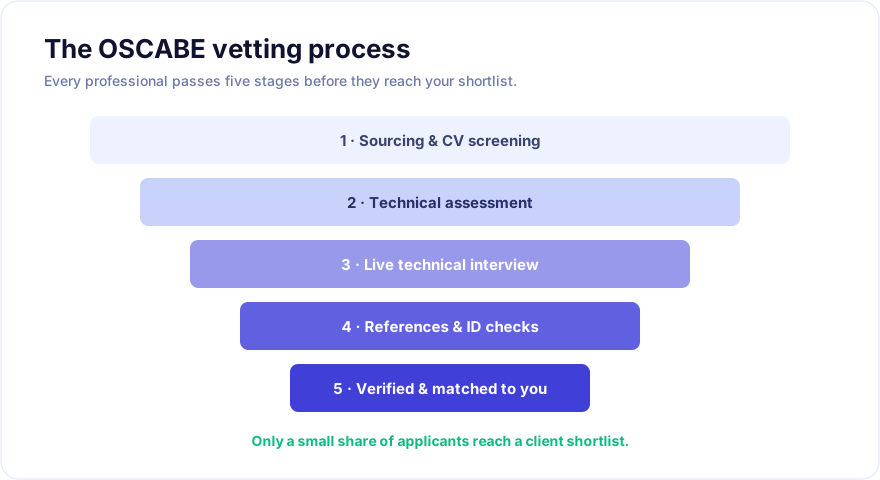
Map every round to something the person will actually do in the job. If a round does not test a competency you have written down, cut it. We pair this loop with the wider assessment funnel in our five-stage framework to vet software engineers.
Signal versus noise: what to measure
The hardest discipline in interviewing is ignoring confident noise. Many traits that feel like signal in the room are actually artefacts of background, nerves or interview practice.
- Trust: how the candidate handles an ambiguous brief, the trade-offs they name unprompted, the quality and tests in their work sample, and how they respond to feedback in review.
- Discount: speed on a memorised puzzle, polish of slides, shared alma mater or hobbies, and verbal confidence untethered from substance.
- Beware the halo: one brilliant answer should raise your interest, not pre-decide the verdict. Capture it as evidence in its competency and let the rest of the loop stand.
A useful test for any interview question: would a great engineer who solves real problems with documentation open do well on it? If your question punishes that person in favour of someone who memorised patterns, it is noise.
Take-homes versus live coding
This is the most-argued question in technical hiring, and the honest answer is that they test different things and a good loop uses both, in moderation.
A take-home reveals how someone works when they have time, tools and quiet: real-world structure, tests, edge cases and judgement about ambiguity. Its risks are length and fairness; a sprawling take-home filters for free time rather than skill, and an unpaid one filters out people with caring responsibilities or a current job.
Live coding reveals reasoning, communication and how someone thinks under mild pressure. Its risk is that a high-pressure, adversarial format measures interview nerves, not engineering. Make it collaborative: pair on a realistic problem, allow a search engine and documentation, and intervene as a colleague would.
| Format | Best for | Main risk | How to do it well |
|---|---|---|---|
| Take-home | Real-world quality, tests, autonomy | Length, unpaid burden, fairness | Cap at 2-4 hrs, pay for it, score on a rubric |
| Live coding | Reasoning, communication, pragmatism | Measuring nerves not skill | Pair collaboratively, allow docs, no gotchas |
| Live system design | Senior judgement, trade-offs | Rewarding memorised diagrams | Use a real domain problem, probe failure modes |
For most roles, a short paid take-home plus one collaborative live session is the sweet spot. Avoid stacking a long take-home on top of multiple live coding rounds; that is how strong candidates drop out.
Scorecards and structured decisions
A scorecard turns opinions into evidence. Define three to five competencies for the role, write what a weak, solid and strong answer looks like for each, and have every interviewer score only the competency they owned, in writing, before any group discussion.
The mechanics matter:
- Each interviewer submits independently before the debrief, so the room does not anchor on the loudest voice.
- Scores are evidence-backed: a number with a sentence of what the candidate actually said or did.
- The debrief discusses disagreements, not averages. Two interviewers split on "communication" is a signal to examine, not to mean away.
This is also your strongest defence against bias and a sensible record if a hiring decision is ever questioned. The structure itself, asking everyone the same questions against the same bar, is what reduces the influence of background and rapport.
Reducing bias in practice
Bias rarely shows up as overt prejudice; it shows up as "culture fit" standing in for "people like me". Structure is the antidote, and a few concrete habits help.
Write questions and rubrics before you see the shortlist, so the bar is set on the role, not on a candidate. Standardise the loop so everyone faces the same rounds. Replace "culture fit" with "values add" and define the specific behaviours you mean, such as how someone collaborates or handles disagreement. Where practical, anonymise the work sample so it is scored on the code, not the name. For distributed and offshore hiring, judge written asynchronous communication on clarity rather than accent, a point we expand on in scaling a startup engineering team with offshore pods.
When a managed model does the interviewing for you
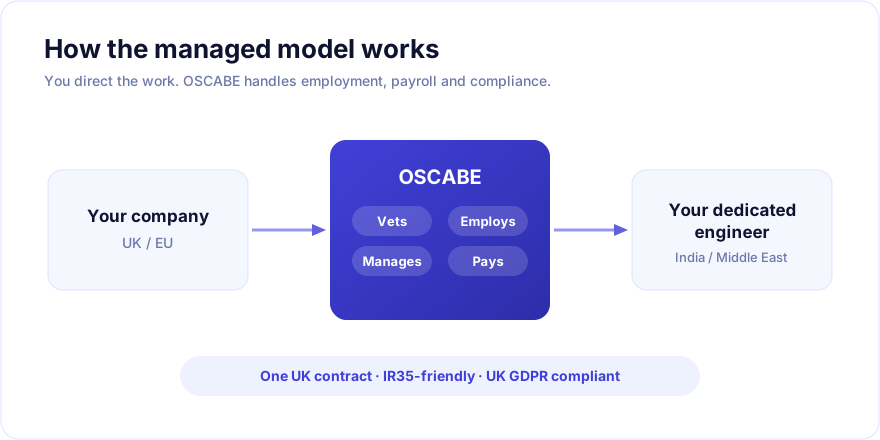
Running this well takes real time from your senior engineers, the very people whose hours are scarcest. A managed provider absorbs the loop and presents only candidates who have passed it.
OSCABE applies structured, rubric-based assessment for both technical ability and the communication needed to work across a 4 to 6 hour overlap with UK and EU teams. You direct the work and keep the final call; we run the structured vetting, employ the engineer and handle replacement if the fit is wrong. A dedicated, fully-managed engineer starts from around £2,000 per month under one UK contract, and matching typically happens within around 72 hours. See /how-it-works or browse /engineers, and for whole teams see knowledge transfer and bus-factor risk in offshore teams.
Frequently asked questions
How many interview rounds should a technical loop have?
For most mid-to-senior roles, four touchpoints are enough: a screen, a short paid work sample, a live technical deep-dive and a behavioural-plus-code-review round. Each should own a distinct competency, and any round that does not test something the person will actually do should be cut. Long loops with five or more live rounds lose strong candidates to fatigue and slow scheduling without adding predictive signal.
Should a take-home test be paid?
Yes, for anything beyond a trivial exercise. Paying for a two-to-four-hour take-home signals respect for the candidate's time, widens your pool to people with current jobs or caring responsibilities, and lets you ask for enough work to get a real signal. An unpaid, sprawling take-home quietly filters your applicants by free time rather than skill, which works against both fairness and quality.
How do scorecards reduce hiring bias?
Scorecards force every interviewer to assess the same competencies against the same written bar and to submit evidence-backed scores independently before any group discussion. That removes the two biggest sources of bias in unstructured interviews: anchoring on the first strong opinion in the room, and substituting vague "culture fit" for measurable behaviour. The result is a decision based on what candidates did, not on how familiar they felt.
How do you interview remote and offshore engineers fairly?
Use the same structured loop and rubric you would use locally, then assess written asynchronous communication explicitly because that is how distributed teams operate day to day. Judge clarity, not accent, and run the live rounds within the working overlap so you see the candidate at their best. Where vetting and compliance are handled by a managed provider, much of this is already complete; see our guide to hiring remote developers in India.
Hire without running the loop yourself
If structured interviewing is eating your senior engineers' time, let us carry it. OSCABE vets, interviews and manages dedicated engineers from India and the Middle East under one UK contract, presenting only candidates who have passed a structured, rubric-based process. Tell us what you are hiring for on /contact and browse vetted profiles on /engineers.