
The SLAs and KPIs that actually matter for a managed remote team fall into four categories: delivery velocity, quality and defects, responsiveness, and retention. Set clear, measurable expectations in each, review them on a regular cadence, and you can hold a provider to outcomes rather than activity. A good managed provider should welcome this, because the whole point of the model is that it owns delivery, performance and retention on your behalf. OSCABE delivers dedicated managed teams under one UK contract, with pods from £7,500 per month and dedicated professionals from £2,000 per month.
This guide gives you a practical four-category framework, sensible metrics in each, and the difference between a service-level agreement (what the provider commits to) and a key performance indicator (what you measure), so you can manage a remote team on evidence rather than vibes.
SLAs vs KPIs: what is the difference?
The two terms are often used interchangeably, but keeping them distinct makes governance much cleaner.
- An SLA (service-level agreement) is a commitment the provider makes, often with a target and sometimes a remedy attached, for example "code review turnaround within one working day" or "a vetted replacement proposed within an agreed window if someone leaves".
- A KPI (key performance indicator) is a metric you track to understand whether delivery is healthy, for example sprint predictability, defect escape rate, or team retention. Not every KPI needs an SLA; some are simply signals you watch.
The sensible approach is to agree a small number of SLAs on the things that genuinely need a commitment (responsiveness, replacement, security), and track a slightly wider set of KPIs as a health dashboard. Too many hard SLAs create perverse incentives; too few leave you with no recourse when something slips. For where managed delivery sits among the options, see staff augmentation vs managed team vs BOT.
A four-category metric framework
The framework below organises metrics into four categories. Treat the targets as illustrative ranges to adapt to your context, not absolutes, and agree your own thresholds with the provider.
| Category | What it measures | Example metrics | Typical SLA or target |
|---|---|---|---|
| Velocity | Predictable throughput | Sprint commitment met, cycle time, throughput trend | Commitment met most sprints; stable cycle time |
| Quality / defects | Output that holds up | Defect escape rate, change failure rate, test coverage | Low and falling defect escape rate |
| Responsiveness | Collaboration within hours | Review turnaround, response time in overlap, blocker resolution | Reviews within one working day |
| Retention | Continuity of the team | Team retention, replacement time, knowledge continuity | Replacement proposed within an agreed window |
The value of grouping metrics this way is balance. Optimise velocity alone and quality suffers; optimise quality alone and delivery stalls; ignore responsiveness and a distributed team feels remote; ignore retention and you lose context every time someone leaves. A healthy managed team performs across all four. See managed teams and pods.
Velocity: measuring predictable delivery
Velocity is about predictability, not raw speed. A team that reliably delivers what it commits to each sprint is far more valuable than one that occasionally sprints fast and then stalls.
The metrics worth tracking are sprint commitment met (how often the team delivers what it planned), cycle time (how long a unit of work takes from start to done), and the throughput trend over several sprints. The signal you want is stability and a gentle upward trend as the team gains context, not a single heroic week. A new team will be slower while it learns your codebase; judge velocity against its own trend, not against a long-term baseline in the first month. For getting a team productive quickly, see how to onboard an offshore development team in 30 days.
A practical caution: avoid turning story points into a hard SLA. Points are a planning tool, not a contract, and putting a number target on them invites inflation. Track predictability and cycle time instead, and discuss the trend in your regular review.
Quality and defects: measuring output that holds up
Quality metrics tell you whether the velocity is real or borrowed against future rework. The most useful are defect escape rate (defects that reach production rather than being caught earlier), change failure rate (how often a change causes a problem), and test coverage on critical paths as a supporting indicator.
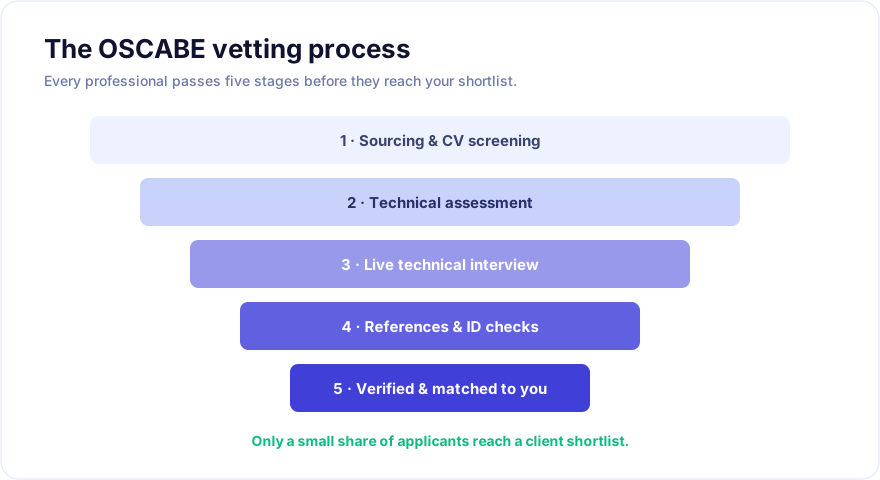
Quality starts before any metric is measured, at the point of vetting. A team selected through a rigorous process produces fewer defects to begin with, which is why quality and vetting belong together. OSCABE's five-stage process, covering CV screening, a technical assessment, a live technical interview, and references and identity checks, is designed to put capable engineers on your team from the start, so your defect metrics begin from a strong baseline rather than being a clean-up exercise.
The target to agree is a low and falling defect escape rate, with a shared definition of what counts as a defect. Watch the trend: a managed team that is genuinely improving should show defects falling as context deepens, not creeping up as corners get cut to hit velocity.
Responsiveness and retention: the distributed-team metrics
These two categories are where managed remote teams specifically succeed or fail, because they are about collaboration across distance and continuity over time.
Responsiveness is about how quickly the team engages within your working day. The metrics that matter are code review turnaround (a common SLA is review within one working day), response time during the overlap window, and how fast blockers get resolved. This is where the 4 to 6 hours of daily overlap OSCABE provides pays off: with a real overlap window, questions get answered live rather than waiting a day for an async round-trip. Agree a clear responsiveness SLA and the distance largely disappears in practice. For the mechanics of working across time zones, see scaling a startup engineering team with offshore pods.
Retention is the metric most buyers forget until it bites. Team retention, the time to propose a vetted replacement, and knowledge continuity when someone does move on are the things that protect a year of accumulated context. In a managed model, retention is the provider's responsibility, so a resignation should be their problem to solve, not a gap in your roadmap. A reasonable SLA is a vetted replacement proposed within an agreed window, with a structured handover so context is not lost. This is the structural advantage of a managed team over a marketplace of individuals, where every departure sends you back to the pool.
On compliance, the same contract should set out UK and EU GDPR-aligned handling and security expectations, so your governance covers data as well as delivery. OSCABE operates under one UK contract, and OSCABE LTD is verifiable on Companies House.
How to run the governance cadence
Metrics only help if you review them on a rhythm and act on them. A workable cadence:
- Weekly: a short delivery check inside the overlap window, focused on blockers and responsiveness.
- Per sprint: review velocity predictability and quality signals, and adjust scope or process where needed.
- Monthly or quarterly: a business review covering all four categories, retention, and any SLA breaches, with agreed actions.
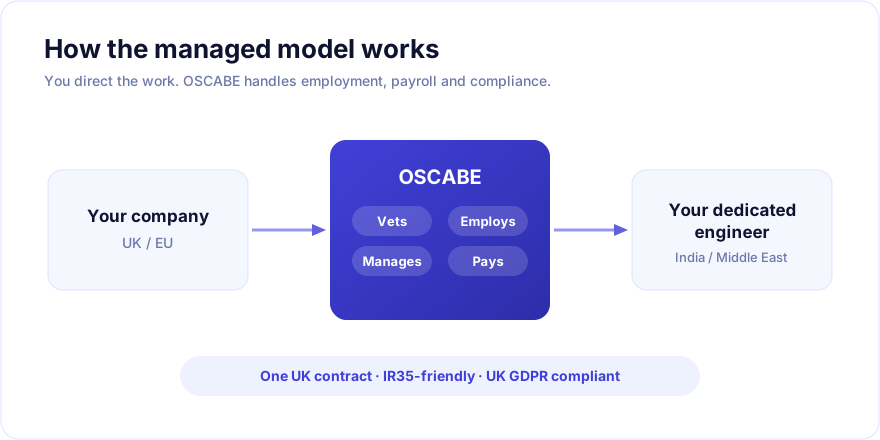
Keep the dashboard small and shared, so both sides see the same numbers. The goal is a partnership managed on evidence, where the provider owns the outcomes and you can see clearly that it is doing so. For the end-to-end model, see how it works.
Frequently asked questions
What SLAs should I set for a managed remote team?
Set hard SLAs only on the things that genuinely need a commitment: responsiveness (for example, code review within one working day), replacement (a vetted replacement proposed within an agreed window if someone leaves), and security and data handling. Track velocity, quality and retention as KPIs on a shared dashboard, and review them on a regular cadence rather than turning every metric into a contractual target.
What KPIs matter most for an offshore team?
Across four categories: velocity (sprint predictability and cycle time), quality (defect escape rate and change failure rate), responsiveness (review turnaround and response time in the overlap window), and retention (team retention and replacement time). Balance across all four matters more than excelling at one, because optimising a single metric usually degrades the others.
How is velocity measured fairly for a new team?
Judge a new team against its own trend, not a long-term baseline, for the first month or two. Track sprint commitment met and cycle time, and look for stability and a gentle improvement as the team learns your codebase. Avoid making story points a hard target, since that invites inflation; use them for planning and measure predictability instead.
Should retention be in an SLA?
Retention itself is best tracked as a KPI, but the provider's response to a departure should be an SLA: a vetted replacement proposed within an agreed window, with a structured handover. In a managed model, retention and replacement are the provider's responsibility, which is precisely the protection a marketplace of individual contractors cannot offer.
Hold your managed team to clear, balanced metrics
The best managed remote teams are easy to govern because the right SLAs and KPIs make performance visible. Cover velocity, quality, responsiveness and retention, agree a handful of real commitments and a shared dashboard, and review on a steady cadence. A provider that owns delivery should welcome being measured this way.
To agree an SLA and KPI framework for your roles, contact OSCABE or browse the engineers we provide. We will set out clear commitments, five-stage vetting and a managed team you can hold to outcomes under one UK contract.