
For UK and EU companies in 2026, nearshore Poland and Romania buy you near-total working-hour overlap and EU data residency at a premium, while offshore India buys you the lowest rates and the deepest talent pool at the cost of a larger time-zone gap. A senior nearshore developer often runs £4,000 to £6,500 per month, against roughly £2,500 to £4,500 in India for comparable skill. A fully-managed offshore team through OSCABE captures India's cost advantage while engineering enough overlap and removing the integration burden, from £2,000 per month all-in. The right answer depends on how much real-time collaboration your work genuinely needs.
This guide compares nearshore Poland and Romania against offshore India on rates, overlap, quality and risk, then sets out honestly when nearshore is the better call and when a managed offshore team wins.
Nearshore and offshore: what is actually different?
Nearshore and offshore mix up two separate questions: where the people sit, and who manages them. Keeping them apart makes the decision cleaner.
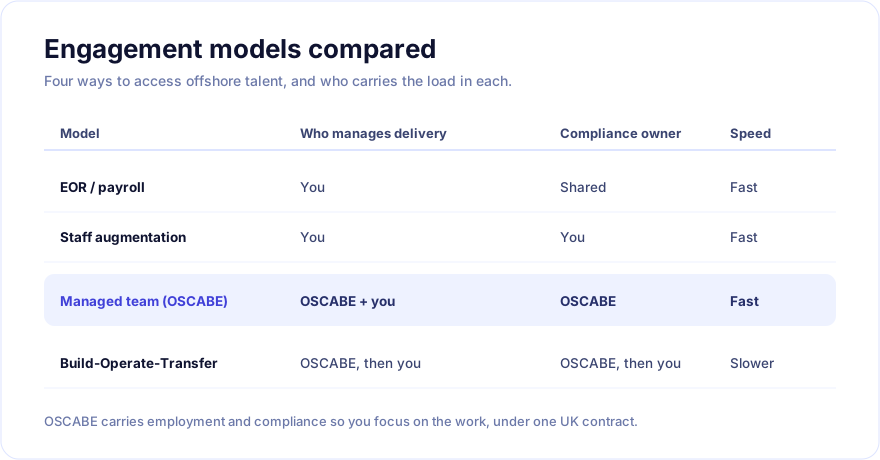
- Nearshore (Poland, Romania). Talent in a nearby region inside or close to EU hours. You get most of the working day shared, EU data residency, and cultural proximity, at rates above India though still below UK levels.
- Offshore (India). Talent in a distant, lower-cost region with the deepest engineering pool. You get the lowest rates and rapid scale, but a larger time-zone gap and, if unmanaged, more integration effort.
- Managed offshore. Not a location but a delivery model. A provider vets, employs, manages and pays a dedicated offshore team and engineers overlap hours, so you keep India's cost advantage without carrying its operational drag.
The common framing of "nearshore versus offshore" misses that a managed model changes the offshore side of the comparison entirely, which is the crux of this guide.
Rates: how far apart are Poland, Romania and India?
Cost is where the regions separate most clearly. The table below shows indicative 2026 monthly ranges for a mid-to-senior developer, drawn from public market data and salary guides. They are planning ranges, not live quotes.
| Factor | Nearshore Poland | Nearshore Romania | Offshore India | Managed offshore (OSCABE) |
|---|---|---|---|---|
| Mid-level developer | £3,000 - £4,500 | £2,800 - £4,200 | £1,600 - £2,800 | from £2,000 all-in |
| Senior developer | £4,500 - £6,500 | £4,000 - £6,000 | £2,700 - £4,500 | scales with seniority |
| Time-zone overlap with UK | 7-8 hours | 7-8 hours | 3-5 hours | managed overlap built in |
| Talent pool depth | strong, mid-sized | strong, mid-sized | very deep | deep, pre-vetted |
| EU data residency | yes (EEA) | yes (EEA) | non-EU transfer needed | handled under UK contract |
| Who manages the team | you | you | you | OSCABE |
| Recruitment and vetting | your effort | your effort | your effort | included |
| Main trade-off | cost premium | cost premium | overlap, integration | low, provider-managed |
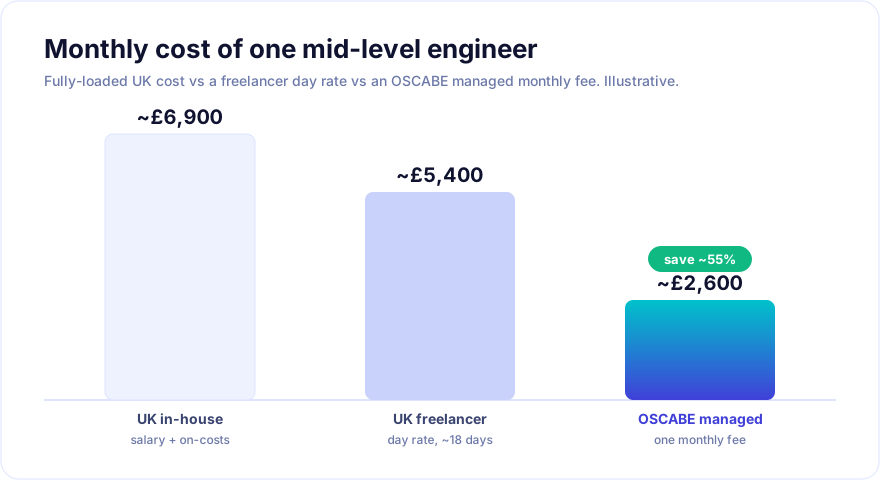
Romania tends to sit slightly below Poland, and both sit well above India for comparable seniority. The managed offshore fee from £2,000 per month undercuts nearshore senior rates while bundling the management and vetting that nearshore arrangements rarely include. For raw figures by region, see the offshore developer rate tables for India, MENA and Eastern Europe and the broader offshore software development rates by country.
Time-zone overlap: the real nearshore advantage
Overlap is the strongest argument for nearshore, and it is a genuine one. Poland and Romania share roughly seven to eight hours of the UK working day, which makes pair programming, live incident response and constant back-and-forth feel seamless. India shares fewer hours head-on, typically three to five, which can slow purely synchronous workflows if nobody manages the gap.
But "fewer overlap hours" and "unworkable" are not the same thing. A managed offshore team arranges shifted hours so the overlap window reliably covers stand-ups, reviews and collaboration. OSCABE delivers four to six hours of arranged overlap, and can blend Indian depth with UAE and wider Middle East talent that sits closer to European hours. The result is most of the nearshore collaboration benefit at offshore cost. For practical tactics, see managing distributed teams across IST and GMT.
So the honest position is: if your work is overwhelmingly real-time, nearshore's natural overlap is a real edge. If it is the usual mix of async delivery with a daily collaboration window, managed offshore closes most of the gap.
Quality: is nearshore really better?
Quality is often assumed to track distance, but the evidence does not support that. Poland and Romania have excellent, well-established engineering cultures. India has an enormous and highly capable talent pool that produces world-class engineers across every discipline. The differentiator is not the country; it is whether the individuals are properly vetted and whether the team is well managed.
This is where an unmanaged engagement, nearshore or offshore, can disappoint, and where a managed model earns its keep. OSCABE runs a five-stage vetting process, so quality is filtered before anyone reaches your team, regardless of region.
The practical takeaway is that quality is a vetting-and-management outcome, not a postcode. A well-managed offshore team can match or exceed an unvetted nearshore one, and a managed provider removes the variance either way.
When nearshore Poland or Romania is the right call
Nearshore is genuinely the better choice in specific situations, and it is worth being clear about them:
- Heavily real-time work. Pair-programming-intensive teams, live incident rotations within EU hours, or design-heavy collaboration that needs constant synchronous contact.
- Strict EU data residency. Where regulatory or client expectations require personal data to stay within the EEA, nearshore keeps processing inside the bloc by default.
- Culture and language proximity outweigh cost. When near-identical working hours and cultural closeness matter more than the rate, the premium can be justified.
For those cases, a Warsaw or Bucharest team sharing most of your day is the cleaner answer, and the cost is the cost. We will not pretend otherwise.
When a managed offshore team wins
For most UK and EU companies that want low cost and reliable delivery together, a managed offshore team is the stronger all-round option. It takes India's economics and removes the drag that worries nearshore-leaning buyers.
The advantages stack up:
- Offshore cost, managed quality. From £2,000 per managed remote employee and from £7,500 per managed pod, in transparent GBP or EUR, below nearshore senior rates.
- Overlap engineered in. Four to six hours of arranged overlap, with the option to blend India and the UAE and wider Middle East for working-hour proximity.
- Vetting and management included. Five-stage vetting and day-to-day management, so quality is not left to chance.
- One UK contract, compliance handled. IR35-friendly, UK GDPR compliant, with international data transfers managed under a single contract, addressing the residency concern nearshore would otherwise own.
For the full structural comparison across models, see offshore vs nearshore vs managed team, and for the economics in detail, the total cost of ownership of offshore vs in-house.
Frequently asked questions
Is nearshore Poland or Romania always better than offshore India?
No. Nearshore gives more working-hour overlap and EU data residency, which matters for heavily real-time or strictly EEA-bound work. But it costs more, and for the typical mix of async delivery with a daily collaboration window, a managed offshore team captures India's lower cost while engineering enough overlap. The right answer depends on how synchronous your work really is.
How many overlap hours do you get with offshore India?
India shares roughly three to five hours of the UK working day head-on. A managed offshore team arranges shifted hours so the overlap reliably covers stand-ups, reviews and collaboration; OSCABE provides four to six hours of arranged overlap and can blend in UAE and Middle East talent that sits closer to European hours, narrowing the gap with nearshore.
Is offshore quality lower than nearshore?
Not inherently. Poland, Romania and India all have strong engineering talent. Quality tracks vetting and management, not distance. An unvetted nearshore hire can underperform a well-managed, five-stage-vetted offshore one. A managed provider removes the variance by filtering quality before anyone joins your team, regardless of region.
What about EU data residency with offshore India?
Offshore India involves a non-EU data transfer, which needs an appropriate mechanism and a documented assessment. A managed model handles this under one UK contract with UK GDPR safeguards, so the residency concern is addressed contractually rather than left to you. Where data must stay strictly within the EEA, nearshore remains the simpler default.
Choose by the work, not the map
Start from how your work actually runs. If it is overwhelmingly real-time or strictly EEA-bound, nearshore Poland or Romania earns its premium. If you want offshore economics with reliable overlap and vetting included, a managed offshore team usually wins on total value.
When you want a concrete figure to compare against a nearshore shortlist, talk to OSCABE. Browse the vetted engineers we can match within 72 hours under one UK contract, with overlap, vetting and compliance handled for you.