
Multilingual AI training data is text, annotations and preference judgments collected across many languages and dialects so a model performs well beyond English, including in low-resource languages with little data online. Sourcing it well is hard: you need native speakers who understand local dialect, register and culture, plus quality control that works when reviewers cannot read every language themselves. The most reliable route is a managed pod of native-speaker linguists, drawing on the linguistic diversity of India and the Middle East, run under one UK contract from around £6,000 per month.
Below we explain what multilingual and low-resource language data is, why sourcing it is genuinely difficult, how dialect coverage and quality control work, and how a managed linguist pod solves the problem.
What is multilingual and low-resource language data?
Definition (multilingual training data): Multilingual training data is the prompts, demonstrations, annotations and preference judgments used to train or evaluate a model in more than one language, so its quality does not collapse outside English.
Definition (low-resource language): A low-resource language is one with relatively little high-quality digital text available, which makes models trained mostly on web data weaker at it, more prone to errors, and harder to evaluate.
The gap is large and practical. A model can be fluent in English and noticeably worse in, say, Tamil, Urdu, Levantine Arabic or Swahili, not because the language is harder, but because there is less data and less evaluation of it. Many safety failures also concentrate in lower-resource languages, where guardrails were trained on thinner data. Closing the gap needs deliberately sourced, human-verified data in those languages, not just machine translation of English.
Why is multilingual data hard to source?
The difficulty is not finding people who speak a language; it is finding people who can produce reliable training data in it, and verifying that data when your own team cannot read it.
The recurring problems:
- Machine translation is not enough. Translating English data introduces "translationese", loses idiom, and propagates the source model's errors into every language at once. Native-authored data is qualitatively different.
- Dialect and register vary widely. "Arabic" spans Modern Standard Arabic and many regional dialects; "Hindi" shades into Urdu and dozens of regional languages. A model trained on one register can fail badly on another.
- Quality control is hard to verify. If no one on your QA team reads the language, how do you know the annotation is good? You need reviewers who are themselves native speakers, plus structured agreement checks.
- Cultural correctness matters. Politeness norms, taboo topics and factual context differ by region. An answer that is fine in one culture can be wrong or offensive in another.
- Thin talent pools per language. For genuinely low-resource languages, qualified annotators are scarce and hard to recruit one by one.
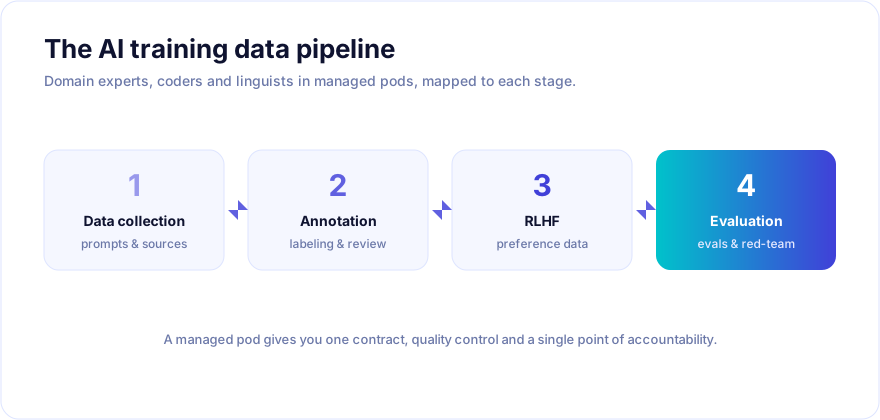
The India and Middle East linguistic advantage
India and the Middle East are unusually well suited to multilingual data work, because the linguistic diversity needed is native to the region rather than imported.
| Region | Languages and reach | Why it helps |
|---|---|---|
| India | Hindi, Tamil, Telugu, Bengali, Marathi, Urdu and many more | Dozens of major languages with large educated, English-fluent speaker bases |
| Middle East | Modern Standard and regional Arabic dialects, plus Persian, Turkish, Urdu | Deep Arabic dialect coverage with professional, multilingual workforces |
| Both | Strong English alongside local languages | Annotators can work to English-language rubrics and brief back reliably |
This combination, native fluency in the target language plus strong working English, is exactly what multilingual data work needs. Annotators can take a rubric written in English, apply it in Tamil or Levantine Arabic, and explain their judgments back to your team in English. It is the same talent depth that makes the region effective for the wider AI training data pipeline, applied to language coverage.
How do you ensure quality and dialect coverage?
Quality in multilingual data is a process problem, made harder by the fact that the work is, by definition, in languages your core team may not read. The controls that make it work:
- Native-speaker annotators and reviewers. Both the people producing data and the people checking it must be native or near-native, so judgments reflect real usage, not textbook approximation.
- Explicit dialect and register targets. Decide upfront which dialects and registers you need (for example MSA plus specific Arabic dialects) and staff for them deliberately, rather than accepting whatever a generic pool provides.
- A rubric that travels. Write evaluation criteria once in English with concrete examples, then calibrate native speakers against it. This is OSCABE's "Trained First" model: the pod is trained on your rubric before producing live data.
- Inter-annotator agreement, per language. Measure agreement within each language separately. A pooled number can hide that one language is well-calibrated and another is noisy.
- Cultural-correctness review. A senior native reviewer checks for cultural and factual appropriateness, not just grammatical correctness.
- Multilingual red-teaming. Because many jailbreaks exploit lower-resource languages, adversarial probing in the target languages catches failures English-only testing never will. See our guide to hiring an AI red-teaming team.
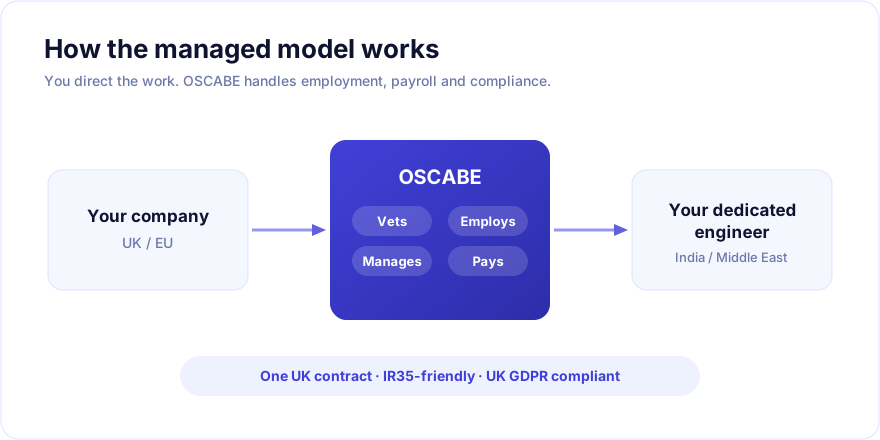
How a managed linguist pod solves the problem
The hardest part of multilingual data, recruiting scarce native-speaker talent per language and managing quality you cannot directly read, is exactly what a managed pod is built to handle. Instead of standing up recruitment and QA for each language yourself, you direct the work and the provider handles sourcing, calibration and management.
There are three broad routes:
- Recruit native speakers yourself. Maximum control, but slow and brittle. For low-resource languages, finding and retaining qualified people one by one is the bottleneck.
- Use a per-task crowd platform. Fast access to many languages, but coverage and quality depend on who you draw, and verifying work in languages you cannot read is on you.
- Engage a managed linguist pod (for example OSCABE). A dedicated team of native-speaker linguists is recruited, trained on your rubric and managed for you under one contract, with quality control built in.
How OSCABE staffs multilingual data pods
OSCABE's AI Training Teams include managed pods of native-speaker linguists for multilingual data collection, annotation, preference judgments and evaluation. The talent pool spans India and the Middle East and includes:
- Native-speaker linguists across major Indian languages and Arabic dialects
- Senior reviewers for cultural-correctness and dialect QA
- Domain experts where language meets a specialist field (legal, medical, finance)
- Red-teaming specialists for multilingual adversarial testing
Pricing is a transparent monthly fee:
| OSCABE managed pod | From (per month) | Focus |
|---|---|---|
| Coding RLHF Team | £6,000 | Code review and coding RLHF |
| Training Data Pipeline Team | £8,000 | Multilingual annotation and data pipelines |
| Domain Expert AI Team | £9,000 | Legal, medical, finance, STEM evaluation |
| RLHF Evaluation Team | £10,000 | Preference data, model eval, red-teaming |
That is roughly 75 to 80% below the effective cost of sourcing equivalent native-speaker hours on per-hour gig platforms, with management and a UK contract included. Because the same dedicated linguists work your project month after month, dialect calibration compounds instead of resetting. For the human-feedback foundations this builds on, see what RLHF is and who provides RLHF teams. See also how it works and pricing.
Frequently asked questions
What is multilingual AI training data?
It is the prompts, demonstrations, annotations and preference judgments used to train or evaluate a model in more than one language, so its quality does not collapse outside English. For low-resource languages (those with little high-quality digital text), this data has to be deliberately sourced from native speakers rather than scraped or machine-translated, because translation introduces errors and loses dialect and cultural nuance.
Can I just machine-translate my English data into other languages?
It is a weak substitute. Machine translation introduces "translationese", loses idiom and register, and copies the source model's errors into every language at once. It also cannot capture dialect differences or cultural correctness. Native-authored and native-reviewed data is qualitatively better, especially for evaluation and preference judgments where subtle quality differences are the whole point.
Why are India and the Middle East good for multilingual data?
Both regions combine native fluency in many languages (dozens of major Indian languages, plus Modern Standard and regional Arabic dialects) with strong working English. That means annotators can apply an English-language rubric in the target language and explain their judgments back to your team, which is exactly what reliable multilingual data work requires. The educated, professional workforces also make scarce-language talent easier to source at quality.
How do you quality-check data in a language my team cannot read?
You use native-speaker reviewers, measure inter-annotator agreement separately for each language, add senior cultural-correctness review, and calibrate everyone against a shared rubric before live work. A managed pod handles this for you, so verification does not depend on your core team reading every language. OSCABE's "Trained First" approach builds the calibration in before any live data is produced.
Put native fluency behind your multilingual model
A model is only multilingual to the extent that real native speakers shaped and checked its training data. Machine translation and untrained crowds leave gaps that show up as errors, awkward register and safety failures in exactly the languages you were trying to support.
To put native-speaker linguists and dialect-aware quality control behind your multilingual model without recruiting scarce talent yourself, explore OSCABE's AI Training Teams or contact us. We will scope a managed linguist pod trained on your rubric, with transparent monthly pricing and a UK contract, so your model performs in every language you need.