
Data Residency for Offshore Teams: Where Your Data Lives (UK/EU)
You can keep your data resident in the UK or EU while an offshore team in India or the Middle East works on it, provided you separate where data is stored from where it is accessed, and put the right controls and contracts around both. In most cases the data itself can stay on UK or EU infrastructure, with offshore engineers reaching it through controlled, logged remote access rather than copying it to local machines. The deciding factor is not geography but governance: who decides where data sits, who can touch it, and who is accountable.
This guide explains what data residency and data localisation actually mean, how they differ from GDPR transfer rules, the technical and contractual controls that keep data in-region, and how a fully-managed model enforces residency in practice.
What does data residency actually mean?
The terms get used loosely, so it helps to be precise. Three related ideas sit underneath most "where does our data live" conversations.
- Data residency is your chosen policy about the geographic location where data is stored and processed, often driven by customer commitments, sector rules or internal risk appetite.
- Data localisation is a stricter, legally mandated version: specific laws requiring certain data to remain within a country's borders (common for some categories of financial, health or government data).
- Data sovereignty is the principle that data is subject to the laws of the country it sits in, which is why location affects which government can compel access to it.
For most UK and EU companies hiring offshore, the live question is residency: you want UK or EU personal data to stay on UK or EU infrastructure, even though the people working with it are elsewhere. That is achievable, but only by design.
Residency is not the same as a GDPR transfer
This is the distinction that trips people up. Keeping data physically stored in the EU does not, by itself, remove your GDPR international transfer obligations.
Under UK and EU GDPR, allowing someone outside the UK or EEA to access personal data generally counts as a restricted transfer, even if the data never leaves an EU data centre. Remote access from India or the UAE to a London-hosted database is still a transfer, because the data becomes available in a third country. So residency and transfer compliance are two separate jobs that you need to do together:
- Residency controls where the bytes physically live (storage location).
- Transfer compliance controls the lawful basis for someone abroad to access them (the IDTA or SCCs plus a transfer risk assessment).
Doing one without the other leaves a gap. We cover the transfer mechanism in our GDPR guide for hiring offshore developers, and the formal cross-border risk assessment in our transfer impact assessment guide. The point to hold onto: good residency design reduces transfer risk but does not remove the need for a transfer tool.
| Concern | What it controls | Typical mechanism |
|---|---|---|
| Data residency | Where data is stored/processed | Region-pinned cloud, EU/UK data centres |
| Data localisation | Legal "must stay in country" rules | Sector-specific compliance, local storage |
| GDPR transfer | Lawful basis for offshore access | UK IDTA or SCCs + UK Addendum |
| Transfer risk | Whether protections hold in practice | Documented transfer risk assessment |
| Access control | Who can reach the data | SSO, MFA, least privilege, VDI |
How do you keep data resident while a team works offshore?
The pattern that works is "data stays put, people reach in". Rather than shipping copies of production data to engineers' laptops in another country, you give them controlled access to data that never leaves the region. The main building blocks:
- Region-pinned infrastructure. Choose cloud regions in the UK or EU and configure services so data at rest stays in those regions. Many providers let you constrain storage, backups and even logs to a chosen region.
- Virtual desktops or bastion access. Engineers work inside a UK or EU-hosted virtual desktop (VDI) or jump host. The data is rendered to their screen but never downloaded locally, so it does not become resident on a device in a third country.
- No-local-copy rules. Disable downloads, USB and clipboard egress for sensitive data; build and test in the in-region environment.
- Masked, synthetic or test data for development. Where engineers do not strictly need production personal data, give them de-identified or synthetic data instead. This is one of the most effective residency and transfer-risk reducers available.
- Encryption in transit and at rest, with keys managed in-region where feasible.
- Access logging, recording who accessed what and when, in-region, and reviewed.
The aim is that the only thing crossing a border is an encrypted, logged, view-only session, not the data itself. That makes residency enforceable rather than a line in a policy.
The access-control layer that makes residency real
Residency commitments are only as strong as the access controls underneath them. The controls that matter most are the same ones that govern any well-run offshore engagement:
- Single sign-on (SSO) with multi-factor authentication (MFA) so identity is centralised and revocable in one place.
- Least privilege and role-based access so each engineer can reach only the data their task requires.
- Just-in-time, time-boxed elevation for any access to production or sensitive stores.
- A clean joiner-mover-leaver process so access is provisioned narrowly and revoked completely the day someone rolls off.
A useful test: if an engineer left tomorrow, could you revoke every route they had to in-region data in minutes, and prove from logs that no resident data was copied out? If yes, your residency design is working. For these controls and the certifications behind them, see our offshore team security guide.
The contractual layer: residency belongs in the DPA
Technical controls need a contractual backbone. Where your company decides why and how personal data is processed, you are the controller and the offshore provider is your processor, which engages UK and EU GDPR Article 28 and a written data processing agreement (DPA). Residency commitments should be written into that agreement, not left as an informal understanding:
- Storage location commitments (which regions data may and may not reside in).
- Sub-processor controls, so a provider cannot move data to a sub-processor in another region without your authorisation. A provider relying on a US-region service for backups, logging or support could quietly undermine an EU residency promise if this is not controlled.
- Transfer mechanism for the offshore access itself.
- Audit and evidence rights so you can verify residency in practice.
Because residency can be silently broken by an unmanaged sub-processor, the sub-processor clauses do a lot of work here.
How a managed model enforces residency
The hard part of offshore residency is not knowing the pattern; it is making sure it is applied consistently and that someone is accountable when a shortcut is tempting. This is where a fully-managed model earns its keep.
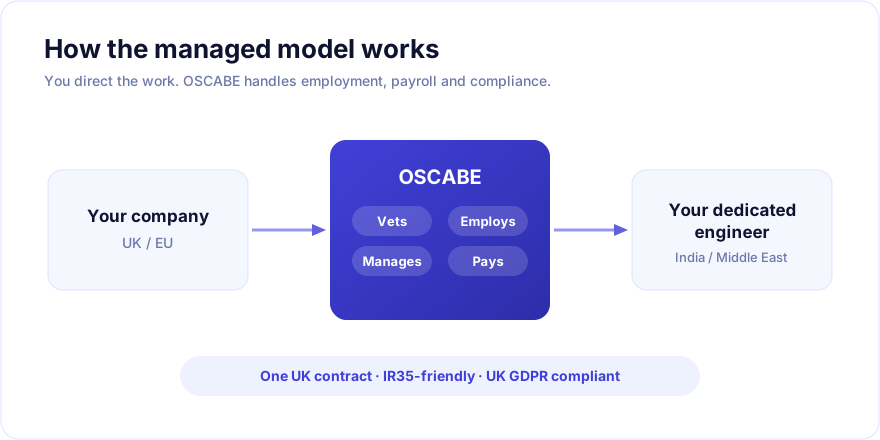
In a managed model the provider employs the engineers directly, so confidentiality, security and "no-local-copy" obligations flow straight down to the individuals doing the work as employment terms, not as best-effort requests to independent freelancers. The provider operates the in-region environment, the virtual desktops, the access controls and the logging as standard, and stands behind them under one contract. Because OSCABE vets every professional through a five-stage process before they reach you, the people working inside that environment are already screened.
OSCABE delivers under UK and EU GDPR-compliant processor terms, with a controller-to-processor DPA, an appropriate transfer mechanism, residency-aware sub-processor governance and ISO 9001:2015-certified processes, all under one UK contract with a single accountable counterparty. That is far easier to govern than a collection of contractors each working on their own laptops in their own jurisdictions. See how it is structured on our managed teams page, and our EU page for EU-specific arrangements.
A practical data-residency checklist
- Decide your residency policy: which data must stay in the UK or EU, and why.
- Pin storage, backups and logs to UK or EU cloud regions.
- Give offshore engineers in-region virtual-desktop or bastion access, not local copies.
- Disable downloads and clipboard egress; use masked or synthetic data in dev.
- Enforce SSO, MFA, least privilege and just-in-time elevation.
- Treat the offshore access as a GDPR transfer: put the IDTA or SCCs and a transfer risk assessment in place.
- Write residency and sub-processor controls into the DPA, with audit rights.
- Confirm a single accountable provider operates and evidences it all.
Frequently asked questions
If our data stays in an EU data centre, do we still have a GDPR transfer?
Generally yes. Allowing someone outside the UK or EEA to access the data is treated as a restricted transfer even if the data is stored in-region, so you still need an appropriate transfer mechanism and a transfer risk assessment. Residency reduces exposure but does not replace the transfer tool, according to current UK and EU guidance.
Can offshore engineers work without ever holding a local copy of the data?
Yes, and that is the recommended pattern for sensitive data. Using UK or EU-hosted virtual desktops or bastion hosts, engineers can view and work with data that is rendered to their screen but never downloaded, with downloads and clipboard egress disabled. Only an encrypted, logged session crosses the border.
Does data localisation law require us to keep everything in-country?
It depends on the data and the jurisdiction. True localisation mandates apply to specific categories (often certain financial, health or public-sector data) rather than all data, so map which datasets are in scope before over-engineering. Where none applies, a residency policy gives you the control you need without a legal mandate.
How does a managed model help with residency specifically?
Because the provider employs the engineers and operates the in-region environment and access controls directly, "data stays put, people reach in" is enforced as standard and as employment obligation, not left to individual discretion. You also get one accountable counterparty and a DPA that fixes storage location and sub-processor controls, which is much easier to govern than many separate contractors.
General information, not legal advice
This article gives general information about data residency, data localisation and UK and EU GDPR for offshore teams as at the date of publication. It is not legal advice and does not create a professional relationship. Outcomes depend on your specific data, sector and facts; in most cases you should take advice from a qualified data protection adviser before acting, and check the current ICO and EU guidance, which can change over time.
Ready to keep your data in-region with an offshore team?
OSCABE provides dedicated, fully-managed developers and AI teams from India and the Middle East under one UK contract, with residency-aware controls, UK and EU GDPR processor terms and a single accountable counterparty. We carry the residency and compliance plumbing so you can focus on delivery. Explore our managed teams, browse our engineers to start matching candidates, or contact us to review your residency setup.