
SOC 2 vs ISO 27001 for Offshore Teams: Which Does Your Vendor Need?
For most UK and EU companies, the honest answer is that your offshore vendor usually needs one credible security framework, not both: ISO 27001 certification suits buyers who want a globally recognised, certified security system, while a SOC 2 report suits buyers (often with US ties) who want auditor-tested evidence that specific controls operated effectively over time. Neither is automatically "better"; the right choice depends on your sector, your customers' expectations and what you are trying to prove. And in every case the certificate or report is only a baseline signal, what actually protects you is whether the underlying controls are real and consistently enforced, backed by a DPA.
This guide explains what each framework actually is, the practical differences, a decision guide for which your vendor needs, and how a fully-managed model enforces the controls underneath either one.
What ISO 27001 and SOC 2 actually are
They sound interchangeable but they are different kinds of thing, which is the root of most confusion.
- ISO 27001 is an international standard for an Information Security Management System (ISMS). An accredited body audits and certifies that the organisation runs a risk-based system of policies, controls and continual improvement. It answers: "Is there a managed, certified security system in place?"
- SOC 2 is an attestation report prepared by auditors against the Trust Services Criteria (security, availability, processing integrity, confidentiality and privacy). It comes as Type I (controls suitably designed at a point in time) or Type II (controls operated effectively over a period, commonly 3 to 12 months). It answers: "Were the stated controls actually working over time?"
So ISO 27001 gives you a certificate that a system exists; SOC 2 gives you a report on how specific controls performed. Both are credible; they simply prove slightly different things, which is why the choice is about fit rather than ranking.
The practical differences
When you are assessing an offshore vendor, a handful of differences actually affect your decision.
| Aspect | ISO 27001 | SOC 2 |
|---|---|---|
| Nature | Certification against a standard | Attestation report by auditors |
| Scope | Whole ISMS, risk-based | Trust Services Criteria you select |
| Output | Certificate (with audit cycle) | Type I (point in time) or Type II (period) report |
| Geographic lean | Strong in UK, EU and globally | US-centric, widely accepted globally |
| Best read as | "A managed security system exists" | "Controls operated effectively over time" |
| Renewal | Surveillance audits, periodic recertification | Repeated annually for ongoing assurance |
| Who tends to ask | UK/EU enterprises, public sector, global buyers | US customers, SaaS procurement, investors |
A few things follow from this table. ISO 27001 tends to land well with UK, EU and global enterprise buyers and is a recognised mark of a system. SOC 2 Type II tends to be what US-leaning procurement and investors expect, and its real value is the over a period evidence, a Type I (point-in-time) report is weaker assurance than a Type II. Crucially, both certifications can be scoped: a vendor can hold a certificate or report that covers only part of the organisation, so always check that the scope includes the team and services you are buying.
Decision guide: which does your vendor need?
Rather than asking "ISO or SOC 2?" in the abstract, work from what you are trying to achieve.
- Your customers or contracts demand a specific one. This usually settles it. If enterprise clients require SOC 2 Type II, your vendor effectively needs SOC 2; if tenders ask for ISO 27001, that is the target. Follow the demand.
- You sell into the US or have US investors. SOC 2 Type II is often the expected currency, so a vendor with it removes friction.
- You sell into the UK, EU or globally and want a recognised system mark. ISO 27001 certification is broadly recognised and easy to explain to UK and EU buyers.
- You are in a regulated sector. Sector rules may point to one or add requirements on top of either; check the specific regime.
- You want assurance over time, not just a snapshot. Prefer SOC 2 Type II over Type I, or ISO 27001 with a current audit cycle.
- You genuinely operate across both worlds. Some vendors hold both; that is reassuring but not usually necessary, and you should weigh it against cost and the strength of the underlying controls.
The most common mistake is treating the logo as the goal. A vendor with an impressive certificate but weak day-to-day enforcement is worse than a vendor with a slightly less prestigious mark and genuinely tight controls. Use the framework as an entry signal, then verify the controls.
The controls that matter regardless of the badge
Whichever framework your vendor holds, the things that actually protect your data day to day are the same, and you should confirm them directly:
- SSO with MFA so identity is centralised and instantly revocable.
- Least privilege and role-based access so each person can reach only what their role needs.
- Just-in-time, time-boxed elevation for production or sensitive access.
- A clean joiner-mover-leaver process so access is granted narrowly and revoked completely on rolloff.
- Managed, encrypted devices with MDM, endpoint protection and automatic patching.
- Secrets in a manager, and development against masked or synthetic data.
- Audit logging that is reviewed, not just collected.
These are the substance behind any certificate. Our offshore team security guide goes through them in depth, including the "could you revoke a leaver's access in minutes?" test that quickly reveals whether access is genuinely controlled.
The contractual layer: a badge is not a DPA
A security certificate is not a substitute for the contract. Where your company decides why and how personal data is processed, you are the controller and the vendor is your processor, so UK and EU GDPR require a written data processing agreement (DPA) meeting Article 28, alongside an appropriate transfer mechanism for data leaving the UK or EEA. The certificate evidences security maturity; the DPA makes the obligations enforceable. You want both. Our DPA and sub-processor management guide covers what that agreement should contain, and our GDPR guide for hiring offshore developers sets out the transfer mechanism that sits alongside it.
How a managed model enforces the controls
The recurring theme is that frameworks signal maturity but do not, by themselves, guarantee enforcement. The hard part offshore is making sure the controls are applied consistently and that someone is accountable when a shortcut is tempting. This is where a fully-managed model earns its keep.
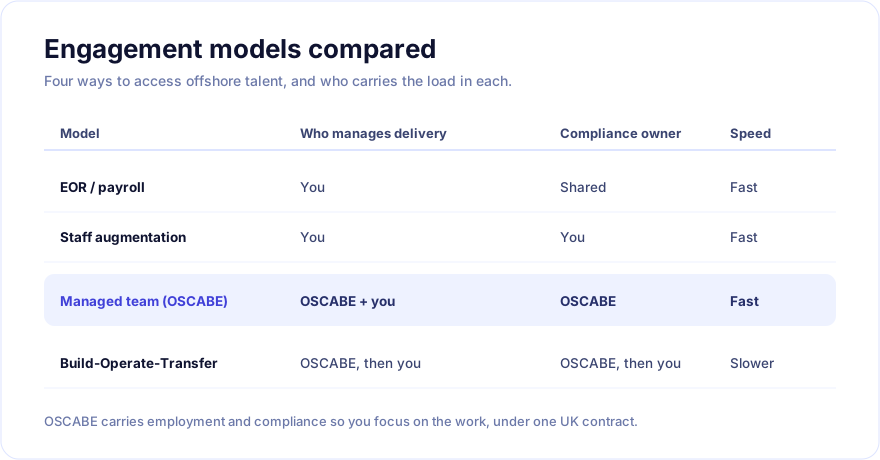
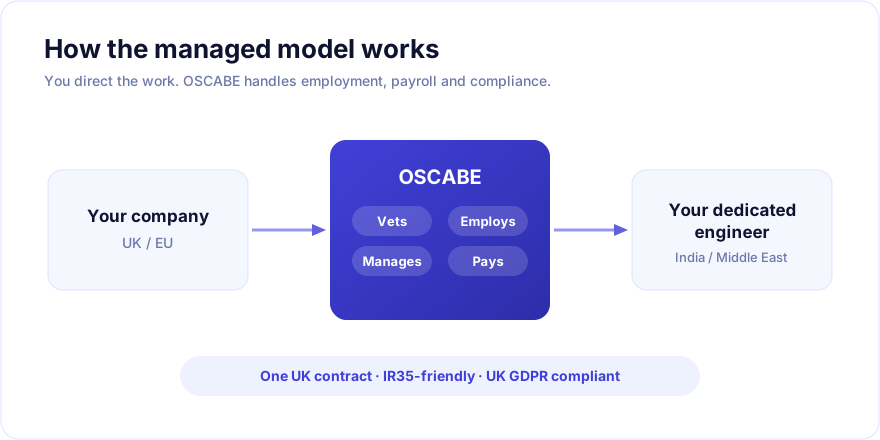
In a managed model the provider employs the engineers directly, so security and confidentiality obligations flow down as employment terms, and the provider operates the device, access and data controls as standard rather than leaving them to each freelancer's good intentions. Because every professional is vetted through a five-stage process before they reach you, the people inside those controls are already screened. The whole engagement sits under one UK contract with a single accountable counterparty, which is far easier to govern, and to evidence, than a collection of individual contractors each running their own setup.
OSCABE delivers dedicated, vetted teams under UK and EU GDPR-compliant processor terms, ISO 9001:2015-certified processes and a security-first operating model, with a DPA and an appropriate transfer mechanism built in. Whether your buyers want ISO 27001, SOC 2 or simply demonstrable, well-governed controls, the managed model gives you enforcement and accountability rather than a logo alone. See our managed teams and how it works pages.
A vendor security-assurance checklist
- Decide what you must prove (and to whom): ISO 27001, SOC 2 Type II, or strong controls.
- Follow customer and contract demand where it points to a specific framework.
- Prefer SOC 2 Type II over Type I for over-time assurance.
- Check the certificate or report scope covers your team and services.
- Verify the underlying access and device controls directly, not just the badge.
- Require a DPA meeting Article 28 plus an appropriate transfer mechanism.
- Confirm a single accountable provider operates and evidences the controls.
Frequently asked questions
Does my offshore vendor need both SOC 2 and ISO 27001?
Usually not. Either can serve as a baseline signal of security maturity, and the right one depends on your sector and your customers' expectations. Holding both is reassuring but rarely necessary; what matters more is that the underlying controls are real and consistently enforced, backed by a DPA.
Is SOC 2 better than ISO 27001, or vice versa?
Neither is inherently better; they prove different things. ISO 27001 certifies that a managed security system exists, while SOC 2 reports that specific controls operated effectively (Type II) or were suitably designed (Type I). Choose based on what your buyers expect and what you need to demonstrate.
What is the difference between SOC 2 Type I and Type II?
Type I assesses whether controls are suitably designed at a single point in time; Type II assesses whether they operated effectively over a period, commonly 3 to 12 months. Type II is stronger assurance because it tests sustained operation, so prefer it where over-time evidence matters.
Does a security certificate replace a DPA?
No. A certificate or report evidences security maturity, but it does not satisfy the GDPR requirement for a written processor contract. Where you are controller and the vendor is processor, you still need a DPA meeting Article 28 and an appropriate transfer mechanism, according to current UK and EU guidance.
General information, not legal advice
This article gives general information about ISO 27001 and SOC 2 for offshore teams as at the date of publication. It is not legal advice and does not create a professional relationship. The right framework and the adequacy of any vendor's controls depend on your specific facts and sector; in most cases you should take advice from a qualified adviser and verify a vendor's certifications, scope and controls directly, as standards and guidance can change over time.
Ready for an offshore team with controls you can stand behind?
OSCABE delivers dedicated, vetted teams from India and the Middle East under one UK contract, with UK and EU GDPR-compliant processor terms, ISO 9001:2015-certified processes, a DPA and an appropriate transfer mechanism, and a single counterparty accountable for enforcing the controls. Whatever framework your buyers expect, you get enforcement, not just a logo. Explore our managed teams, browse our engineers to start matching candidates, or contact us to discuss your security requirements.