
IR35 is the UK's off-payroll working rule that decides whether a contractor working through their own company should be taxed like an employee. If an engagement is "inside IR35", income tax and National Insurance apply as if the worker were on payroll; if it is "outside", the contractor is taxed as a genuine business. Since 2021, for medium and large clients the responsibility for determining status, and the liability if it is wrong, has sat with the client. A genuine managed service, where the provider owns delivery and the people, is structured differently from inside-IR35 contracting, which is why the OSCABE model is IR35-friendly.
This guide explains the rules in plain terms for hiring managers, sets out the status tests, clarifies who carries the risk, and shows where a managed model fits. It is written for general understanding and is not legal or tax advice.
Not legal or tax advice. This article is general information for hiring managers, not a substitute for professional advice. IR35 outcomes depend on the specific facts of each engagement. For authoritative guidance, refer to HMRC, and take qualified legal or tax advice before making status decisions.
What is IR35 and why does it exist?
IR35, formally the off-payroll working rules, exists to stop "disguised employment". The concern is a worker who behaves like an employee but supplies their labour through an intermediary, usually a personal service company, to pay less tax. The rule asks a simple underlying question: if you stripped away the contract and the intermediary, would this person look like your employee?
If the answer is yes, the engagement is inside IR35 and should be taxed broadly as employment. If the answer is no, because the worker runs a genuine business, takes real commercial risk and is not integrated into the client like staff, it is outside IR35. The authoritative source is HMRC's off-payroll working (IR35) guidance.
Crucially, IR35 is about the relationship with an individual contractor and their intermediary. It is not designed to catch a business-to-business service contract where a supplier delivers an outcome using its own employed staff. That distinction is central to why a managed model is treated differently.
Inside IR35 vs outside IR35: what is the difference?
The practical difference is who bears the employment-style tax and who carries the compliance burden. The table summarises it.
| Aspect | Inside IR35 | Outside IR35 |
|---|---|---|
| Tax treatment | Taxed broadly as employment (PAYE, NI) | Taxed as a genuine business |
| Who determines status | The client (medium/large) | The client (medium/large) |
| Who carries liability if wrong | The fee-payer / client | The fee-payer / client |
| Typical net pay to worker | Lower | Higher |
| Admin burden on client | High | High |
The key point for hiring managers is that whichever side a contractor falls, the off-payroll rules place the determination and the liability on you, the client, for medium and large organisations. That is a real administrative and financial exposure, and it is why many UK businesses have stepped back from engaging individual personal service company contractors.
How is IR35 status actually determined?
Status is judged on the overall picture of the working relationship, not a single clause. Three tests carry the most weight:
- Control. How much say does the client have over how, when and where the work is done? High control points towards employment.
- Personal service and substitution. Must the named individual do the work, or can the supplier send a substitute? A genuine right of substitution points away from employment.
- Mutuality of obligation. Is the client obliged to offer work and the worker obliged to accept it on an ongoing basis, like a job? Ongoing mutuality points towards employment.
Other factors, such as who provides equipment, whether the worker is integrated into the team, and whether they take financial risk, also feed the assessment. HMRC provides a tool, Check Employment Status for Tax (CEST), though many advisers treat its output as a starting point rather than the final word.
For a deeper treatment in the offshore context, see our explainer on IR35 and offshore developers from India.
Who carries the IR35 risk?
Since April 2021, for engagements with medium and large clients the responsibility shifted from the contractor to the client end of the chain. In practice:
- The client makes the status determination and issues a Status Determination Statement.
- The fee-payer (often the client or an agency in the chain) operates PAYE if the role is inside IR35.
- If a determination is wrong, HMRC can pursue the client or fee-payer for unpaid tax, NI, interest and penalties.
This is the heart of why IR35 worries hiring managers: getting a determination wrong is not the contractor's problem to fix, it is yours. The exposure has made one-person contractor engagements administratively heavy and commercially risky, and pushed many teams towards models where the question does not arise in the same way. The cost dimension reinforces this, since an inside-IR35 contractor is both expensive and admin-heavy compared with a permanent hire or a managed service; for the underlying numbers, see our breakdown of the cost to hire a software engineer in the UK for 2026.
Why is a managed model IR35-friendly?
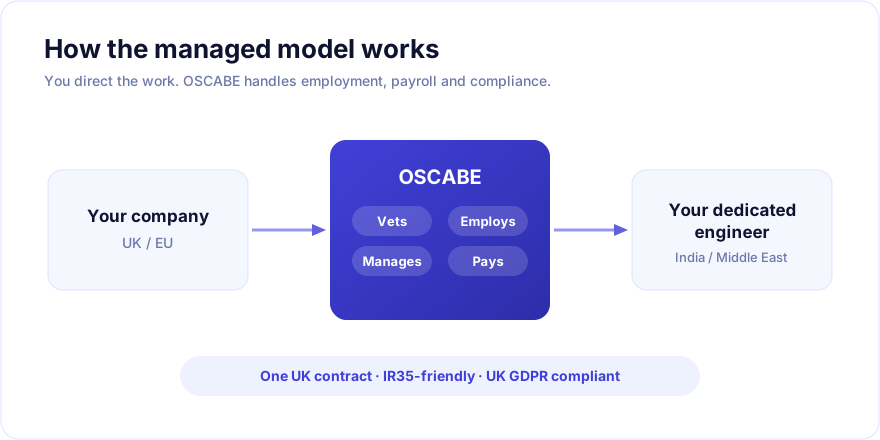
A genuine managed service changes the nature of the relationship, which is why it sits differently from inside-IR35 contracting. With OSCABE, you are not engaging an individual through a personal service company. You are buying a business-to-business managed service under one UK contract, where OSCABE employs the people, manages delivery, and is responsible for the outcome.
That distinction matters because:
- The people are employed by the provider, not supplied as disguised employees. OSCABE recruits, employs, manages and pays the engineer locally in India or the Middle East.
- The contract is for a managed service and outcome, not for the personal labour of a named individual operating like staff.
- The provider carries the delivery and employment obligations, so the off-payroll status question that applies to personal service company contractors does not arise in the same way.
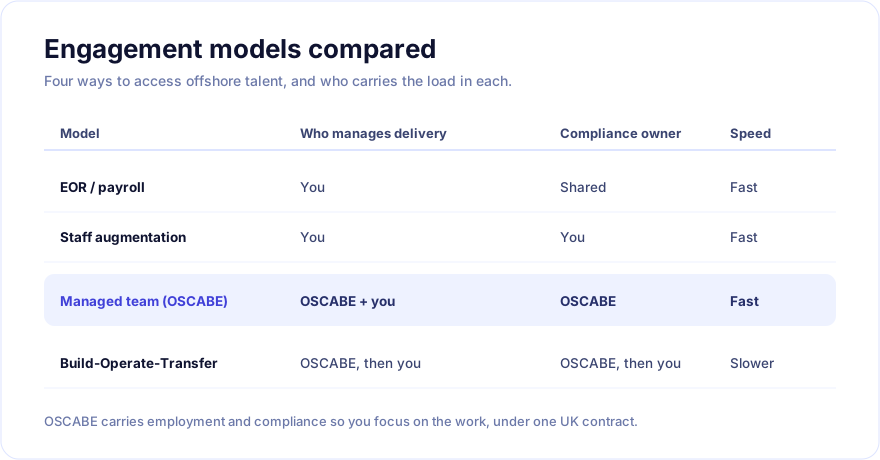
This is genuinely different from staff augmentation that simply places a contractor inside your team. The table below contrasts the common models.
| Model | What you engage | IR35 exposure |
|---|---|---|
| PSC contractor inside your team | An individual via their company | High; client determines and may carry liability |
| Day-rate contractor (inside) | An individual, taxed as employment | Client / fee-payer operates PAYE |
| Staff augmentation | A supplied individual working as your staff | Depends on facts; can attract scrutiny |
| Managed service (OSCABE) | A B2B service with provider-employed staff | Structured to sit outside the off-payroll rules |
As always, the facts of each engagement matter, and you should take your own advice. But the structural reason a managed model is described as IR35-friendly is that it is a real outsourced service, not a relabelled employment relationship. You can see how this works on our how it works page.
Frequently asked questions
What does inside IR35 mean?
Inside IR35 means HMRC considers the engagement to be, in substance, employment. The worker's income is taxed broadly like a salary, with income tax and National Insurance applied, even though they work through their own company. For medium and large clients, the client determines this status and can carry the liability if the determination is wrong.
Who is responsible for IR35 status in 2026?
For medium and large clients, the client is responsible for determining a contractor's IR35 status and issuing a Status Determination Statement. The fee-payer in the chain operates PAYE where a role is inside. If the determination is wrong, HMRC can pursue the client or fee-payer for unpaid tax, NI, interest and penalties. Small clients are treated differently; check current HMRC guidance.
Does IR35 apply to a managed service or offshore team?
A genuine managed service is a business-to-business contract where the provider employs the staff and owns delivery, which is structurally different from engaging an individual contractor through a personal service company. With OSCABE, the engineer is employed and managed by OSCABE, so the off-payroll status question that applies to PSC contractors does not arise in the same way. The specific facts still matter, so take your own advice. See our IR35 and offshore developers explainer.
Is a managed remote team cheaper than an inside-IR35 contractor?
Usually, and more predictably. Inside-IR35 day-rate contractors often cost £400 to £600 per day, around £88,000 to £130,000 per year, plus the administrative burden of status determination. A managed remote engineer through OSCABE starts from £2,000 per month as a single fee with compliance handled. Compare the wider economics in the total cost of ownership: offshore vs in-house.
Take the IR35 question off your plate
If IR35 administration and risk are slowing down how you add engineering capacity, a genuine managed service removes the off-payroll question from the equation while still giving you a dedicated, vetted professional. When you want to understand how it would apply to your situation, talk to OSCABE for a transparent monthly quote under one UK contract, and browse vetted profiles on our engineers page. Remember this article is general information, not legal or tax advice; take qualified advice before making status decisions.