
To hire remote Salesforce developers in 2026, first decide whether you need configuration and admin work, custom Apex and Lightning development, or platform architecture, then choose between a UK direct hire at roughly GBP 55k-130k, a contractor, or a fully-managed remote professional. With UK Salesforce architects in short supply and day rates rising, the lowest-risk route is often a managed remote Salesforce developer, admin or architect from OSCABE: a dedicated, pre-vetted professional under one UK contract from £2,000/month, IR35-friendly and UK/EU GDPR compliant, working in your core hours.
What does a Salesforce developer do?
Salesforce is a configuration-first platform, so the work spans a spectrum from clicks to code. At one end an administrator configures objects, flows, permissions and reports without writing code; at the other a developer extends the platform with Apex, Lightning Web Components and integrations; and an architect sits above both, owning data model, security and the overall solution design. Most growing Salesforce orgs need a blend of all three, which is why hiring well means matching the person to the layer of work, not just the job title.
Typical responsibilities across the Salesforce roles include:
- Configuring objects, flows, validation rules, page layouts and security with declarative tools.
- Writing custom business logic in Apex, plus triggers, batch jobs and asynchronous processing.
- Building user interfaces with Lightning Web Components (LWC) and Aura.
- Integrating Salesforce with external systems through REST and SOAP APIs, platform events and middleware.
- Managing deployments, environments and release pipelines, often with Salesforce DX and Git.
- Owning data model, sharing and security architecture, and keeping the org scalable and maintainable.
A strong Salesforce professional understands governor limits, the declarative-versus-programmatic trade-off, and when configuration is the right answer instead of custom code.
Admin, developer or architect: which do you need?
The most common hiring mistake on Salesforce is buying the wrong layer. A great deal of platform work can be solved with configuration, so paying senior developer rates for tasks an admin should handle wastes budget; conversely, asking an admin to build complex Apex integrations sets the project up to fail. Map the work first.
- Administrator: day-to-day configuration, user management, reports, dashboards and declarative automation with Flow. The right hire when your processes change often but you rarely need custom code.
- Developer: Apex, LWC, triggers and integrations for logic the platform cannot express declaratively. The right hire when you are extending Salesforce or connecting it to other systems.
- Architect: data model, security model, multi-cloud design, large-scale integration and technical governance. The right hire when your org has grown complex, spans multiple business units, or is heading for a major implementation.
Many teams need a developer who can also administer, plus access to architect-level judgement for the decisions that are expensive to reverse. A managed provider can blend these levels in one engagement rather than forcing you to over-hire on a single profile.
How much do remote Salesforce developers cost?
Salesforce talent commands a premium because the ecosystem is large, certification-driven and consistently short of experienced people, especially at architect level. Based on public salary guides and market data (such as Glassdoor and surveys from Hays and Robert Half), UK Salesforce administrators typically earn around GBP 40k-60k, developers around GBP 60k-90k mid-level and GBP 95k-130k+ senior, while certified technical architects sit higher again and are genuinely hard to recruit. Contractor day rates commonly run GBP 450-800+, with architects at the top of that range. A managed offshore professional delivers comparable capability as one predictable monthly fee.
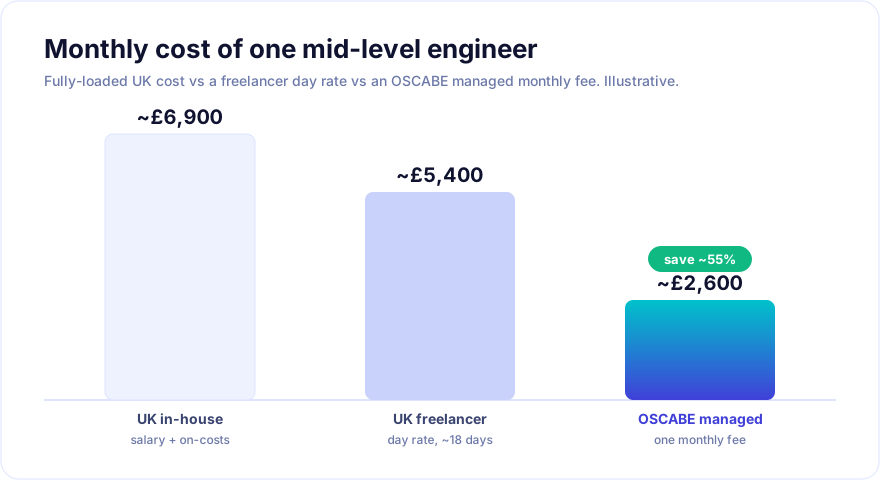
| Seniority | UK local salary (base) | UK fully-loaded annual | OSCABE managed monthly | OSCABE managed annual |
|---|---|---|---|---|
| Salesforce admin | £40k-£60k | ~£54k-£78k | from £2,000 | from £24,000 |
| Mid Salesforce developer | £60k-£90k | ~£80k-£116k | ~£2,800-£3,600 | ~£34k-£43k |
| Senior developer | £95k-£130k+ | ~£124k-£168k+ | ~£3,900-£4,900 | ~£47k-£59k |
| Technical architect | £120k-£160k+ | ~£155k-£205k+ | ~£4,500-£5,800 | ~£54k-£70k |
| Salesforce pod (3-4) | £210k-£340k+ | £270k-£440k+ | from £7,500 | from £90,000 |
OSCABE provides a Managed Remote Employee from £2,000/month and a Managed Remote Team or pod from £7,500/month, billed in GBP or EUR under one UK contract. For broader salary context see the cost to hire a software engineer in the UK, and for where ecosystem talent and rates sit globally the offshore rates by country guide.
Why is there a Salesforce architect shortage?
Salesforce architects are scarce for structural reasons, not a passing market dip. Becoming a credible architect requires years of hands-on platform delivery, breadth across multiple clouds, and the certifications that culminate in the Application and System Architect tracks. That pipeline is long, and demand from enterprises rolling out Sales Cloud, Service Cloud and increasingly Data Cloud keeps outpacing supply. The result in the UK and EU is long vacancy times, rising day rates and aggressive competition for the few certified technical architects on the market.
This scarcity is exactly where a managed offshore route helps. The global Salesforce ecosystem is enormous, with deep certified talent in India in particular, so a managed provider can reach architect-level capability that is slow and expensive to recruit locally, and present it under one UK contract.
What Salesforce skills should you look for?
Match the professional to the layer of work and your clouds:
- Apex: triggers, classes, asynchronous patterns (batch, queueable, future) and a firm grasp of governor limits and bulkification.
- Lightning: Lightning Web Components and Aura, plus the modern LWC-first approach to UI.
- Declarative tools: Flow, validation rules, security and sharing, knowing when configuration beats code.
- Integration: REST and SOAP APIs, platform events, Change Data Capture and middleware such as MuleSoft.
- DevOps: Salesforce DX, source-driven development, Git and automated deployment pipelines.
- Clouds and data model: Sales Cloud, Service Cloud, Experience Cloud and increasingly Data Cloud, with sound object and sharing design.
For platform standards, the official Salesforce developer documentation is a useful benchmark when assessing competence. Certifications (Platform Developer I and II, Administrator, and the architect tracks) are a helpful signal, but practical delivery within governor limits matters more than badge count.
Where can you find remote Salesforce developers?
Three routes:
- Job boards and direct hire: maximum control but the highest cost and slowest path, and at architect level the local pool is thin enough to stall for months.
- Consultancies and contractors: fast access to skills but high day rates, variable continuity and limited team integration.
- Managed remote teams: a provider sources, vets and employs dedicated Salesforce professionals (typically from India or the UAE/Middle East, where ecosystem talent is deep) under one Western contract.
OSCABE is a managed service rather than a marketplace, so your Salesforce professional works only for you and integrates into your team. See how it works, or go straight to hire remote software engineers. For a full-stack pairing around custom UI and APIs, our full-stack hiring guide is a useful companion.
How do you vet a remote Salesforce developer?
Effective Salesforce vetting tests platform judgement, not just certification recall:
- A practical exercise: build a small Apex trigger with bulkification and tests, or a Flow plus LWC for a given requirement.
- A code and configuration review focused on governor limits, security, the declarative-versus-code decision and clean structure.
- A design discussion on data model, sharing rules and integrating Salesforce with an external system at scale.
- Communication and English assessment for cross-border collaboration, plus references and ID checks.
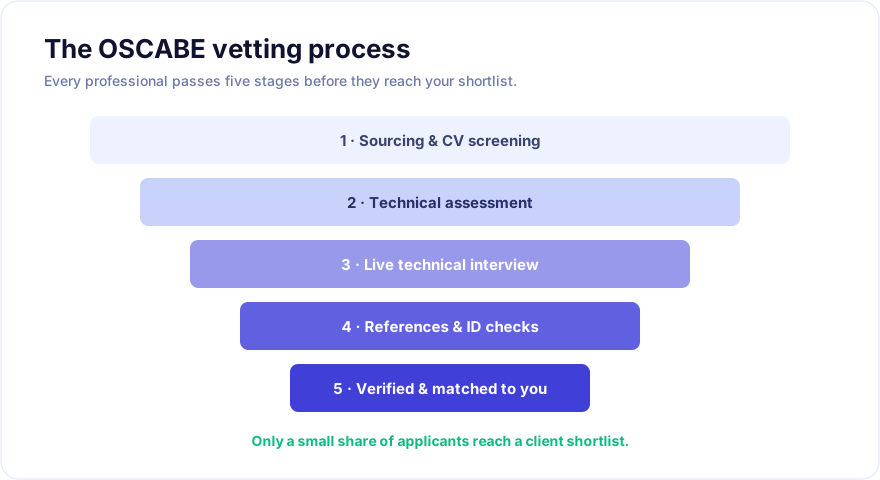
OSCABE applies a 5-stage vetting process covering technical screening, practical assessment, communication, references and culture fit, so capable professionals reach you ready to contribute.
Our guide to hiring remote developers from India explains the sourcing pipeline behind this.
How do time zones and the managed model work?
India (GMT+5:30) and the UAE (GMT+4) overlap generously with the UK and CET working day, giving 4 to 6 hours of shared time for stand-ups, refinement and reviews, plus earlier-morning coverage for releases and admin work. OSCABE aligns hours to your core schedule for real-time collaboration.
The managed model removes the parts of remote hiring that go wrong, and for a scarce, certification-heavy skill like Salesforce it also removes the long local search. Instead of juggling contractors and consultancies, you get a dedicated professional employed and managed by OSCABE LTD (UK-registered, Company No. 15913493) while you keep full control of the work. Explore the structure on our managed teams and how it works pages.
How do IR35 and UK GDPR apply?
Two compliance points matter for Salesforce work. IR35: engaging individual offshore contractors directly can create employment-status and tax risk, whereas contracting with OSCABE for a managed service keeps the engagement IR35-friendly - see our IR35 and offshore developers explainer. Data protection: Salesforce orgs hold customer and personal data by definition, so UK and EU GDPR-compliant arrangements are essential. OSCABE operates under GDPR-compliant, ISO 9001:2015-certified processes with appropriate controls.
How long does it take to hire?
Hiring a Salesforce developer directly in the UK typically takes 6-12 weeks including notice, and recruiting a certified architect frequently runs longer because the pool is so small. A managed route is far faster: OSCABE can present vetted Salesforce professionals within days and onboard a dedicated developer, admin, architect or pod quickly, because vetting and contracting are already in place. Review options on our pricing page or meet our engineers.
Frequently asked questions
Do I need a Salesforce developer or an administrator?
It depends on the work. Choose an administrator for configuration, flows, reports and user management; choose a developer for Apex, Lightning Web Components and integrations the platform cannot handle declaratively. OSCABE can match the right layer, or a developer who also administers, to suit your org.
Can you provide a certified Salesforce architect?
Yes. Architect-level talent is the hardest Salesforce skill to recruit in the UK, so OSCABE draws on the deep certified pool in India and the Middle East to match architects for data model, security and large-scale integration work under one UK contract.
Is a managed Salesforce developer cheaper than a UK hire?
Typically, yes. A mid-level UK Salesforce developer costs around £80k-£116k fully loaded, while a managed remote professional starts at £2,000/month with no recruiter fees, employer NI or equipment costs to add.
Will the professional work in our hours and tools?
Yes. OSCABE aligns hours to your UK or CET core schedule and embeds the professional in your Salesforce org, sandboxes and workflows as a dedicated team member.
Ready to add Salesforce talent to your team?
If you need reliable Salesforce development, administration or architecture without the UK salary bill or a months-long search for scarce certified talent, a managed remote professional is the pragmatic choice. OSCABE delivers dedicated, vetted Salesforce developers, admins and architects in your core hours, under one UK contract, IR35-friendly and UK/EU GDPR compliant, from £2,000/month. Get in touch or meet our engineers to start matching candidates today.