
To hire remote QA and test automation engineers for UK and EU teams in 2026, first decide whether you need manual QA, automation engineering or a blend, then choose between a direct hire at roughly GBP 40k-90k, a freelancer, or a fully-managed remote engineer. The lowest-risk route is a managed QA engineer from OSCABE: a dedicated, pre-vetted tester or SDET under one UK contract from £2,000/month, IR35-friendly and UK/EU GDPR compliant, working in your core hours.
What does a QA or test automation engineer do?
Quality assurance protects your release quality and your reputation. A QA engineer designs test cases, finds defects before users do, and verifies that features behave as specified. A test automation engineer (often called an SDET) goes further, writing code that exercises the application automatically so regressions are caught on every commit rather than by hand.
Typical responsibilities include:
- Writing and maintaining test plans, cases and exploratory test charters.
- Building automated UI, API and end-to-end test suites.
- Wiring tests into CI/CD so they run on every pull request and deployment.
- Triaging defects, reproducing issues and verifying fixes.
- Reporting on coverage, flakiness and release readiness.
In lean teams a single capable automation engineer can lift quality across the whole product, which is why the role pays for itself quickly.
Manual QA vs automation: which do you need?
The two are complementary, not interchangeable:
- Manual QA: ideal for exploratory testing, usability, new features without stable specs, and edge cases that are hard to script. Lower cost, faster to start, but does not scale to large regression suites.
- Test automation (SDET): ideal for regression, repeated checks and fast feedback in CI. Higher skill and cost, slower to set up, but pays off as the product and test surface grow.
Most teams want a blend: manual testing for new and exploratory work, automation for the stable regression core. A good hire can do both and knows when each is the right tool.
Building a test strategy, not just running tests
The value of a strong QA engineer is not the number of tests they write but the strategy behind them. A sensible approach follows the test pyramid: many fast unit tests, a smaller layer of integration and API tests, and a thin layer of slower end-to-end UI tests reserved for the journeys that matter most. Over-investing in brittle UI tests is one of the most common and expensive mistakes teams make.
A good engineer also manages the things that quietly erode trust in a suite: flaky tests that fail at random, slow pipelines that developers learn to ignore, and coverage that looks high but misses the risky paths. They prioritise by risk, keep the suite fast and reliable, and report honestly on what is and is not covered. When you hire, look for someone who talks about strategy and maintainability, not just tools.
How much do remote QA engineers cost?
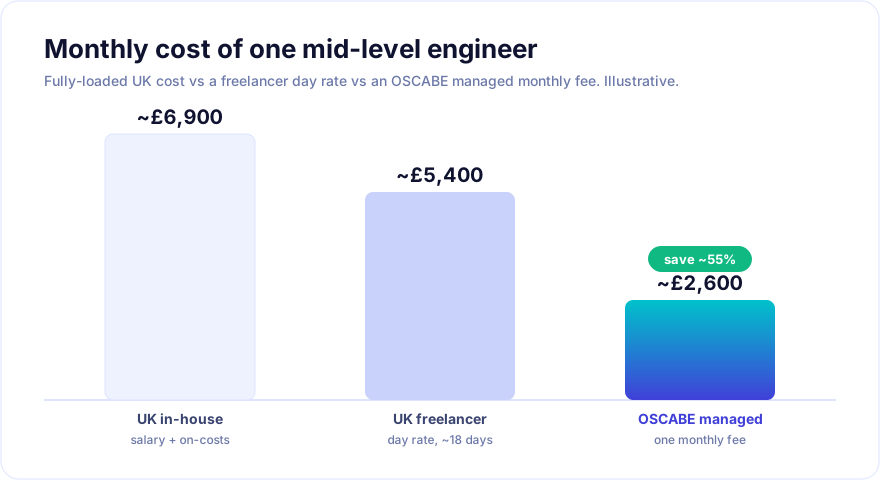
QA salaries vary with the automation skill premium - SDETs who write robust frameworks command materially more than manual testers. Based on aggregated market data and recruiter salary guides (such as Glassdoor and surveys from Hays and Robert Half), UK QA engineers typically earn around GBP 35k-50k for manual roles, GBP 50k-70k for mid automation, and GBP 75k-90k+ for senior SDET and lead roles. Freelance day rates commonly run GBP 300-550+. A managed offshore engineer delivers comparable capability as one predictable monthly fee.
| Seniority | UK local salary (base) | UK fully-loaded annual | OSCABE managed monthly | OSCABE managed annual |
|---|---|---|---|---|
| Manual QA | £35k-£50k | ~£48k-£65k | from £2,000 | from £24,000 |
| Mid automation / SDET | £50k-£70k | ~£68k-£90k | ~£2,800-£3,500 | ~£34k-£42k |
| Senior SDET / QA lead | £75k-£90k+ | ~£98k-£118k+ | ~£3,800-£4,800 | ~£46k-£58k |
| QA pod (3-4 engineers) | £160k-£270k+ | £205k-£345k+ | from £7,500 | from £90,000 |
OSCABE provides a Managed Remote Employee from £2,000/month and a Managed Remote Team or pod from £7,500/month, billed in GBP or EUR under one UK contract. For wider cost context see the true cost of an offshore development team and the full-stack hiring guide.
What QA and automation skills should you look for?
Match the engineer to your stack and testing maturity:
- Web automation: Playwright (modern, fast, cross-browser) or Cypress (developer-friendly, JavaScript-first) for end-to-end UI tests, plus Selenium where legacy suites exist.
- API testing: Postman, REST Assured or code-based API tests, plus contract testing for services.
- Frameworks and languages: TypeScript/JavaScript, Python or Java/C# depending on your stack and chosen tool.
- CI/CD integration: running suites in GitHub Actions, GitLab CI or Jenkins, with sensible parallelism and reporting.
- Quality engineering: test design, risk-based prioritisation, flaky-test management, and performance or accessibility testing where relevant.
- Mindset: a tester who thinks about how things break, not just whether the happy path works.
For tooling standards, the official Playwright documentation is a useful benchmark when assessing automation competence.
Where can you find remote QA engineers?
Three routes:
- Job boards and direct hire: maximum control, highest cost and slowest, with all compliance on you.
- Freelance marketplaces: fast but inconsistent, with no IR35 or GDPR cover and variable quality.
- Managed remote teams: a provider sources, vets and employs dedicated QA and automation engineers (typically from India or the UAE/Middle East) under one Western contract.
OSCABE is a managed service rather than a marketplace, so your QA engineer works only for you and integrates into your team. See how it works, or go straight to hire remote QA engineers. If you are pairing QA with delivery teams, our DevOps hiring guide covers the CI side.
How do you vet a remote QA engineer?
Effective QA vetting tests both judgement and craft:
- A practical exercise: write test cases for a given feature, then automate a short end-to-end or API scenario.
- A code review of an existing test suite, looking at structure, reliability and maintainability.
- A discussion on test strategy: what to automate, what to leave manual, and how to handle flakiness.
- Communication and English assessment for cross-border collaboration, plus references and ID checks.
OSCABE applies a 5-stage vetting process covering technical screening, practical assessment, communication, references and culture fit, so capable engineers reach you ready to contribute.
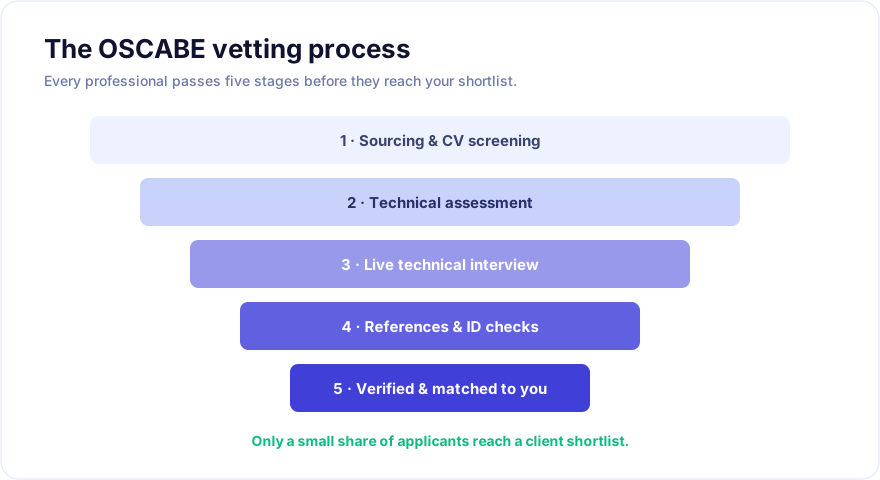
The same pipeline behind our full-stack hiring guide applies to QA roles.
How do time zones and the managed model work?
India (GMT+5:30) and the UAE (GMT+4) overlap generously with the UK and CET working day, giving 4 to 6 hours of shared time for stand-ups, defect triage and test reviews, plus earlier-morning regression runs that are ready before your team logs on. OSCABE aligns engineer hours to your core schedule for real-time collaboration.
The managed model means you get a dedicated QA engineer employed and managed by OSCABE LTD (UK-registered, Company No. 15913493) while you keep full control of the work. Explore the structure on our managed teams and how it works pages, and for the economics read the true cost of an offshore development team.
How do IR35 and GDPR apply?
Two compliance points matter. IR35: engaging individual offshore contractors directly can create employment-status and tax risk, whereas contracting with OSCABE for a managed service keeps the engagement IR35-friendly - see our IR35 and offshore developers explainer. Data protection: QA engineers often work with test data derived from real records, so UK and EU GDPR-compliant arrangements and proper data handling are essential. OSCABE operates under GDPR-compliant, ISO 9001:2015-certified processes with appropriate controls.
How long does it take to hire?
Hiring a QA or automation engineer directly in the UK or EU typically takes 6-12 weeks including notice periods. A managed route is far faster: OSCABE can present vetted QA engineers within days and onboard a dedicated tester or pod quickly, because vetting and contracting are already in place. Review options on our pricing page or meet our engineers.
Frequently asked questions
Should I hire a manual tester or an automation engineer first?
It depends on your product stage. If you ship frequently and lack a regression safety net, an automation engineer pays off fast. If your features are still changing shape, start with strong manual QA and add automation as the core stabilises. OSCABE can match either, or one engineer who does both.
Is a managed QA engineer cheaper than a UK hire?
Typically, yes. A mid-level UK automation engineer costs around £68k-£90k fully loaded, while a managed remote QA engineer starts at £2,000/month with no recruiter fees, employer NI or equipment costs to add.
Can your QA engineers set up automation from scratch?
Yes. A senior SDET can stand up a Playwright, Cypress or Selenium framework, wire it into your CI, and build the first regression suite, then hand a maintainable foundation to your team.
Will the engineer work in our hours and tools?
Yes. OSCABE aligns engineer hours to your UK or CET core schedule and embeds them in your test management, CI and tracking tools as a dedicated team member.
Ready to raise your release quality?
If you need dependable QA and test automation without the UK salary bill or the freelancer lottery, a managed remote QA engineer is the pragmatic choice. OSCABE delivers dedicated, vetted QA and automation engineers in your core hours, under one UK contract, IR35-friendly and UK/EU GDPR compliant, from £2,000/month. Get in touch or meet our engineers to start matching candidates today.