
To hire remote Node.js developers in 2026, decide whether you need API and microservices work, real-time systems or full-stack JavaScript, then choose between a direct UK hire at roughly GBP 50k-105k, a freelancer, or a fully-managed remote developer. The lowest-risk route is a managed remote Node.js developer from OSCABE: a dedicated, pre-vetted engineer under one UK contract from £2,000/month, IR35-friendly and UK/EU GDPR compliant, working in your core hours.
What does a Node.js developer do?
A Node.js developer builds server-side applications in JavaScript or TypeScript on the Node runtime. Node's event-driven, non-blocking model makes it a strong fit for APIs, microservices, real-time features and high-concurrency workloads, which is why it underpins so many SaaS products and modern backends. Because it shares a language with the browser, Node also lets product teams run JavaScript end to end.
Typical responsibilities include:
- Designing and building REST or GraphQL APIs and backend services.
- Architecting microservices and the messaging between them.
- Building real-time features with WebSockets or server-sent events.
- Integrating databases, caches, queues and third-party APIs.
- Writing tests, handling code review and keeping services observable and supportable.
A capable Node developer pairs JavaScript fluency with solid backend fundamentals: data modelling, security, performance and clean architecture.
When is Node.js the right choice?
Node.js is not the answer to every backend problem, and a good hire will tell you so. It shines for I/O-bound, high-concurrency workloads: API gateways, real-time chat and notifications, streaming, and the kind of glue services that spend most of their time waiting on databases and other APIs. It is less suited to heavy CPU-bound number crunching, where a worker offload or a different runtime usually fits better.
For most product teams the decisive advantage is one language across the stack. A team fluent in JavaScript or TypeScript can move people between frontend and backend, share validation and types, and ship faster with a smaller group. If your front end already runs React, a Node backend keeps the mental model consistent and reduces context switching. When you weigh Node against Python, Go or .NET, the choice usually comes down to your team's existing skills, the shape of your workload, and the ecosystem your integrations live in.
How much do remote Node.js developers cost?
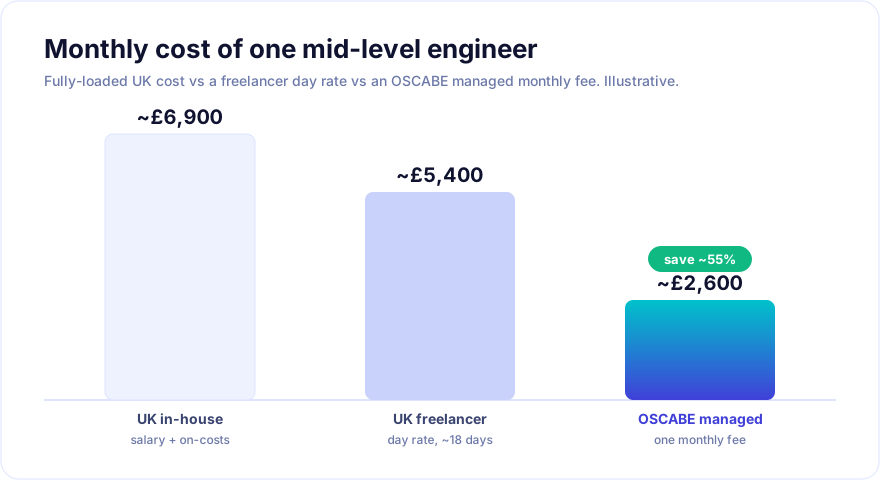
Node.js demand stays high because it powers both startups and enterprise backends. Based on aggregated market data and recruiter salary guides (such as Glassdoor and surveys from Hays and Robert Half), UK Node.js developers typically earn around GBP 50k-70k mid-level and GBP 85k-105k+ at senior level, higher in London and for specialist real-time or platform work. Freelance day rates commonly run GBP 350-650+. A managed offshore developer delivers comparable capability as one predictable monthly fee.
| Seniority | UK local salary (base) | UK fully-loaded annual | OSCABE managed monthly | OSCABE managed annual |
|---|---|---|---|---|
| Junior Node.js | £40k-£52k | ~£54k-£68k | from £2,000 | from £24,000 |
| Mid Node.js | £55k-£72k | ~£74k-£93k | ~£2,800-£3,500 | ~£34k-£42k |
| Senior Node.js | £85k-£105k+ | ~£110k-£135k+ | ~£3,800-£4,800 | ~£46k-£58k |
| Node.js pod (3-4 devs) | £180k-£290k+ | £230k-£370k+ | from £7,500 | from £90,000 |
OSCABE provides a Managed Remote Employee from £2,000/month and a Managed Remote Team or pod from £7,500/month, billed in GBP or EUR under one UK contract. For salary context see the cost to hire a software engineer in the UK and our Python hiring guide for a backend comparison.
What Node.js skills should you look for?
Match the developer to your architecture and framework choice:
- Frameworks: Express (minimal, ubiquitous), NestJS (opinionated, TypeScript-first, great for larger codebases) or Fastify for high throughput.
- Language: modern JavaScript and, increasingly, TypeScript for type safety on larger teams.
- APIs and integration: REST and GraphQL design, authentication and authorisation, message queues (RabbitMQ, Kafka) and event-driven patterns.
- Databases: PostgreSQL and MongoDB, with sensible data modelling, plus Redis for caching and sessions.
- Architecture: microservices, API gateways and an understanding of Node's single-threaded event loop and where to offload heavy work.
- Engineering practice: testing (Jest, Vitest), Docker, CI/CD and observability.
For platform standards, the official Node.js documentation is a useful benchmark when assessing competence. The strongest Node hires understand the event loop and concurrency, not just framework syntax.
Where can you find remote Node.js developers?
Three routes:
- Job boards and direct hire: maximum control, highest cost and slowest, with all compliance on you.
- Freelance marketplaces: fast and flexible but inconsistent, with no IR35 or GDPR cover and high churn.
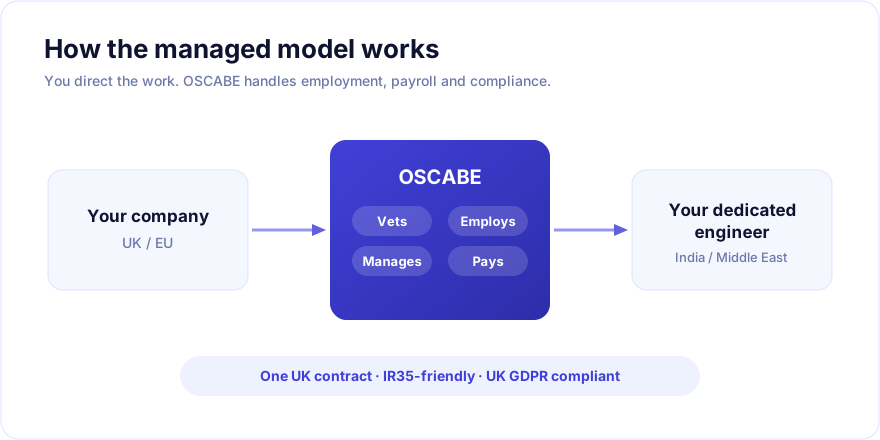
- Managed remote teams: a provider sources, vets and employs dedicated Node.js developers (typically from India or the UAE/Middle East) under one Western contract.
OSCABE is a managed service rather than a marketplace, so your Node.js developer works only for you and integrates into your team. See how it works, or go straight to hire remote Node.js developers. For frontend pairings, our React hiring guide is a useful companion.
How do you vet a remote Node.js developer?
Effective Node vetting balances practical coding with architectural judgement:
- A live or take-home exercise: build a small Express or NestJS API, add a data layer, or debug an async bug.
- A code review focused on async correctness, error handling, security and clean structure.
- A design discussion on scaling a service, choosing between monolith and microservices, and handling load.
- Communication and English assessment for cross-border collaboration, plus references and ID checks.
OSCABE applies a 5-stage vetting process covering technical screening, practical assessment, communication, references and culture fit, so capable developers reach you ready to contribute. Our guide to hiring remote developers from India explains the sourcing pipeline.
Common mistakes when hiring Node.js developers
A few patterns trip up teams that hire on framework keywords alone:
- Confusing JavaScript familiarity with backend depth. Many candidates can wire up an Express route but cannot reason about connection pooling, transactions or backpressure. Test the fundamentals, not the syntax.
- Ignoring the event loop. Blocking the single thread with synchronous work is the classic Node failure mode. A strong developer knows what belongs in a worker, a queue or a separate service.
- No TypeScript discipline on a growing codebase. Plain JavaScript is fine for small services, but on a larger team weak typing turns into runtime bugs. Look for sensible typing habits.
- Overlooking security. Input validation, dependency hygiene and safe handling of secrets matter as much in Node as anywhere; ask how they manage them.
Hiring through a managed provider removes much of this risk, because these checks are built into structured vetting rather than left to a single interview.
How do time zones and the managed model work?
India (GMT+5:30) and the UAE (GMT+4) overlap generously with the UK and CET working day, giving 4 to 6 hours of shared time for stand-ups, pairing and reviews, plus earlier-morning coverage. OSCABE aligns developer hours to your core schedule for real-time collaboration.
The managed model removes the parts of remote hiring that go wrong. Instead of juggling freelancers, you get a dedicated developer employed and managed by OSCABE LTD (UK-registered, Company No. 15913493) while you keep full control of the work.
Explore the structure on our managed teams and how it works pages, and compare approaches in the Python hiring guide.
How do IR35 and UK GDPR apply?
Two compliance points matter. IR35: engaging individual offshore contractors directly can create employment-status and tax risk, whereas contracting with OSCABE for a managed service keeps the engagement IR35-friendly - see our IR35 and offshore developers explainer. Data protection: Node.js services often handle user and personal data, so UK and EU GDPR-compliant arrangements are essential. OSCABE operates under GDPR-compliant, ISO 9001:2015-certified processes with appropriate controls.
How long does it take to hire?
Hiring a Node.js developer directly in the UK typically takes 6-12 weeks including notice periods. A managed route is far faster: OSCABE can present vetted Node.js developers within days and onboard a dedicated developer or pod quickly, because vetting and contracting are already in place. Review options on our pricing page or meet our engineers.
Frequently asked questions
Express or NestJS: which should I hire for?
It depends on your codebase. Choose Express for lightweight services and maximum flexibility; choose NestJS for larger, TypeScript-first applications that benefit from structure and conventions. OSCABE can match a developer experienced in whichever your stack uses.
Is a managed Node.js developer cheaper than a UK hire?
Typically, yes. A mid-level UK Node.js developer costs around £74k-£93k fully loaded, while a managed remote developer starts at £2,000/month with no recruiter fees, employer NI or equipment costs to add.
Can a Node.js developer also do front-end work?
Often, yes. Many Node developers are comfortable across the JavaScript stack with React or similar, making them effective full-stack hires. OSCABE can match a full-stack or backend-focused profile to suit.
Will the developer work in our hours and tools?
Yes. OSCABE aligns developer hours to your UK or CET core schedule and embeds them in your stack and workflows as a dedicated team member.
Ready to add Node.js talent to your team?
If you need reliable Node.js engineering without the UK salary bill or the freelancer lottery, a managed remote developer is the pragmatic choice. OSCABE delivers dedicated, vetted Node.js developers in your core hours, under one UK contract, IR35-friendly and UK/EU GDPR compliant, from £2,000/month. Get in touch or meet our engineers to start matching candidates today.