
To hire remote Golang developers in 2026, decide whether you need backend microservices, cloud-native infrastructure or high-performance systems work, then choose between a direct UK hire at roughly GBP 60k-120k, a freelancer, or a fully-managed remote developer. Because experienced Go engineers are comparatively scarce, the lowest-risk and fastest route is often a managed remote Golang developer from OSCABE: a dedicated, pre-vetted engineer under one UK contract from £2,000/month, IR35-friendly and UK/EU GDPR compliant, working in your core hours.
What does a Go developer do?
A Go (Golang) developer builds fast, concurrent backend services in a language designed by Google for simplicity and scale. Go compiles to a single static binary, starts instantly and handles thousands of concurrent connections cheaply, which makes it a default choice for microservices, APIs, networking tools and cloud-native infrastructure. Much of the modern infrastructure stack - including Docker, Kubernetes and many CNCF projects - is itself written in Go.
Typical responsibilities include:
- Designing and building high-throughput backend services and APIs.
- Writing concurrent code with goroutines and channels, safely and idiomatically.
- Building and operating microservices, often on Kubernetes.
- Developing CLI tools, networking services and platform components.
- Writing tests, handling code review and keeping services lean and observable.
Go's deliberate simplicity means well-written code is easy to read and maintain, but using concurrency correctly still takes real experience.
Go vs other backend languages
Choosing Go is usually a deliberate trade-off. Compared with the main alternatives:
- Go vs Python: Go is far faster and handles concurrency natively, at the cost of Python's vast data and AI ecosystem. Teams often use Python for data and ML and Go for the performance-critical services around it.
- Go vs Node.js: both suit high-concurrency I/O, but Go's static typing, compiled performance and goroutine model make it stronger for CPU-aware backend services and infrastructure, while Node keeps one language across the front end.
- Go vs Java: Go offers much simpler deployment (a single binary), faster start-up and lower memory use, which is why many cloud-native and platform teams have moved workloads from the JVM to Go.
The pattern is consistent: teams reach for Go when they need predictable performance, cheap concurrency and simple operations, particularly in platform, infrastructure and high-throughput backend roles.
Why are Go developers scarce, and what does that mean for rates?
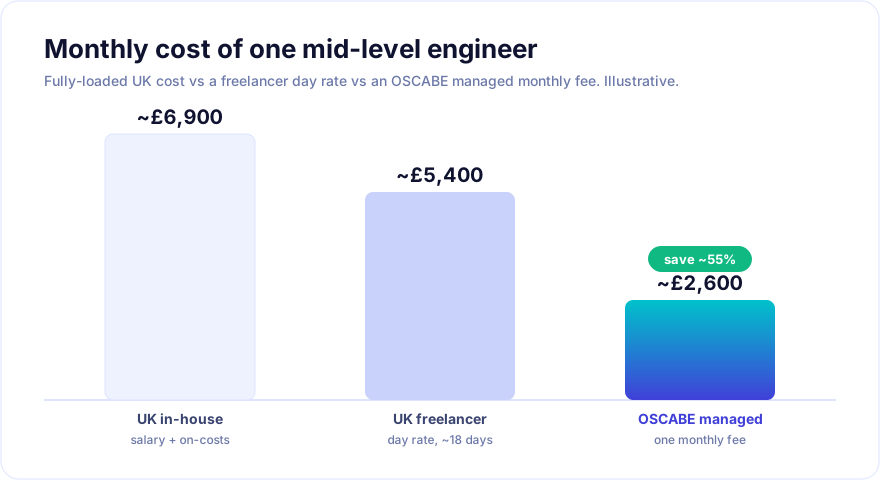
Go is widely used in infrastructure and platform teams but is taught less often than Java, Python or JavaScript, so the pool of genuinely experienced Go engineers is smaller than demand. That scarcity pushes salaries toward the top of the backend range and makes direct hiring slow. Based on aggregated market data and recruiter salary guides (such as Glassdoor and surveys from Hays and Robert Half), UK Go developers typically earn around GBP 65k-85k mid-level and GBP 100k-120k+ at senior level, with platform and infrastructure specialists higher again. Freelance day rates commonly run GBP 450-750+. A managed offshore developer delivers comparable capability as one predictable monthly fee, and sidesteps the slow local search.
| Seniority | UK local salary (base) | UK fully-loaded annual | OSCABE managed monthly | OSCABE managed annual |
|---|---|---|---|---|
| Junior Go | £45k-£58k | ~£60k-£75k | from £2,000 | from £24,000 |
| Mid Go | £65k-£85k | ~£85k-£110k | ~£3,000-£3,700 | ~£36k-£44k |
| Senior Go / platform | £100k-£120k+ | ~£128k-£155k+ | ~£4,000-£5,000 | ~£48k-£60k |
| Go pod (3-4 devs) | £210k-£330k+ | £270k-£420k+ | from £7,500 | from £90,000 |
OSCABE provides a Managed Remote Employee from £2,000/month and a Managed Remote Team or pod from £7,500/month, billed in GBP or EUR under one UK contract. For cross-country rate context see our offshore rates by country guide and the DevOps and cloud cost guide.
What Go skills should you look for?
Match the developer to your workload and infrastructure:
- Core language: idiomatic Go, the standard library, error handling and a clear grasp of interfaces and composition over inheritance.
- Concurrency: goroutines, channels, context cancellation, and avoiding race conditions and deadlocks - the area where experience matters most.
- Services and APIs: REST and gRPC, with frameworks such as the standard net/http, Gin or Echo.
- Cloud-native: Docker, Kubernetes, and building services that scale horizontally; familiarity with CNCF tooling is a strong signal.
- Data and messaging: PostgreSQL, Redis, and queues such as Kafka or NATS.
- Engineering practice: table-driven testing, benchmarks, profiling (pprof), CI/CD and observability.
For language standards, the official Go documentation is a useful benchmark when assessing competence. The clearest signal of seniority is correct, idiomatic concurrency under load.
Where can you find remote Go developers?
Three routes, with scarcity making the choice sharper:
- Job boards and direct hire: maximum control but highest cost and slowest, and with a thin local Go pool the search can drag on for months.
- Freelance marketplaces: fast but inconsistent, with no IR35 or GDPR cover and variable depth in concurrency.
- Managed remote teams: a provider sources, vets and employs dedicated Go developers (typically from India or the UAE/Middle East) under one Western contract, tapping a far larger global pool.
OSCABE is a managed service rather than a marketplace, so your Go developer works only for you and integrates into your team. See how it works, or go straight to hire remote backend developers. For where Go talent and rates sit globally, the offshore rates by country guide is a useful starting point.
How do you vet a remote Go developer?
Effective Go vetting probes concurrency and engineering judgement, not just syntax:
- A live or take-home exercise: build a small concurrent service or worker pool, or debug a data race.
- A code review focused on idiomatic Go, error handling, goroutine safety and clean interfaces.
- A design discussion on structuring microservices, handling backpressure and scaling under load.
- Communication and English assessment for cross-border collaboration, plus references and ID checks.
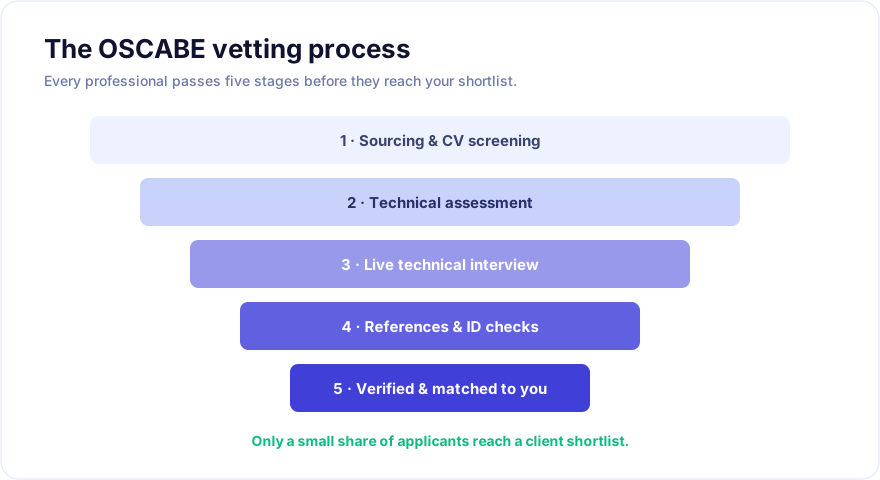
OSCABE applies a 5-stage vetting process covering technical screening, practical assessment, communication, references and culture fit, so capable developers reach you ready to contribute.
For teams pairing Go with infrastructure work, our DevOps hiring guide covers the operational side.
How do time zones and the managed model work?
India (GMT+5:30) and the UAE (GMT+4) overlap generously with the UK and CET working day, giving 4 to 6 hours of shared time for stand-ups, pairing and reviews, plus earlier-morning coverage. OSCABE aligns developer hours to your core schedule for real-time collaboration.
The managed model removes the parts of remote hiring that go wrong, and for a scarce skill like Go it also removes the long local search. Instead of juggling freelancers, you get a dedicated developer employed and managed by OSCABE LTD (UK-registered, Company No. 15913493) while you keep full control of the work. Explore the structure on our managed teams and how it works pages, and compare cloud roles in the DevOps and cloud cost guide.
How do IR35 and UK GDPR apply?
Two compliance points matter. IR35: engaging individual offshore contractors directly can create employment-status and tax risk, whereas contracting with OSCABE for a managed service keeps the engagement IR35-friendly - see our IR35 and offshore developers explainer. Data protection: Go services frequently process personal and operational data, so UK and EU GDPR-compliant arrangements are essential. OSCABE operates under GDPR-compliant, ISO 9001:2015-certified processes with appropriate controls.
How long does it take to hire?
Hiring a Go developer directly in the UK often takes longer than other backend roles because of the small talent pool, regularly stretching past 12 weeks. A managed route is far faster: OSCABE can present vetted Go developers within days and onboard a dedicated developer or pod quickly, because vetting and contracting are already in place. Review options on our pricing page or meet our engineers.
Frequently asked questions
Why is Go so well suited to microservices?
Go compiles to a small static binary, starts instantly and handles high concurrency cheaply through goroutines, so services are lightweight, fast and easy to deploy in containers. That is also why much of the cloud-native ecosystem, including Kubernetes, is written in Go.
Is a managed Go developer cheaper than a UK hire?
Typically, yes, and easier to find. A mid-level UK Go developer costs around £85k-£110k fully loaded and can be slow to recruit, while a managed remote developer starts at £2,000/month with no recruiter fees, employer NI or equipment costs to add.
Can your Go developers work with Kubernetes?
Many can. Go and Kubernetes are a natural pairing, so OSCABE can match a developer comfortable building and operating Go microservices on Kubernetes and the wider cloud-native stack.
Will the developer work in our hours and tools?
Yes. OSCABE aligns developer hours to your UK or CET core schedule and embeds them in your stack and workflows as a dedicated team member.
Ready to add Go talent to your team?
If you need scarce, high-quality Go engineering without a months-long local search or the freelancer lottery, a managed remote Golang developer is the pragmatic choice. OSCABE delivers dedicated, vetted Go developers in your core hours, under one UK contract, IR35-friendly and UK/EU GDPR compliant, from £2,000/month. Get in touch or meet our engineers to start matching candidates today.