
Hiring developers in Dublin in 2026 means competing directly with the European engineering hubs of Google, Meta, Amazon, Microsoft and a dense cluster of other multinationals, which pushes salaries high and supply tight. The pragmatic alternative for many UK and EU companies is a managed remote developer: a dedicated, pre-vetted engineer from OSCABE under one UK contract from £2,000/month, IR35-friendly and UK/EU GDPR compliant, working in your core hours, without entering the Dublin bidding war.
Why is hiring developers in Dublin so hard?
Dublin is one of Europe's most concentrated technology hubs, and that is precisely what makes local hiring difficult. The same multinationals that made Dublin attractive (Google, Meta, Amazon, Microsoft, LinkedIn, Stripe, and many more) also absorb a large share of the senior engineering talent and set the compensation benchmark. For a scale-up or SME, that means three structural challenges at once.
- Salary competition: you are bidding against employers who can pay FAANG-level total compensation, including equity that a smaller company cannot easily match.
- Tight supply: experienced engineers are in heavy demand and often already employed, so vacancies stay open and counter-offers are common.
- Cost of living and base pay: Dublin's high living costs feed through into salary expectations, lifting the floor on what candidates will accept.
The result is long time-to-hire, high salaries and real retention risk once you have hired, because the same large employers are always recruiting. None of this means Dublin is a poor place to build a team; it means the local market is expensive and competitive, and worth pairing with an alternative.
What do developers actually cost in Dublin?
Dublin developer salaries run at the upper end of the European range, driven by multinational competition. Based on public salary guides and market data (such as Glassdoor and recruiter surveys), Irish developers typically earn around EUR 55k-75k mid-level and EUR 90k-130k+ at senior level, with specialist and platform roles higher again, and the very top set by the multinationals' total-compensation packages. Once you add employer PRSI, recruitment fees, equipment and the cost of a long search, the fully-loaded figure climbs further. A managed offshore developer delivers comparable capability as one predictable monthly fee, billed in GBP or EUR.
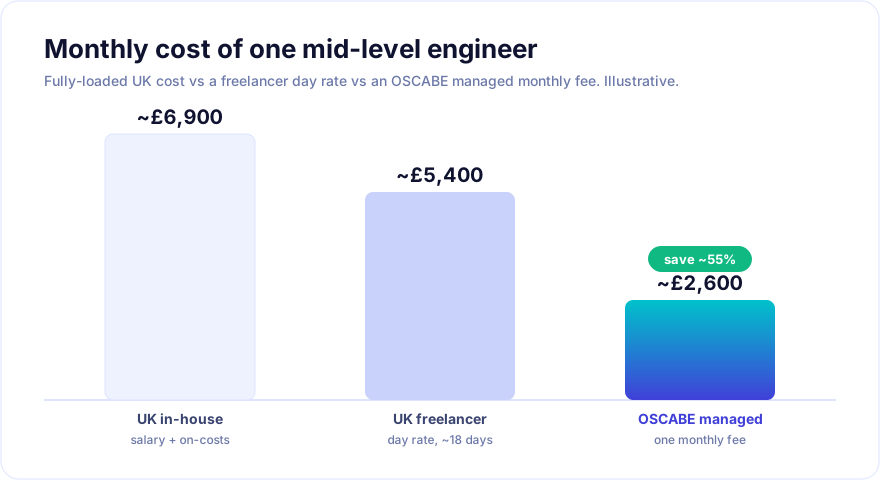
| Seniority | Dublin local salary (base) | Dublin fully-loaded annual | OSCABE managed monthly | OSCABE managed annual |
|---|---|---|---|---|
| Junior developer | €40k-€55k | ~€48k-€66k | from £2,000 | from £24,000 |
| Mid developer | €55k-€75k | ~€66k-€90k | ~£2,700-£3,500 | ~£32k-£42k |
| Senior developer | €90k-€130k+ | ~€108k-€156k+ | ~£3,800-£4,800 | ~£46k-£58k |
| Engineering pod (3-4) | €230k-€370k+ | €275k-€445k+ | from £7,500 | from £90,000 |
OSCABE provides a Managed Remote Employee from £2,000/month and a Managed Remote Team or pod from £7,500/month, billed in GBP or EUR under one UK contract. For a like-for-like UK view see the cost to hire a software engineer in the UK, and for the underlying gap our India versus UK developer salary comparison.
How much can a managed remote alternative save?
Because a managed remote developer is sourced from regions with a lower cost base and billed as one fee with no employer PRSI, recruiter commission or equipment to add, the saving against a Dublin in-house hire is substantial. For an equivalent mid-level engineer, companies typically see a saving of around half or more versus the fully-loaded local cost, while keeping a dedicated, full-time professional rather than a fractional freelancer.
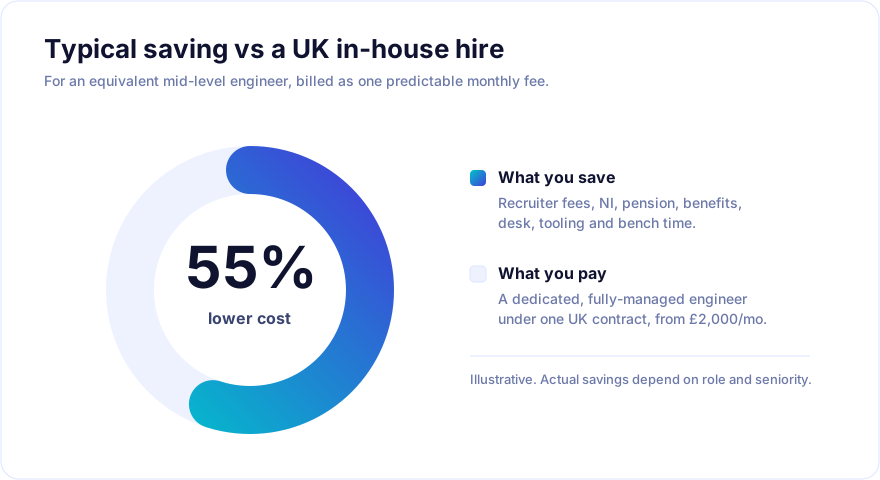
The saving is only worth having if quality holds, which is why the managed model pairs cost with vetting and ongoing management rather than simply offering cheaper labour. For where rates sit by region, the offshore rates by country guide gives the wider picture, and our full-stack hiring guide covers a common role profile.
Dublin in-house versus managed remote: how to choose
Local hiring still makes sense for some roles, so this is about the right tool for each need rather than replacing your Dublin team wholesale.
- Keep in Dublin the roles that genuinely need to be in the room: a small senior core, customer-facing leadership, and anything tied to physical presence or specific local context.
- Use managed remote for the larger share of delivery work: feature development, backend and frontend engineering, QA, data and platform support, where a dedicated remote professional in your core hours performs the same role at a fraction of the cost.
This blended model lets a Dublin-based company grow engineering capacity without multiplying the local salary bill or losing months to a competitive search. The managed developer is dedicated to you and embedded in your team, not shared across clients.
How does the managed model work, and is it compliant?
The managed model removes the parts of remote hiring that go wrong. Instead of setting up an entity abroad or juggling freelancers, you get a dedicated developer employed and managed by OSCABE LTD (UK-registered, Company No. 15913493) while you keep full control of the day-to-day work. OSCABE sources, vets, employs, manages and pays the professional under one UK contract.
Two compliance points matter for UK and Irish companies. IR35: engaging individual offshore contractors directly can create employment-status and tax risk, whereas contracting with OSCABE for a managed service keeps the engagement IR35-friendly - see our IR35 and offshore developers explainer. Data protection: under both UK and EU GDPR (which applies in Ireland), personal data must be handled lawfully, so GDPR-compliant arrangements are essential. OSCABE operates under GDPR-compliant, ISO 9001:2015-certified processes with appropriate controls. EU-based companies can explore the cross-border setup on our EU page.
How does vetting keep quality high?
A lower cost only works if the engineering is genuinely strong, so vetting is the core of the model. OSCABE applies a 5-stage vetting process covering technical screening, practical assessment, communication, references and culture fit, so only capable developers reach you ready to contribute. The aim is to match the quality you would expect from a strong Dublin hire, at a managed monthly fee, with cross-border communication tested up front. Our guide to hiring remote developers from India explains the sourcing pipeline in more detail.
How do time zones work for a Dublin team?
India (GMT+5:30) and the UAE (GMT+4) overlap generously with the Irish and UK working day, giving 4 to 6 hours of shared time for stand-ups, pairing and reviews, plus earlier-morning coverage. Ireland sits on the same clock as the UK, so the overlap that works for a London team works identically for a Dublin one, with no extra timezone planning required. OSCABE aligns developer hours to your core schedule so a managed remote professional collaborates in real time with your Dublin team rather than working in isolation, joining the same ceremonies and tools as your local engineers. Explore the structure on our managed teams and how it works pages.
How long does it take to hire?
Hiring a developer directly in Dublin frequently runs past 12 weeks given the competitive market and notice periods, and offers are often lost to counter-bids. A managed route is far faster: OSCABE can present vetted developers within days and onboard a dedicated professional or pod quickly, because vetting and contracting are already in place. Review options on our pricing page or meet our engineers.
Frequently asked questions
Why are Dublin developer salaries so high?
Dublin hosts the European headquarters of many of the world's largest technology firms, which compete for the same engineers and set compensation benchmarks that include significant equity. Combined with a high cost of living and tight supply, that pushes local developer salaries to the upper end of the European range.
Is a managed remote developer really cheaper than hiring in Dublin?
Typically, yes, and by a wide margin. A managed remote developer starts at £2,000/month with no employer PRSI, recruiter fees or equipment to add, against a Dublin mid-level cost that runs roughly €66k-€90k fully loaded, often producing a saving of around half or more.
Can a managed remote developer work with our Dublin team and EU clients?
Yes. The developer is dedicated to you, aligned to your core hours and embedded in your tools, so they work alongside your Dublin team. OSCABE operates under UK and EU GDPR-compliant processes, and EU-based companies can see the arrangement on our EU page.
Do we have to replace our whole Dublin team?
No. Most companies keep a senior in-house core in Dublin and use managed remote professionals to scale delivery capacity, blending local presence with cost-effective dedicated engineers in their core hours.
Ready to scale your team without the Dublin bidding war?
If hiring in Dublin means competing with FAANG salaries and losing months to a tight market, a managed remote developer is the pragmatic alternative. OSCABE delivers dedicated, vetted engineers in your core hours, under one UK contract, IR35-friendly and UK/EU GDPR compliant, from £2,000/month. Get in touch or meet our engineers to start matching candidates today.