
EU AI Act for Data and Annotation Teams: 2026 Obligations
If your AI lab builds or feeds high-risk systems, the EU AI Act makes the data layer a compliance surface in its own right: the people who collect, label and review training data are now part of how you demonstrate data governance, documentation and traceability. The Act phases in over several years, and August 2026 is a key milestone when many obligations for high-risk AI systems become applicable under current EU guidance. The practical takeaway for data and annotation teams is that quality, provenance and documentation stop being internal niceties and become evidence you may need to produce.
This guide explains, at a general level, what the EU AI Act means for data and annotation work, the data-governance duties that touch labelling teams, the phased timeline including the 2026 milestone, and how a fully-managed annotation pod helps you meet the bar.
What the EU AI Act is, in brief
The EU AI Act is the European Union's horizontal regulation for artificial intelligence. Rather than regulating a single sector, it takes a risk-based approach and sorts AI systems into tiers, with obligations scaling to the risk:
- Unacceptable risk: a small set of prohibited practices.
- High risk: systems used in sensitive contexts (for example certain employment, credit, biometric, education or safety uses) that carry the heaviest obligations.
- Limited risk: mainly transparency duties (for example telling people they are interacting with AI).
- Minimal risk: the bulk of AI, largely unregulated by the Act.
There are also specific provisions for general-purpose AI models. Most of the obligations that reach into data and annotation work sit in the high-risk tier, so that is where annotation teams should focus their attention. The official text and guidance are published by the EU; treat them as the primary source rather than any summary.
Why data and annotation teams are in scope at all
The Act does not regulate "annotation teams" by name, but several high-risk obligations land squarely on the data that those teams produce. In particular, current EU guidance points to duties around:
- Data governance and management for training, validation and test datasets, including relevance, representativeness and, as far as possible, freedom from errors and appropriate handling of bias.
- Examination for bias that could affect health, safety or fundamental rights, and steps to detect, prevent and mitigate it.
- Technical documentation that describes the system, including the data used and how it was prepared, in enough detail to assess compliance.
- Record-keeping and traceability so decisions and data lineage can be reconstructed.
- Human oversight designed into how the system is built and operated.
Every one of those touches the annotation pipeline. If your dataset has to be representative and bias-examined, the labelling guidelines, the labeller selection, the quality-assurance process and the audit trail all become part of your compliance story. This is why "who labels your data, and how it is documented" is now a governance question, not just a quality one.
The phased timeline and the 2026 milestone
The EU AI Act does not switch on all at once. It applies in stages after entering into force, and the dates matter for planning. The broad shape, under current EU guidance, is:
| Phase (approx.) | What becomes applicable | Relevance to data/annotation |
|---|---|---|
| Early phase | Prohibited-practice bans; AI literacy duties | Awareness and training |
| Mid phase | General-purpose AI model obligations; governance bodies | Provenance, documentation expectations rise |
| August 2026 | Many high-risk system obligations become applicable | Data governance, documentation, traceability in scope |
| Later phase | Remaining high-risk rules (certain embedded products) | Extended transition for some product categories |
The exact dates and categories are set out in the Regulation itself and accompanying EU guidance, and the transition for some embedded high-risk products runs longer. The headline for data teams: treat August 2026 as the point by which your data-governance and documentation practices for high-risk systems should be in working order, not a date to start thinking about them. Building provenance and quality records retrospectively is far harder than capturing them as you label.
What AI labs should actually do
Translating the obligations into operational practice, the work for a lab that relies on data and annotation teams generally includes:
- Define and document labelling guidelines. Clear, versioned instructions that you can show an assessor, with rationale for edge cases.
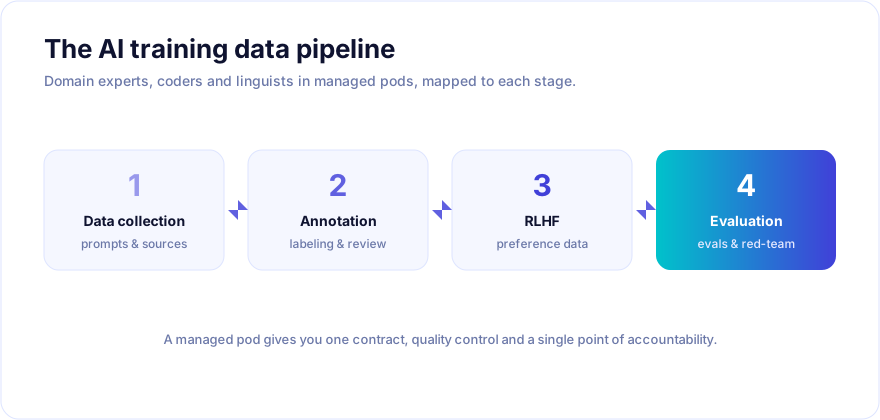
- Capture data provenance. Record where source data came from, what rights you have to use it, and how it flowed through collection, annotation, RLHF and evaluation.
- Build quality assurance into the pipeline. Multi-pass review, inter-annotator agreement measures, and a documented escalation path for ambiguous cases.
- Examine and mitigate bias. Check datasets for representativeness and known bias risks, and record what you checked and what you did about it.
- Keep an audit trail. Who labelled what, under which guideline version, reviewed by whom, and when, so lineage can be reconstructed.
- Design human oversight. Ensure humans can understand and, where required, intervene in the system's operation.
- Mind the data-protection overlap. Where training data includes personal data, GDPR still applies on top of the AI Act, so transfer rules, minimisation and a DPA remain relevant. See our GDPR guide for hiring offshore developers and our DPA and sub-processor management guide.
None of this is exotic for a well-run annotation operation; the change is that it must be evidenced and traceable rather than assumed.
How a managed annotation pod helps
The Act rewards consistency, documentation and accountability, which is exactly where ad-hoc, anonymous crowd labelling tends to struggle. A fully-managed annotation pod is built for the opposite.
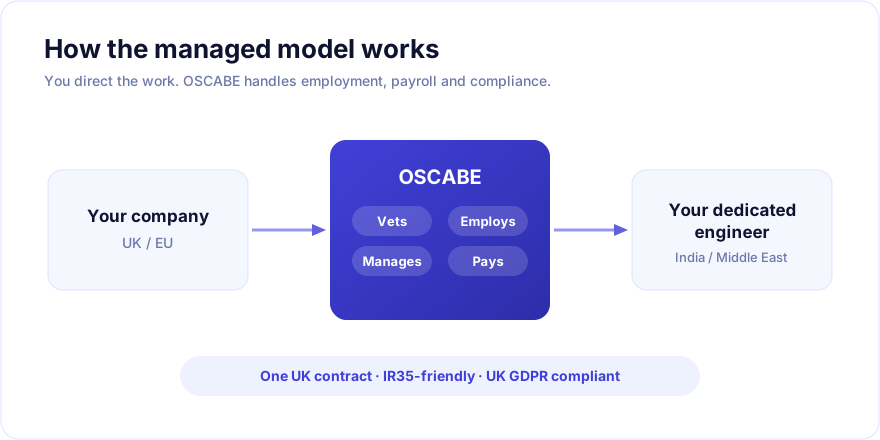
In a managed pod the provider employs the annotators, domain experts and reviewers directly, so guideline adherence, confidentiality and quality obligations flow down as employment terms, and you get a stable, known, vetted team rather than a rotating anonymous crowd. That stability is what makes documentation and traceability achievable: the same reviewed people, working to versioned guidelines, with a clean audit trail of who did what.
OSCABE delivers AI training and annotation work through dedicated managed pods under one UK contract, with five-stage vetting, documented quality assurance, ISO 9001:2015-certified processes and UK and EU GDPR-compliant data handling. Because the team is employed, managed and accountable through a single counterparty, the provenance, quality and audit records that the AI Act expects are a natural by-product of how the pod operates, not an afterthought. See our AI training teams and managed teams pages, and our EU page for EU-specific arrangements. For the security framework around the data itself, see our offshore team security guide.
An EU AI Act readiness checklist for data teams
- Classify your systems: are any high-risk under the Act?
- Treat August 2026 as the deadline for high-risk data-governance readiness.
- Version and document your labelling guidelines.
- Capture data provenance and usage rights end to end.
- Build multi-pass QA and inter-annotator agreement into the pipeline.
- Examine datasets for representativeness and bias, and record the steps.
- Keep a who-did-what audit trail tied to guideline versions.
- Layer GDPR controls where training data includes personal data.
Frequently asked questions
Does the EU AI Act apply to my AI lab if we are outside the EU?
It can. The Act has extraterritorial reach in defined circumstances, for example where a system's output is used in the EU, so non-EU labs serving the EU market may be in scope. Check the Regulation's scope provisions and current EU guidance against your specific situation rather than assuming you are outside it.
Is data annotation itself regulated by the AI Act?
Not as a standalone activity, but the data your annotation produces feeds high-risk obligations around data governance, bias examination, documentation and traceability. In practice that means your labelling guidelines, reviewer process and audit trail become part of how you demonstrate compliance for a high-risk system.
What exactly happens in August 2026?
Under current EU guidance, August 2026 is a milestone when many obligations for high-risk AI systems become applicable, with a longer transition for certain embedded products. The precise dates and categories are set out in the Regulation, so verify them there; the planning message is that high-risk data-governance and documentation practices should be operational by then.
How does using a managed pod help with AI Act compliance?
A managed pod gives you a stable, vetted, employed team working to versioned guidelines with documented QA and a clean audit trail, which is precisely what the Act's documentation and traceability expectations require. It does not transfer your legal obligations as the system provider, but it makes the evidence far easier to produce than anonymous crowd labelling does.
General information, not legal advice
This article gives general information about the EU AI Act as it relates to data and annotation work as at the date of publication. It is not legal advice and does not create a professional relationship. The Act is detailed and phased, and timelines and obligations depend on your specific systems and role; in most cases you should take advice from a qualified adviser and rely on the official EU text and guidance, which can change over time.
Ready to build AI datasets the AI Act can stand behind?
OSCABE delivers dedicated, fully-managed AI training and annotation pods from India and the Middle East under one UK contract, with vetted teams, documented quality assurance and UK and EU GDPR-compliant data handling. We give you the stable, accountable data layer that documentation and traceability demand. Explore our AI training teams, browse our engineers to start matching specialists, or contact us to scope your annotation pipeline.