
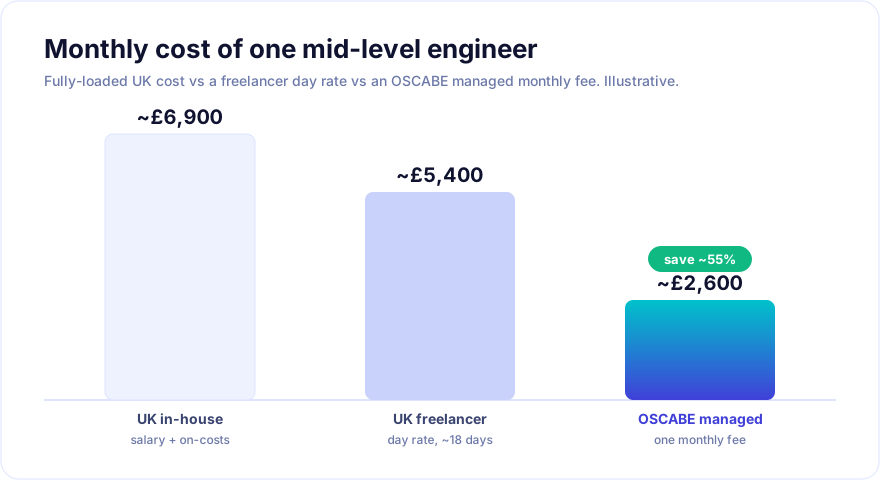
For most UK and EU companies in 2026, a contractor day rate is the most expensive way to buy developer capacity, an FTE salary is the most committed, and a managed monthly fee is the most predictable. A senior UK contractor at £550 per day works out near £120,000 a year before IR35 risk; an equivalent FTE costs roughly £85,000 base plus on-costs; a dedicated, fully-managed remote developer through OSCABE starts from £2,000 per month, around £24,000 per year all-in. The right choice depends on how long you need the capacity, how much you can manage, and your IR35 exposure.
This guide compares the three engagement models on true cost, control, speed and risk, with the IR35 angle made explicit, so you can pick the one that fits the work rather than defaulting to whichever is easiest to start.
Three ways to buy developer capacity
The three models answer the same need - getting code shipped - but they sit very differently on cost, commitment and who carries the risk.
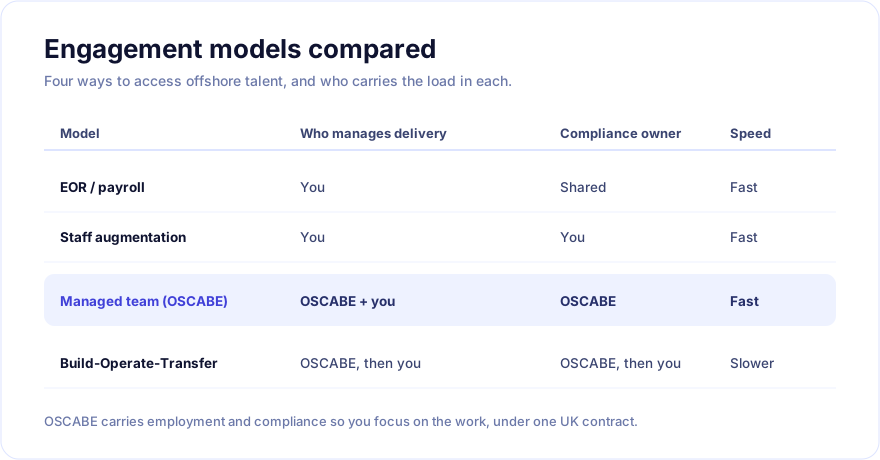
- Contractor day rate. A freelancer or limited-company contractor bills per day worked. Fast to start and flexible to stop, but the priciest per-day option, with no commitment in either direction and a live IR35 question for UK engagements.
- FTE salary. A permanent employee on a fixed salary plus employer on-costs. Maximum control and continuity, but the slowest to hire, the hardest to scale down, and the model that carries every hidden cost of ownership.
- Managed monthly fee. A dedicated remote professional vetted, employed, managed and paid by a provider under one contract, billed as a transparent monthly fee. Predictable cost, no payroll or recruitment burden, and structured as a B2B service rather than inside-IR35 contracting.
The honest framing is that none is universally best. A two-week spike suits a contractor; a permanent platform owner suits an FTE; sustained build capacity at a controlled cost suits a managed model.
What each model really costs
Headline figures mislead here, because a day rate looks cheap until you annualise it and a salary looks cheap until you load it. The table below normalises all three to an annual figure for a senior developer, using indicative 2026 UK ranges from public market data and salary guides.
| Factor | Contractor day rate | FTE salary | Managed monthly fee (OSCABE) |
|---|---|---|---|
| Typical rate | £450 - £650 / day | £75,000 - £95,000 base | from £2,000 / month |
| Annualised cost | roughly £100,000 - £140,000 | roughly £98,000 - £125,000 loaded | from £24,000 all-in |
| Employer NI, pension | not applicable | you pay (13.8% + 3%) | included |
| Recruitment fee | you pay or platform margin | 15% - 25% of salary | included |
| Equipment, HR, payroll | contractor's own | you provide | included |
| Notice / commitment | low (both ways) | high (your liability) | rolling, managed |
| Speed to start | days | weeks to months | around 72-hour matching |
| IR35 position (UK) | high risk if inside | not applicable (employee) | low (managed B2B service) |
| Best for | short spikes, niche skills | core, long-term ownership | sustained build at controlled cost |
The annualised view is the one budgets forget. A £550 day rate across roughly 220 billable days is about £121,000, which is more than a fully-loaded senior FTE and several times a managed remote developer for comparable output. For the full loaded view of the employee option, see the cost to hire a software engineer in the UK, and for the broader ownership picture, the total cost of ownership of offshore vs in-house.
The IR35 angle you cannot ignore
For UK buyers, the IR35 question separates these models sharply. Since the off-payroll reforms, medium and large clients are responsible for determining a contractor's status, and getting it wrong carries tax and penalty risk.
A day-rate contractor working like an embedded team member, under your direction and control, looks a lot like an employee for tax purposes and may fall inside IR35, which raises the effective cost and the compliance burden. See the official off-payroll working (IR35) guidance for how status is assessed.
An FTE sidesteps IR35 entirely because they are simply an employee. A genuine managed service sits differently again: you contract for a delivered service from a provider, not for an individual's time, so the relationship is business-to-business rather than disguised employment. That is why a managed remote model is structured to be IR35-friendly. For a deeper treatment, read our explainer on IR35 and offshore developers from India.
Control, continuity and risk, not just price
Cost is the headline, but control, continuity and where the risk sits often decide the model in practice.
Control over the work. With an FTE you direct everything, which is the point for a core role. With a contractor, heavy direction is exactly what pushes you toward an inside-IR35 determination, so there is a tension between control and tax status. A managed remote developer gives you day-to-day working control over the tasks while the provider holds the employment relationship, which keeps the B2B structure intact.
Continuity. A contractor can hand in notice mid-sprint, and a permanent employee can resign, restarting recruitment and ramp each time. A managed model puts retention and replacement on the provider, so a departure becomes their problem to solve rather than a gap in your roadmap.
Where the risk sits. An FTE concentrates employment, redundancy and on-cost risk on you. A contractor concentrates IR35 and availability risk on you. A managed fee shifts employment, compliance and replacement risk to the provider, leaving you with a predictable monthly cost. For the full hidden-cost view, see the total cost of ownership of offshore vs in-house.
When does each model make sense?
Match the model to the shape of the need, not the convenience of starting.
Choose a contractor day rate when the work is genuinely short-term, the skill is niche and scarce, or you need cover for a defined gap. Accept that you are paying a premium for flexibility, and run a proper IR35 determination before you start.
Choose an FTE salary when the role is core, long-lived and needs deep institutional knowledge: a platform owner, a security lead, or anyone whose value compounds with tenure. Budget the full loaded cost, not the base, and accept the slower hiring cycle.
Choose a managed monthly fee when you need sustained build capacity at a predictable cost without carrying recruitment, payroll, equipment and IR35 risk yourself. It gives you a dedicated person who works as part of your team, while the provider handles employment and compliance. This is where most ongoing delivery work lands once the numbers are compared. Explore the managed remote employee model or scale to a managed pod from £7,500 per month.
Many companies blend all three: an FTE core, a managed pod for steady delivery, and the occasional contractor for a true spike. For how the structural models differ, see offshore vs nearshore vs managed team.
Frequently asked questions
Is a contractor day rate cheaper than hiring an employee?
Usually not, once you annualise it. A £550 day rate over roughly 220 billable days is about £121,000 per year, which exceeds a fully-loaded senior FTE in most cases. Contractors are priced for flexibility, so they make sense for short spikes, not sustained capacity. For ongoing work, a managed monthly fee is typically far cheaper than either.
How does a managed monthly fee avoid IR35 problems?
Because you contract for a delivered service from a provider rather than for an individual contractor's time, the relationship is business-to-business rather than disguised employment. OSCABE employs, manages and pays the developer, so the arrangement is structured to be IR35-friendly. Always review the official IR35 guidance for your specific facts.
Can I convert a contractor or managed developer into an FTE later?
Often, yes, depending on the arrangement. Some companies start with a managed remote developer to validate the role and skills, then decide whether to bring it in-house. A managed model lowers the risk of that decision because vetting and ramp are already handled. Talk to us about transfer options if long-term in-housing is the goal.
Which model is fastest to start?
A managed monthly fee is usually fastest for a vetted, dedicated person, with OSCABE matching in around 72 hours. A contractor can start in days if you already have a candidate and an agreed IR35 status. An FTE is the slowest, with weeks to months of sourcing, interviewing and notice periods before they begin.
Pick the model that fits the work
Before defaulting to whichever model is easiest to start, annualise the cost, weigh the IR35 exposure, and match the commitment to how long you actually need the capacity. For short spikes, a contractor earns its premium; for core roles, an FTE is worth the loaded cost; for sustained delivery at a controlled price, a managed monthly fee usually wins.
When you want a concrete figure for managed remote developers against your roles, talk to OSCABE. Browse the vetted engineers we can match within 72 hours under one UK contract, with IR35 and compliance handled.