
To hire developers in Zurich, you can recruit locally at Switzerland's highest-in-Europe salaries, engage contractors, or place dedicated, fully-managed remote developers under one Western contract. A mid-level Zurich developer commonly costs well over CHF 120k fully loaded, and senior engineers considerably more, whereas a managed remote developer from OSCABE starts at €2,000/month, arrives pre-vetted, and works your Central European Time core hours while staying EU GDPR compliant. For Swiss companies, the cost gap is the largest in Europe, which makes a managed model an unusually powerful lever for stretching an engineering budget.
This guide explains why Zurich and Swiss salaries sit at the top of the European table, quantifies the cost gap against managed remote delivery, and shows where a managed model fits alongside a Zurich team.
Why are Zurich developer salaries the highest in Europe?
Switzerland combines a high cost of living, a strong currency and a deep concentration of banking, insurance, pharma and tech employers, which pushes engineering pay to the top of the European range. Zurich in particular hosts global banks, insurers and the Swiss offices of major tech firms, all competing for a limited local talent pool. Based on public salary guides and market data (such as figures published by Glassdoor and Swiss recruiter surveys), Zurich developer salaries are commonly quoted in the six figures in Swiss francs even at mid-level, with senior and specialist engineers higher still.
Two features make the Swiss picture distinct. First, salaries are denominated in CHF, a historically strong currency, so converted to EUR or GBP they look even larger to a foreign buyer. Second, while Swiss employer social contributions are more moderate than some EU neighbours, the gross figures are so high that the fully-loaded cost per developer is still the steepest in Europe. The net effect is a per-head cost that dwarfs almost every alternative.
How big is the cost gap versus managed remote?
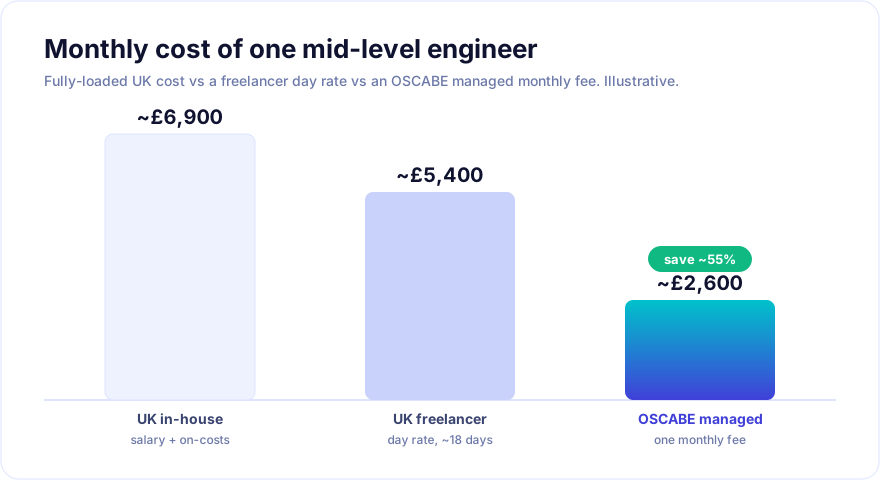
The gap between a Zurich hire and a managed remote developer is wider than for any other European hub. The table below is indicative; exact figures move with exchange rates and seniority, so treat them as approximate ranges from public salary guides and market data rather than precise quotes.
| Seniority | Zurich gross salary (CHF, typical) | Approx in EUR | Zurich fully-loaded annual (approx) | OSCABE managed monthly |
|---|---|---|---|---|
| Junior developer | CHF 85k-105k | ~€88k-€109k | ~€100k-€124k | from €2,000 |
| Mid developer | CHF 110k-135k | ~€114k-€140k | ~€130k-€160k | ~€2,800-€3,400 |
| Senior / lead | CHF 140k-175k+ | ~€145k-€181k+ | ~€166k-€207k+ | ~€3,800-€4,600 |
| Pod (3-4 devs) | CHF 450k-680k+ | ~€467k-€706k+ | €530k-€800k+ | from €7,500 |
Currency note: Switzerland uses the Swiss franc (CHF); euro figures are approximate conversions that move with exchange rates. OSCABE bills in GBP or EUR under one UK contract. Even at the conservative end, a single mid-level Zurich developer can cost more fully loaded than an entire small managed pod's starting fee. For context across other markets, see our India vs UK developer salary comparison and offshore software development rates by country.
What does the saving let you do?
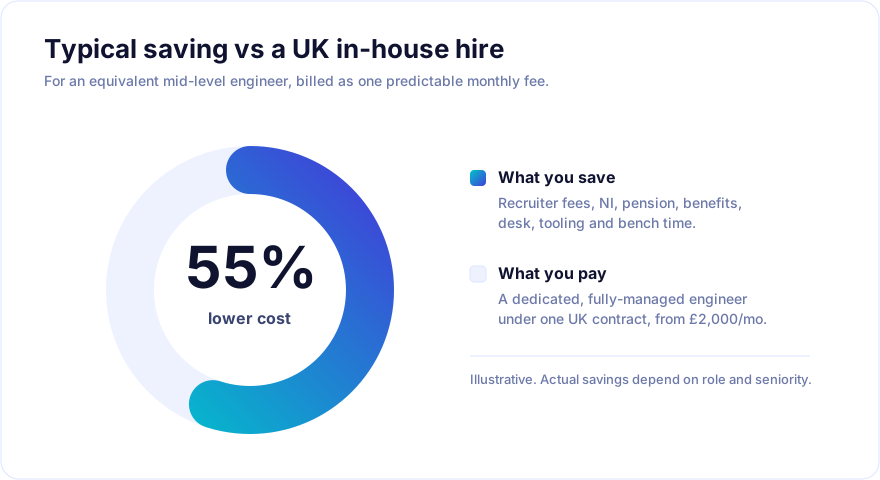
Because the per-head gap is so large, Swiss companies can use a managed model to fundamentally change what their budget buys. The same spend that funds one or two Zurich engineers can fund a multi-person managed pod, which shifts the conversation from "can we afford another hire?" to "how much capacity do we want?".
Practical ways Swiss buyers reinvest the difference:
- More capacity per franc: trade one expensive local seat for a small dedicated pod that can cover more of the roadmap.
- Faster delivery: add testing, DevOps or data engineering alongside core development without a Zurich-sized budget hit.
- Predictable cost: swap variable salary inflation, bonuses and on-costs for one fixed monthly fee in EUR or GBP.
- Protected local headcount: keep scarce Zurich engineers for the work that genuinely must be on-site or client-facing, and build the rest remotely.
This is not about replacing your Zurich team; it is about extending it cost-effectively. Learn how OSCABE supports companies across Europe on our EU page, and see the model on how it works.
Where does a Zurich-based hire still make sense?
A managed model is a complement, not a wholesale substitute. Some roles still belong in Zurich: senior staff who must sit with regulated banking or insurance stakeholders, client-facing technical leads, and positions tied to Swiss on-site requirements. The smart pattern is to spend your premium Zurich budget where physical presence and local context add real value, and to use a managed remote team for the broader engineering capacity that does not need a Swiss postcode.
For many Swiss companies the outcome is a blended team: a lean, senior local core in Zurich plus a dedicated managed pod aligned to the same hours and standards. That keeps the parts that need Switzerland in Switzerland while removing the cost penalty from everything else.
It is worth being honest about what does not transfer. Deep familiarity with a specific Swiss regulator, on-site incident response within the office, and relationships with local stakeholders are genuinely tied to place, and a remote pod will not replicate them. The pattern that works is to be deliberate about that boundary: list the responsibilities that truly require Zurich presence, staff those locally, and route everything else - the bulk of build, test, integration and maintenance work - to the managed team. Drawn that way, the line is rarely as long as a first instinct suggests, which is exactly why the budget arithmetic shifts so sharply in a Swiss company's favour.
What skills should you screen for, and how are developers vetted?
Screen for the same fundamentals whether the role is local or managed: strong core engineering in your stack (JavaScript/TypeScript, Python, Java or .NET), cloud and CI/CD familiarity, testing discipline, architecture judgement at senior level, and clear written English for cross-border collaboration. For specialist needs, our full-stack hiring guide and data engineering guide cover the relevant profiles.
OSCABE runs a 5-stage vetting process so every developer is screened on technical skill, practical output, communication, references and ID before you meet them. Only a small share of applicants reach a client shortlist, so you interview a short, qualified list. Our guide to hiring remote developers from India explains how that pipeline works in practice.
How do time zones and compliance work?
India (GMT+5:30) and the UAE (GMT+4) overlap comfortably with Central European Time (GMT+1, CEST GMT+2 in summer), giving 4 to 6 hours of daily overlap with the Zurich working day - plenty for stand-ups, pairing and reviews, with earlier-morning coverage on top. OSCABE aligns developer hours to your CET core schedule, so a remote pod feels co-located with your Zurich team.
On compliance, any developer handling personal data must operate under GDPR-compliant arrangements with appropriate safeguards for international transfers. OSCABE provides UK GDPR-compliant processor terms (the UK regime mirrors the EU General Data Protection Regulation) and ISO 9001:2015-certified processes; Swiss data protection under the revised FADP is closely aligned with GDPR, so the same controls translate well. Because you contract with OSCABE LTD rather than individual contractors, you also avoid cross-border contractor-status and payroll complexity. Our GDPR guide for hiring offshore developers covers the detail.
Frequently asked questions
How much cheaper is a managed developer than a Zurich hire?
Substantially. A mid-level Zurich developer can cost roughly €130k-€160k fully loaded, while a managed remote developer starts at €2,000/month (around €24k a year) with no recruiter fees, social contributions or equipment costs to add. The per-head gap is the largest of any major European hub.
Can OSCABE bill a Swiss company in EUR?
Yes. OSCABE bills in GBP or EUR under one UK contract. You receive a single invoice rather than running CHF payroll for multiple individuals, which simplifies budgeting against a strong, variable franc.
Does Swiss data protection law allow this?
Yes, with appropriate safeguards. Switzerland's revised Federal Act on Data Protection (FADP) is closely aligned with the EU GDPR, and OSCABE operates under GDPR-compliant, ISO 9001:2015-certified processes with controls for international transfers and access.
Will the team work in our Zurich hours?
Yes. OSCABE aligns developer working hours to your Central European Time core schedule, giving 4 to 6 hours of daily overlap so stand-ups, pairing and reviews happen in real time during the Zurich working day.
Ready to extend your Zurich team affordably?
If Swiss salaries are capping how much engineering capacity you can build, a managed remote team turns the largest cost gap in Europe into your advantage. OSCABE delivers dedicated, vetted developers in your CET hours, GDPR compliant and under one contract, from €2,000/month, so you can keep a lean senior core in Zurich and scale the rest cost-effectively. See our EU page, get in touch, or browse our engineers to start matching candidates now.