
To hire developers in Stockholm, Paris or Madrid, you can recruit locally in each city, engage EU contractors, or place dedicated, fully-managed remote developers under one Western contract. Local fully-loaded costs vary widely between these three hubs - Stockholm and Paris sit at the higher end of EU pay, Madrid noticeably lower - while a managed remote developer from OSCABE starts at €2,000/month, arrives pre-vetted, and works your Central European Time core hours while staying EU GDPR compliant. For companies hiring across more than one of these cities, a managed model gives you one contract, one cost base and consistent quality regardless of location.
This guide compares developer salaries city by city, explains where each market is strong, and shows how a managed remote option changes the maths when you are building across multiple EU locations.
What does it cost to hire developers in Stockholm, Paris and Madrid?
These three cities illustrate how much EU developer costs differ by geography. Based on public salary guides and market data (such as figures published by Glassdoor, local recruiter surveys and tech salary reports), a mid-level developer's gross salary typically lands highest in Stockholm and Paris and meaningfully lower in Madrid, before you add each country's employer social contributions, recruiter fees and onboarding time. Sweden and France carry relatively high employer on-costs; Spain's are more moderate. The result is three quite different local cost bases for the same role.
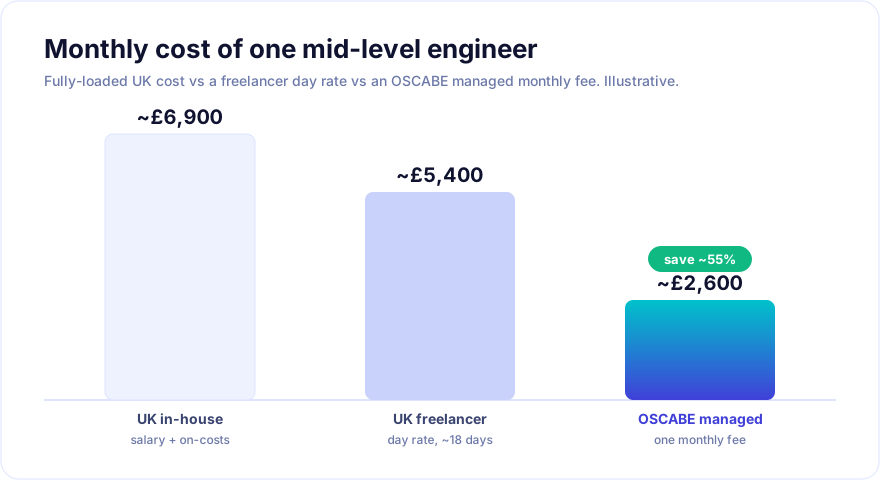
| City | Mid-level gross salary (typical) | Employer on-costs | Fully-loaded annual (approx) | OSCABE managed monthly |
|---|---|---|---|---|
| Stockholm | ~SEK 600k-780k (€53k-€69k) | ~31% social charges | ~€70k-€90k | from €2,000 |
| Paris | ~€48k-€65k | ~40-45% employer charges | ~€68k-€94k | from €2,000 |
| Madrid | ~€38k-€52k | ~30% employer charges | ~€49k-€68k | from €2,000 |
| Multi-city pod (3-4 devs) | varies by mix | varies | €150k-€370k+ | from €7,500 |
Currency note: Sweden uses the krona (SEK), so Stockholm salaries are quoted in SEK with an approximate euro conversion; rates move with exchange rates. OSCABE bills in GBP or EUR under one UK contract. For a broader cross-market view, see our offshore software development rates by country, and for the underlying salary gap, our India vs UK developer salary comparison.
The headline is that hiring the same role in Stockholm or Paris can cost roughly 30-50% more than in Madrid once on-costs are included, and all three sit well above a managed remote fee. If your strategy is to build durable engineering capacity rather than plant flags in specific cities, those differences are money you can redeploy.
Where is each city strong?
Each hub has its own character, which matters when you decide where to hire what.
- Stockholm: a mature, product-led ecosystem with deep strength in fintech, gaming, music tech and B2B SaaS, and a culture of strong English and high engineering standards. Supply is good but expensive, and competition for senior talent is intense.
- Paris: a large, diverse market spanning enterprise, AI, fintech and a vibrant startup scene, with particular depth in data and machine learning. French-language requirements and high employer charges shape local hiring, and notice periods can be long.
- Madrid: a fast-growing hub with a strong, increasingly international developer pool, good availability and lower costs than northern Europe, which is why many companies use it as a value-for-money EU engineering base.
The practical implication: if you only hire in one city, local market dynamics dominate. If you hire across two or three, you inherit three different salary bands, three sets of employment rules and three onboarding pipelines - exactly the complexity a managed model is designed to remove.
Why a managed remote model suits multi-city EU hiring
When you are building across Stockholm, Paris and Madrid at once, the friction is not just cost; it is fragmentation. Three local payrolls (or three EOR arrangements), three legal regimes, three notice-period regimes and three recruitment efforts add overhead and slow you down. A managed remote model collapses that into a single relationship.
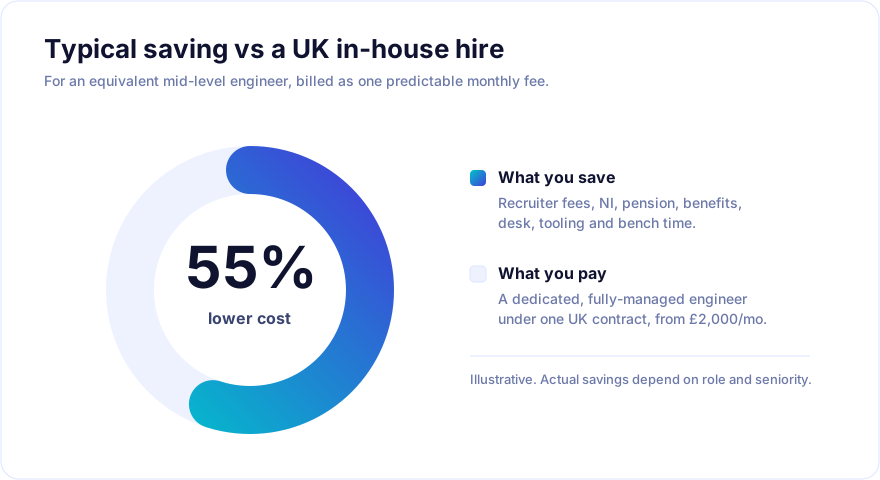
With OSCABE, dedicated developers from India or the Middle East work to your CET core hours under one UK contract, billed in EUR or GBP, with EU GDPR compliance built in. You get:
- One cost base instead of three local salary bands plus on-costs.
- One contract and one invoice, rather than multiple local employment or EOR arrangements.
- Consistent vetting and quality regardless of which city the work would otherwise have sat in.
- Faster scaling, because vetting and contracting are already in place.
This does not replace a local presence where you genuinely need one - say, a client-facing role that must be in Paris. It complements it, letting you keep scarce local headcount for what truly must be local and build the rest of your capacity through a managed team. Learn how OSCABE supports EU buyers on our EU page, and see the structure on how it works.
What skills and seniority should you screen for?
Whether you hire locally or via a managed team, screen for the same fundamentals rather than a city label:
- Core engineering: strong fundamentals in your primary stack (for example JavaScript/TypeScript, Python, Java or .NET), data modelling and API design.
- Cloud and delivery: familiarity with AWS, Azure or GCP, CI/CD, containers and testing discipline.
- Architecture judgement at senior level: the ability to reason about performance, security and maintainability, not just feature delivery.
- Communication and written English: essential for asynchronous, cross-border collaboration across CET teams.
For data and AI-heavy roles common in Paris and Stockholm, our guide to hiring remote data engineers and data scientists covers the specialist profile. For full-stack product teams, see our full-stack hiring guide.
How are remote developers vetted?
Effective vetting pairs a practical build with code-quality review and a communication check. A typical pipeline includes a short take-home or live exercise against a real problem, a review of design and testing discipline, an architecture discussion at the appropriate level, and an English-language assessment for cross-border work.
OSCABE runs a 5-stage vetting process so every developer is screened on technical skill, practical output, communication, references and ID before you meet them. Only a small share of applicants reach a client shortlist, so you interview a short, qualified list rather than filtering CVs across three cities. Our guide to hiring remote developers from India explains how that pipeline works.
How do time zones and compliance work?
India (GMT+5:30) and the UAE (GMT+4) overlap comfortably with Central European Time (GMT+1, CEST GMT+2 in summer), giving 4 to 6 hours of daily overlap with the working day in Stockholm, Paris and Madrid - plenty for stand-ups, pairing and reviews, with earlier-morning coverage on top. OSCABE aligns developer hours to your CET core schedule so the team feels co-located.
On compliance, any developer handling EU personal data must operate under GDPR-compliant arrangements with appropriate safeguards for transfers outside the EEA. OSCABE provides UK GDPR-compliant processor terms (the UK regime mirrors the EU General Data Protection Regulation) and ISO 9001:2015-certified processes. Because you contract with OSCABE LTD rather than individuals in three countries, you also avoid cross-border contractor-status and payroll complexity. Our GDPR guide for hiring offshore developers covers the specifics.
Frequently asked questions
Is a managed remote developer cheaper than hiring in Stockholm, Paris or Madrid?
Typically, yes, and the gap is largest for the higher-cost hubs. A mid-level developer can cost roughly €70k-€94k fully loaded in Stockholm or Paris and around €49k-€68k in Madrid, whereas a managed remote developer starts at €2,000/month with no recruiter fees, social contributions or equipment costs to add.
Can OSCABE support hiring across all three cities at once?
Yes. That is where the managed model is strongest. Instead of three local payrolls and recruitment efforts, you get dedicated developers under one UK contract, aligned to CET, with consistent vetting and a single invoice. See our EU page for how this works.
Will the developers work in our Central European Time hours?
Yes. OSCABE aligns developer working hours to your CET core schedule, so stand-ups, pairing and code review happen in real time during the working day in Stockholm, Paris or Madrid.
Do we still need any local presence?
Only where the role genuinely must be local, such as certain client-facing or on-site positions. A managed team complements local hires by covering the engineering capacity that does not need to sit in a specific city, freeing your local headcount for what does.
Ready to build across Stockholm, Paris and Madrid?
If you are scaling engineering across multiple EU cities and want to avoid three salary bands, three payrolls and three recruitment pipelines, a managed remote team is the efficient choice. OSCABE delivers dedicated, vetted developers in your CET hours, EU GDPR compliant and under one contract, from €2,000/month. See our EU page, get in touch, or browse our engineers to start matching candidates now.